Who Owns the Campus Residence When the Developer's Lease Runs Out?
Most of the student towers rising near Canadian campuses sit on land the university never sells. The school signs a ground lease, usually somewhere between 35 and 50 years, and a private partner designs, builds, finances and runs the residence. The land stays public. The building, for decades, works like private property. What happens at the end of the lease gets far less attention than the ribbon cutting.
Consider an Alberta university in a position many schools have faced over the past decade. Its residences went up in the 1960s and 70s. The cinderblock rooms are tired, the mechanical systems are near the end of their life, and the deferred maintenance list runs into the millions. Provincial operating grants have tightened. The province's Alberta 2030: Build Skills for Jobs strategy has encouraged post-secondary schools to find more independent ways to raise revenue and manage their facilities.
Demand is not the problem. The University of Alberta serves more than 44,000 students in the 2026/27 academic year, with thousands waiting for a campus bed. Off campus, Edmonton's purpose-built rental vacancy rate sat around 1.4% in CMHC's 2024 data, and average rents rose by double digits between 2023 and 2025. A modern high-density residence in an Alberta city can now cost more than $100 million to build.
So the school takes the deal on the table. A developer backed by pension money or a real estate investment trust will build a new tower on university land. The university adds no large loan to its balance sheet. It hands off the 24/7 maintenance calls. The federal GST rebate on new purpose-built rentals, which covers student residences, helps the developer's numbers work. The lease runs 45 years. Every part of this is defensible, and a board would struggle to explain turning it down.
The years that follow
The tower opens with private bathrooms, suite kitchens, study lounges and a gym. Rents are set well above what the old university-run dorms charged, because the partner needs a return. Students who can pay move in. Students who cannot head into the wider Edmonton market and compete with families for basement suites in Garneau and Strathcona, where long-time residents were already pushing back on noise and parking from the tower itself.
The university has given up most of its say. Under a long lease, it cannot easily change who the building serves or how it is run, even if priorities shift or the relationship sours. It also gave up the rental income it would have earned as owner. That was the price of avoiding the debt.
The clause that matters
The turning point arrives quietly, in roughly year 35. Under a typical ground lease, the land never left university hands, and the building generally reverts to the landowner when the lease ends. That sounds like a good outcome. The school gets a tower back for nothing.
Now look at it from the operator's side. With ten years left, any new roof, elevator or heating plant pays off mostly after the lease ends, for someone else. Unless the lease spells out handback standards, reserve funds and inspection rights, nothing compels the partner to spend that money. The building that comes back is 45 years old and was maintained to a short horizon. That is the same aging-residence problem the university started with, a generation later.
Some agreements deal with this carefully, with condition requirements and capital reserves written in from the start. Others leave it vague, and in those cases the board that signed is long gone by the time anyone reads that section closely.
The same structure shows up well beyond campus. Leasehold condos and buildings on leased land are sold in Alberta, and a buyer or investor looking at one in 2026 can ask the questions a university should ask. Ask how many years remain on the lease. Ask what condition the building has to be in when it is handed back. Ask who is paying for the roof in year 40. Each answer should be in a document you can read before you sign.


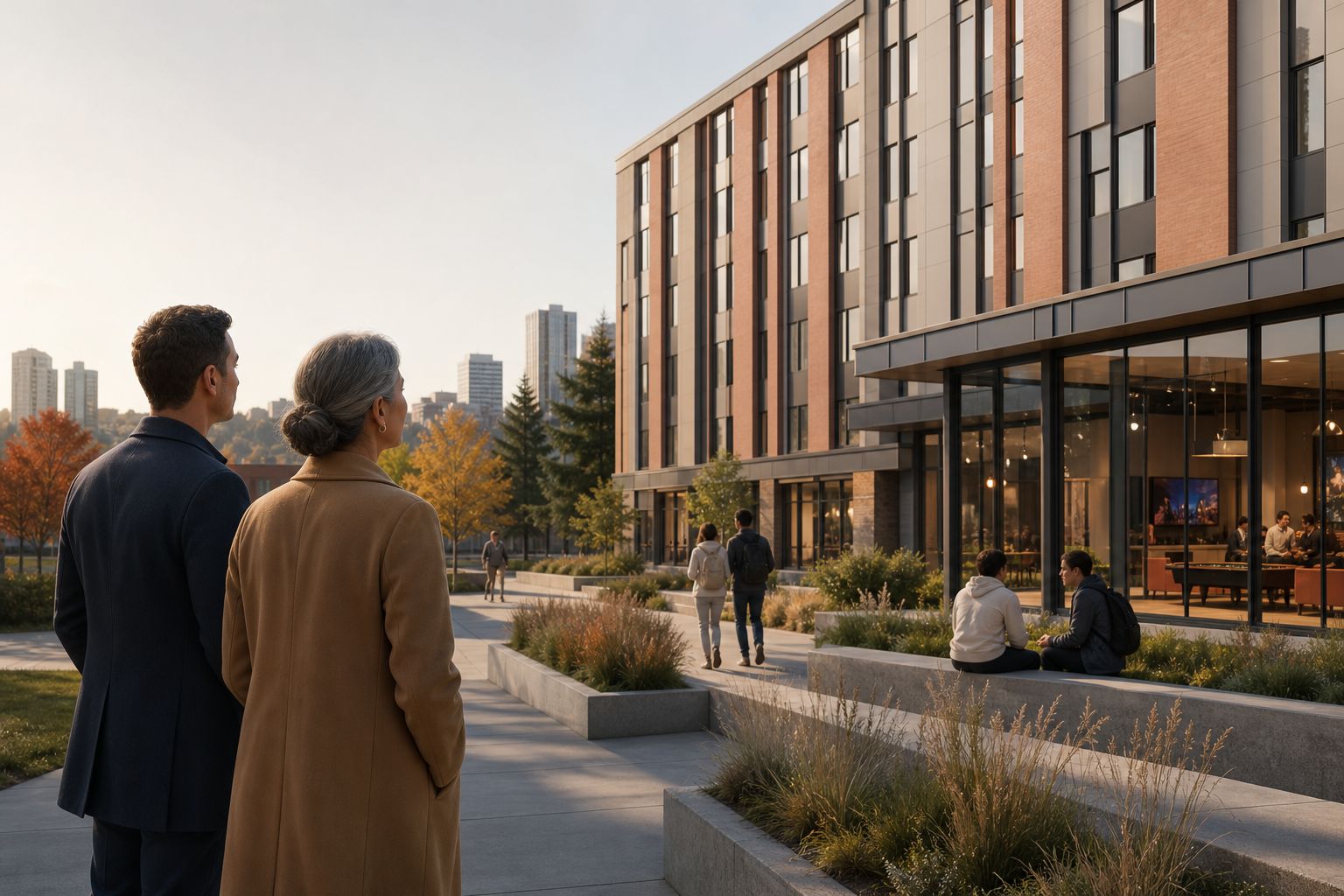

Most of the student towers rising near Canadian campuses sit on land the university never sells. The school signs a ground lease, usually somewhere between 35 and 50 years, and a private partner designs, builds, finances and runs the residence. The land stays public. The building, for decades, works like private property. What happens at the end of the lease gets far less attention than the ribbon cutting.
Consider an Alberta university in a position many schools have faced over the past decade. Its residences went up in the 1960s and 70s. The cinderblock rooms are tired, the mechanical systems are near the end of their life, and the deferred maintenance list runs into the millions. Provincial operating grants have tightened. The province's Alberta 2030: Build Skills for Jobs strategy has encouraged post-secondary schools to find more independent ways to raise revenue and manage their facilities.
Demand is not the problem. The University of Alberta serves more than 44,000 students in the 2026/27 academic year, with thousands waiting for a campus bed. Off campus, Edmonton's purpose-built rental vacancy rate sat around 1.4% in CMHC's 2024 data, and average rents rose by double digits between 2023 and 2025. A modern high-density residence in an Alberta city can now cost more than $100 million to build.
So the school takes the deal on the table. A developer backed by pension money or a real estate investment trust will build a new tower on university land. The university adds no large loan to its balance sheet. It hands off the 24/7 maintenance calls. The federal GST rebate on new purpose-built rentals, which covers student residences, helps the developer's numbers work. The lease runs 45 years. Every part of this is defensible, and a board would struggle to explain turning it down.
The years that follow
The tower opens with private bathrooms, suite kitchens, study lounges and a gym. Rents are set well above what the old university-run dorms charged, because the partner needs a return. Students who can pay move in. Students who cannot head into the wider Edmonton market and compete with families for basement suites in Garneau and Strathcona, where long-time residents were already pushing back on noise and parking from the tower itself.
The university has given up most of its say. Under a long lease, it cannot easily change who the building serves or how it is run, even if priorities shift or the relationship sours. It also gave up the rental income it would have earned as owner. That was the price of avoiding the debt.
The clause that matters
The turning point arrives quietly, in roughly year 35. Under a typical ground lease, the land never left university hands, and the building generally reverts to the landowner when the lease ends. That sounds like a good outcome. The school gets a tower back for nothing.
Now look at it from the operator's side. With ten years left, any new roof, elevator or heating plant pays off mostly after the lease ends, for someone else. Unless the lease spells out handback standards, reserve funds and inspection rights, nothing compels the partner to spend that money. The building that comes back is 45 years old and was maintained to a short horizon. That is the same aging-residence problem the university started with, a generation later.
Some agreements deal with this carefully, with condition requirements and capital reserves written in from the start. Others leave it vague, and in those cases the board that signed is long gone by the time anyone reads that section closely.
The same structure shows up well beyond campus. Leasehold condos and buildings on leased land are sold in Alberta, and a buyer or investor looking at one in 2026 can ask the questions a university should ask. Ask how many years remain on the lease. Ask what condition the building has to be in when it is handed back. Ask who is paying for the roof in year 40. Each answer should be in a document you can read before you sign.
Read Next
Five Money Checks Canadian Snowbirds Should Finish Before Heading South
Canadian Bank Security Assumes a Human Is Logging In. AI Agents Break That
Before Storm Winds Arrive, Turn 5 Yard Hazards Into Protective Buffers
A 25 Basis Point Hike Doesn't Erase Variable's Long-Run Edge Over Fixed