Toronto's Double Land Transfer Tax Punishes Buyers Now and Sellers Later
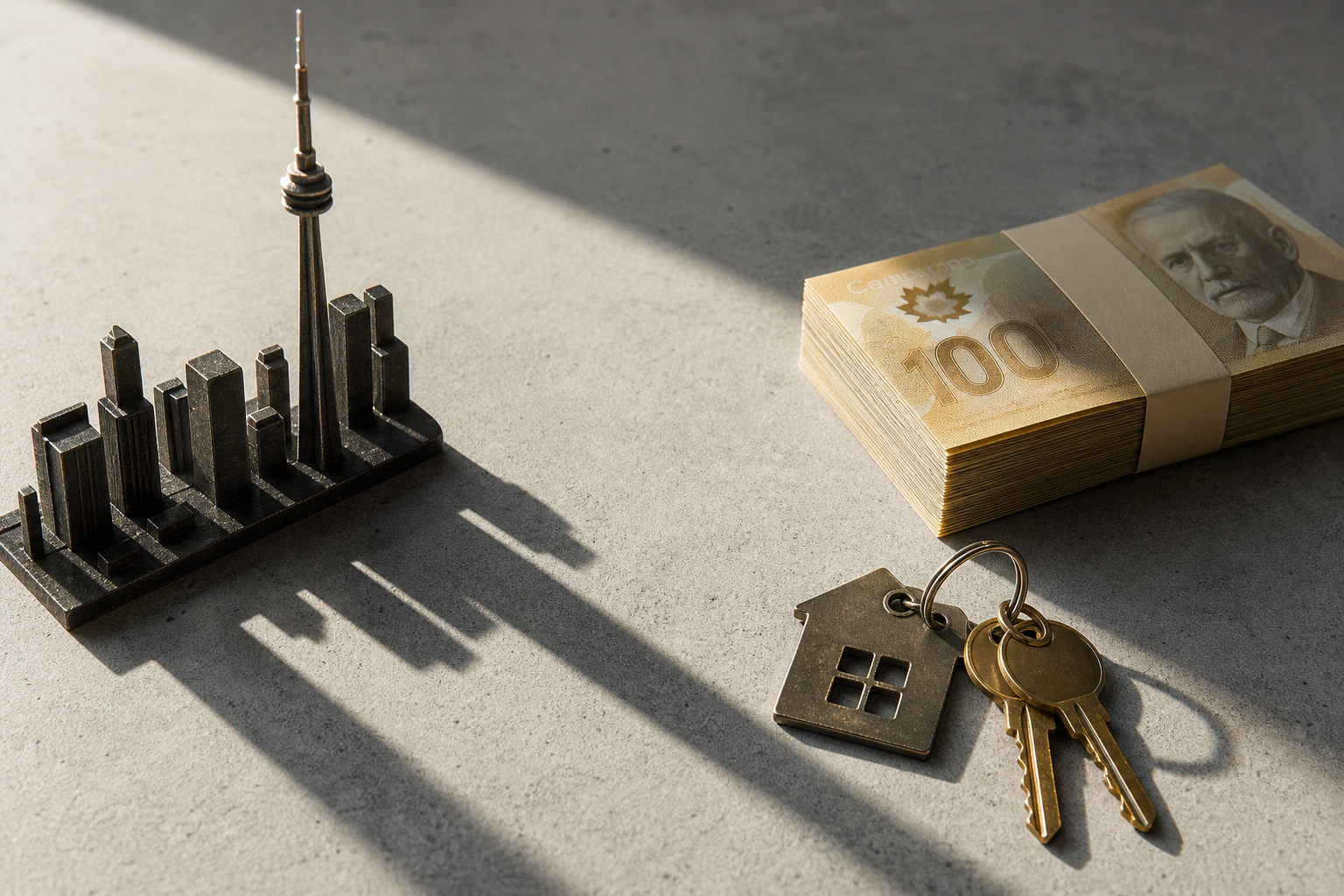
A $500,000 home in Toronto comes with roughly $12,950 in land transfer tax, and the buyer has to hand it over in cash on closing day. Half goes to the province. The other half goes to the city. Buy a home at the same price in Edmonton and the provincial registration fees come to about a thousand dollars.
That gap is usually described as a buyer's problem. It ends up being everyone's. Toronto's double tax is a charge on moving, and anyone who owns a home in the city pays it at least twice: once when they buy, and again when they sell, through the price. If you're planning a purchase, a sale or a downsize, or you're writing housing policy, this tax is already shaping your numbers whether it shows up on your statement or not.
The tax comes out of your down payment first
Land transfer tax can't usually be added to your mortgage. It's paid from savings, alongside the down payment, legal fees and moving costs. For a first-time buyer, the province and city offer rebates that cut the bill, but the rest still comes from the same pool of cash that decides how much you can put down.
Here's some illustrative arithmetic. CREA's national average sale price for August 2026 was $668,219. A Toronto buyer at that price would owe close to $19,700 in combined tax before any rebate. Every dollar of that is a dollar that didn't go toward equity, and for a buyer sitting near the 20% down mark, it can be the difference between paying for mortgage insurance and avoiding it.
Treat the tax as money you lose on day one, and plan your savings target with it already subtracted.
Sellers pay it too, just later
A buyer with a fixed budget doesn't separate the tax from the price. If $19,700 has to go to the government, there's $19,700 less to offer the seller. Over time that cost works its way into what homes sell for. The seller never sees a tax bill, yet they're getting a smaller cheque.
Then that seller usually buys again, inside the city, and pays the tax on their next home. A family that moves three times over twenty years pays it three times on the way in and absorbs it three times on the way out.
When you're estimating your home's value, assume buyers have already priced this in.
It decides who moves and when
High transaction costs make people stay put. An empty nester weighing a smaller condo looks at a five-figure tax on the new place and decides the old house is fine for a few more years. That keeps a family-sized home off the market. A worker offered a job across the city stays where they are and commutes. Economists call this a barrier to mobility, and in a city already short on listings, it means fewer homes changing hands than people actually need.
For policymakers, there's a second cost. Revenue tied to the number of sales drops hard in a slow market. National sales slipped 0.7% month over month in CREA's latest figures, and a city that depends on transfer tax feels every dip like that in its budget.
What the comparison shows
Alberta charges no percentage-based land transfer tax at all, only registration fees. The province raised those fees back in 2024, so it isn't free, and cities there lean more on annual property tax to fund services. That trade-off is real. Still, an annual property tax lands on everyone who owns a home, while Toronto's tax lands only on the people who decide to move, at the exact moment they're shortest on cash.
So before you list, buy or vote on this, ask yourself: if moving cost about a thousand dollars instead of twenty thousand, would you have moved already? If the answer is yes, the tax made that decision for you.



A $500,000 home in Toronto comes with roughly $12,950 in land transfer tax, and the buyer has to hand it over in cash on closing day. Half goes to the province. The other half goes to the city. Buy a home at the same price in Edmonton and the provincial registration fees come to about a thousand dollars.
That gap is usually described as a buyer's problem. It ends up being everyone's. Toronto's double tax is a charge on moving, and anyone who owns a home in the city pays it at least twice: once when they buy, and again when they sell, through the price. If you're planning a purchase, a sale or a downsize, or you're writing housing policy, this tax is already shaping your numbers whether it shows up on your statement or not.
The tax comes out of your down payment first
Land transfer tax can't usually be added to your mortgage. It's paid from savings, alongside the down payment, legal fees and moving costs. For a first-time buyer, the province and city offer rebates that cut the bill, but the rest still comes from the same pool of cash that decides how much you can put down.
Here's some illustrative arithmetic. CREA's national average sale price for August 2026 was $668,219. A Toronto buyer at that price would owe close to $19,700 in combined tax before any rebate. Every dollar of that is a dollar that didn't go toward equity, and for a buyer sitting near the 20% down mark, it can be the difference between paying for mortgage insurance and avoiding it.
Treat the tax as money you lose on day one, and plan your savings target with it already subtracted.
Sellers pay it too, just later
A buyer with a fixed budget doesn't separate the tax from the price. If $19,700 has to go to the government, there's $19,700 less to offer the seller. Over time that cost works its way into what homes sell for. The seller never sees a tax bill, yet they're getting a smaller cheque.
Then that seller usually buys again, inside the city, and pays the tax on their next home. A family that moves three times over twenty years pays it three times on the way in and absorbs it three times on the way out.
When you're estimating your home's value, assume buyers have already priced this in.
It decides who moves and when
High transaction costs make people stay put. An empty nester weighing a smaller condo looks at a five-figure tax on the new place and decides the old house is fine for a few more years. That keeps a family-sized home off the market. A worker offered a job across the city stays where they are and commutes. Economists call this a barrier to mobility, and in a city already short on listings, it means fewer homes changing hands than people actually need.
For policymakers, there's a second cost. Revenue tied to the number of sales drops hard in a slow market. National sales slipped 0.7% month over month in CREA's latest figures, and a city that depends on transfer tax feels every dip like that in its budget.
What the comparison shows
Alberta charges no percentage-based land transfer tax at all, only registration fees. The province raised those fees back in 2024, so it isn't free, and cities there lean more on annual property tax to fund services. That trade-off is real. Still, an annual property tax lands on everyone who owns a home, while Toronto's tax lands only on the people who decide to move, at the exact moment they're shortest on cash.
So before you list, buy or vote on this, ask yourself: if moving cost about a thousand dollars instead of twenty thousand, would you have moved already? If the answer is yes, the tax made that decision for you.
Read Next
Five Money Checks Canadian Snowbirds Should Finish Before Heading South
Canadian Bank Security Assumes a Human Is Logging In. AI Agents Break That
Before Storm Winds Arrive, Turn 5 Yard Hazards Into Protective Buffers
A 25 Basis Point Hike Doesn't Erase Variable's Long-Run Edge Over Fixed