Installing a Pool Will Raise Your Insurance Premium, Here's by How Much in Canada
A $50,000 inground pool typically adds $200 to $500 annually to your home insurance premium in Ontario, and that's before you factor in the mandatory liability bump most brokers will push you to take. Here's what actually drives the cost.
Why the premium jumps
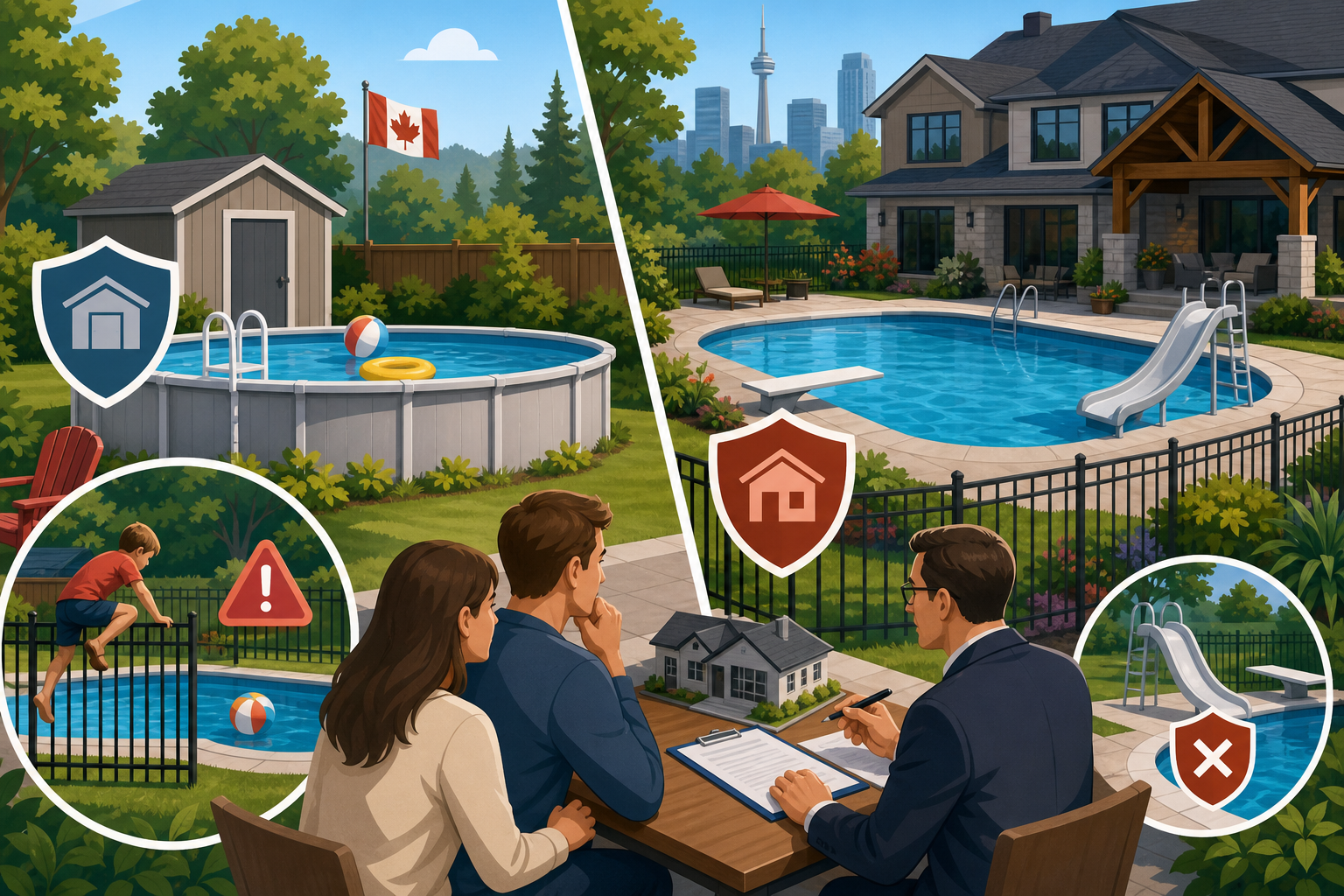
Pools fall into two categories for insurance purposes. Above-ground and semi-inground pools are classified as "detached structures," sitting on the same line as your shed or garage. Inground pools are treated as permanent improvements to the dwelling itself, meaning they raise your home's replacement cost. That replacement-cost recalculation is where the first premium increase comes from, your insurer now assumes it will cost more to rebuild your house and property from scratch.
The second driver is liability. Homeowners are legally responsible for injuries on their property, and pools are magnets for lawsuits. A child who climbs your fence, falls in, and drowns creates liability exposure even if they were trespassing. Canadian courts enforce a strict "duty of care" standard for children, the legal concept sometimes called an "attractive nuisance" in the U.S., and insurers price for that risk. Most brokers recommend raising personal liability coverage from the standard $1 million to at least $2 million once a pool goes in. That bump alone can add $75 to $150 per year.
What you're required to disclose
Failing to notify your insurer about a new pool installation is a material change in risk. If you file a claim later, say, a tree falls on the house or you have a basement flood, the insurer can void your entire policy for non-disclosure, not just deny the pool-related portion. Call your broker or agent within 30 days of completing installation, even if the pool isn't filled yet.
Most standard policies don't automatically cover damage to the pool structure itself. Freezing cracks, liner tears, or a collapse from ice heaving require a separate "pool and hot tub endorsement." That endorsement typically costs $50 to $100 annually. Without it, you're replacing a $15,000 liner out of pocket.
The fence isn't negotiable
Four-sided fencing with a self-latching, self-closing gate is required under Ontario's Building Code and similar municipal bylaws across Canada. But meeting city code doesn't mean your insurer is satisfied. Some carriers require gates with locks, not just latches. Some specify minimum fence heights of 1.5 meters regardless of what your municipality allows. If your pool came with the house and the fence is grandfathered under an old bylaw, the insurer doesn't care, they'll either require you to upgrade or decline coverage entirely.
What raises the rate further
Diving boards and slides are uninsurable for many Canadian carriers. Aviva and Intact have both been known to refuse coverage outright if a diving board is present, or to exclude liability for any injuries tied to it. A three-meter diving board can push your premium up another $300 to $600 per year with carriers that will cover it, because dive-related spinal injuries are catastrophically expensive to settle.
Saltwater pools cost slightly more to insure than chlorine pools in some cases, salt accelerates corrosion on nearby metal structures, which insurers view as added property-damage risk. The difference is usually under $50 annually, but it exists.
One thing nobody tells you upfront
Installing a pool through a certified member of the Pool & Hot Tub Council of Canada can lower your rate compared to an unverified contractor or a DIY kit. Insurers view professional installation as lower-risk because it's more likely to meet proper drainage, electrical, and structural standards. Ask your installer for proof of certification before you sign, then send a copy to your broker when you notify them. It won't eliminate the premium increase, but it can shave 10 to 15 percent off the pool-related surcharge.



A $50,000 inground pool typically adds $200 to $500 annually to your home insurance premium in Ontario, and that's before you factor in the mandatory liability bump most brokers will push you to take. Here's what actually drives the cost.
Why the premium jumps
Pools fall into two categories for insurance purposes. Above-ground and semi-inground pools are classified as "detached structures," sitting on the same line as your shed or garage. Inground pools are treated as permanent improvements to the dwelling itself, meaning they raise your home's replacement cost. That replacement-cost recalculation is where the first premium increase comes from, your insurer now assumes it will cost more to rebuild your house and property from scratch.
The second driver is liability. Homeowners are legally responsible for injuries on their property, and pools are magnets for lawsuits. A child who climbs your fence, falls in, and drowns creates liability exposure even if they were trespassing. Canadian courts enforce a strict "duty of care" standard for children, the legal concept sometimes called an "attractive nuisance" in the U.S., and insurers price for that risk. Most brokers recommend raising personal liability coverage from the standard $1 million to at least $2 million once a pool goes in. That bump alone can add $75 to $150 per year.
What you're required to disclose
Failing to notify your insurer about a new pool installation is a material change in risk. If you file a claim later, say, a tree falls on the house or you have a basement flood, the insurer can void your entire policy for non-disclosure, not just deny the pool-related portion. Call your broker or agent within 30 days of completing installation, even if the pool isn't filled yet.
Most standard policies don't automatically cover damage to the pool structure itself. Freezing cracks, liner tears, or a collapse from ice heaving require a separate "pool and hot tub endorsement." That endorsement typically costs $50 to $100 annually. Without it, you're replacing a $15,000 liner out of pocket.
The fence isn't negotiable
Four-sided fencing with a self-latching, self-closing gate is required under Ontario's Building Code and similar municipal bylaws across Canada. But meeting city code doesn't mean your insurer is satisfied. Some carriers require gates with locks, not just latches. Some specify minimum fence heights of 1.5 meters regardless of what your municipality allows. If your pool came with the house and the fence is grandfathered under an old bylaw, the insurer doesn't care, they'll either require you to upgrade or decline coverage entirely.
What raises the rate further
Diving boards and slides are uninsurable for many Canadian carriers. Aviva and Intact have both been known to refuse coverage outright if a diving board is present, or to exclude liability for any injuries tied to it. A three-meter diving board can push your premium up another $300 to $600 per year with carriers that will cover it, because dive-related spinal injuries are catastrophically expensive to settle.
Saltwater pools cost slightly more to insure than chlorine pools in some cases, salt accelerates corrosion on nearby metal structures, which insurers view as added property-damage risk. The difference is usually under $50 annually, but it exists.
One thing nobody tells you upfront
Installing a pool through a certified member of the Pool & Hot Tub Council of Canada can lower your rate compared to an unverified contractor or a DIY kit. Insurers view professional installation as lower-risk because it's more likely to meet proper drainage, electrical, and structural standards. Ask your installer for proof of certification before you sign, then send a copy to your broker when you notify them. It won't eliminate the premium increase, but it can shave 10 to 15 percent off the pool-related surcharge.
Read Next
GIC rates stall as bonds retreat: why deposit accounts still lag
Why Your Employer's Life Insurance Probably Covers Less Than You Think
August Sales Fell 6.9%: What CREA's Numbers Actually Reveal About Buyer Hesitation
Canada's Resource Advantage: What Global Investors Are Betting On in 2026