Ford's Selloff Is a Verdict on Tech Spending, Not Just Detroit
Ford's shares dropped sharply during a stretch when F-150s are easier to find on Edmonton dealer lots than they have been in years. Inventory has settled since the supply chain mess, and dealers are offering better incentives to move trucks. Plenty of product, good deals, falling stock. That combination tells you the market is worried about something other than whether Ford can build a truck.
The common read on a drop like this is that it's a Ford story: warranty bills, a soft quarter, an electric vehicle unit losing money on every unit it sells. All of that is real. What the selloff adds is a second, wider message. Investors are cooling on expensive technology bets that haven't found paying customers, and they're questioning how much new debt the average household can take on. Both doubts apply well beyond one automaker, and both touch your portfolio and your own borrowing.
Company problems explain some drops, and this one only partly
Give the usual view its due. Ford has carried high warranty and quality costs for years, and it is tightening factory oversight to fix them. Its Model e electric division has posted heavy per-vehicle losses while it pays to scale up batteries and production. When a company keeps paying to repair what it already sold, the stock deserves to be marked down. If that were the whole picture, you could judge Ford on its own fixes and move on.
The trouble is that Ford's strongest unit is still doing its job. Ford Pro, the commercial fleet and services side, earns healthy margins and has been covering losses elsewhere. A business with a solid floor under it doesn't usually fall this hard on its own mistakes. Something in the wider market is being repriced.
Tech spending gets judged by who's paying for it
Ford is trying to earn money like a software company, selling subscriptions for features such as BlueCruise, its hands-free highway driving system. On paper, monthly fees on millions of vehicles look like the kind of steady income markets reward richly. The selloff suggests buyers haven't fully accepted paying monthly for what their truck can do.
Use this test on any company, in autos or elsewhere, promising future returns from big technology spending: is there a customer paying for it today, or only a forecast? Older automakers face a double bill. They fund tomorrow's technology while running the plants that build the gas trucks people buy now. When the market stops giving credit for the forecast, that double bill shows up in the share price all at once.
The stock is really pricing the monthly payment
Most new vehicles are financed. With average new vehicle prices in Canada around $63,000 in 2026 (after reaching highs in the mid-2020s), the purchase depends on whether a household can handle another large payment. The Bank of Canada has pointed to interest rates as a main driver of how consumers felt through 2024 and 2025, especially about big-ticket items like trucks and SUVs. When investors sell Ford, much of what they're selling is their confidence in that payment.
That puts household finances at the centre of the story. A truck payment does more than squeeze a monthly budget. Lenders count it when they work out how much mortgage you qualify for, and Canada's stress test already has you qualifying at your contract rate plus 2 percentage points, or 5.25%, whichever is higher. A new truck loan can shrink the home you can buy by more than people expect.
Alberta adds its own twist. A strong energy sector can keep heavy-duty truck demand here high while the rest of the country slows, so a national headline may not match what you see on 97 Street. A local boom still doesn't change the math of a debt ratio.
When an auto stock falls on doubts about technology payoffs and borrowing costs, treat it as a forecast about the buyer. Then ask whether that buyer, sometimes the person in your own driveway, can carry one more payment.


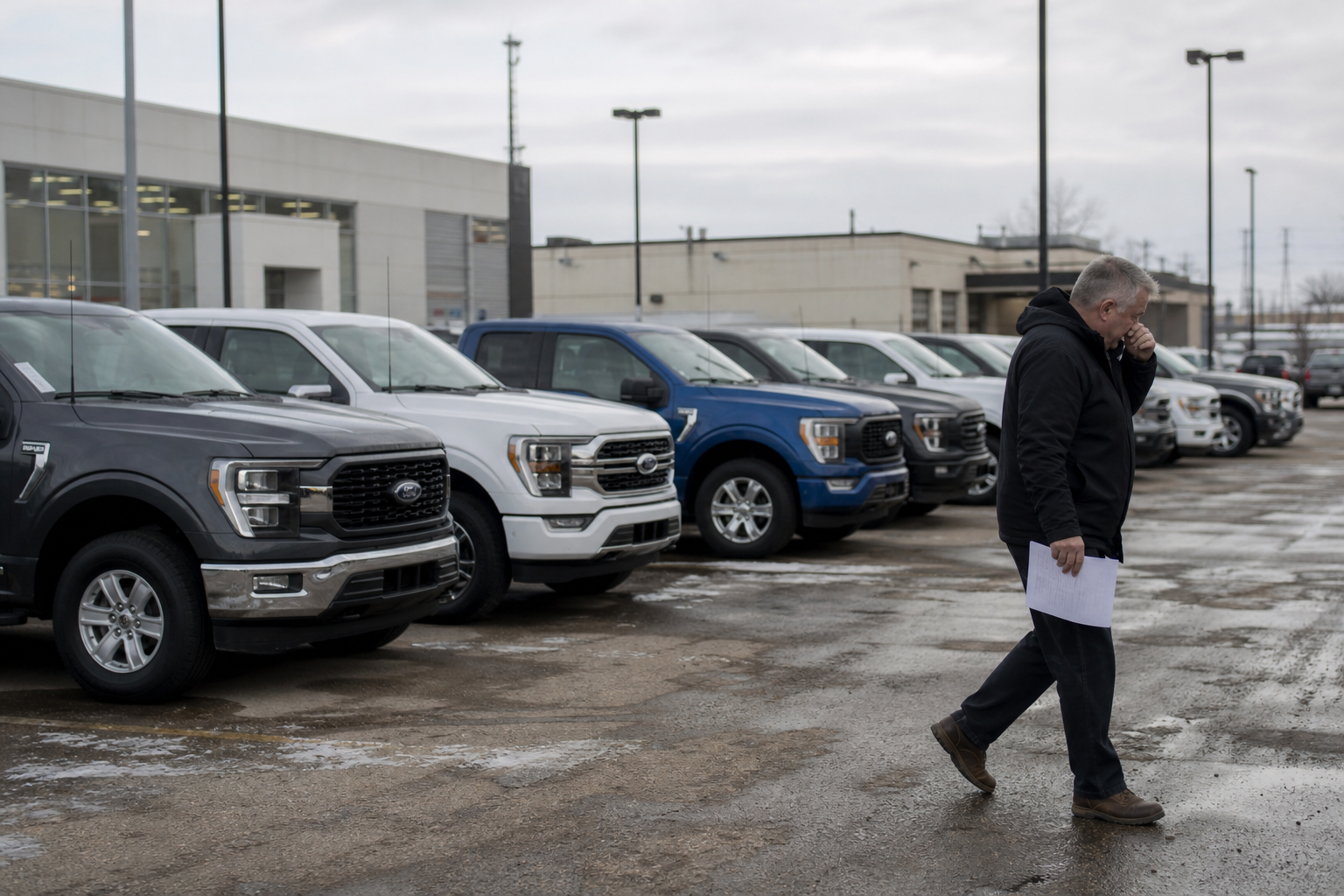

Ford's shares dropped sharply during a stretch when F-150s are easier to find on Edmonton dealer lots than they have been in years. Inventory has settled since the supply chain mess, and dealers are offering better incentives to move trucks. Plenty of product, good deals, falling stock. That combination tells you the market is worried about something other than whether Ford can build a truck.
The common read on a drop like this is that it's a Ford story: warranty bills, a soft quarter, an electric vehicle unit losing money on every unit it sells. All of that is real. What the selloff adds is a second, wider message. Investors are cooling on expensive technology bets that haven't found paying customers, and they're questioning how much new debt the average household can take on. Both doubts apply well beyond one automaker, and both touch your portfolio and your own borrowing.
Company problems explain some drops, and this one only partly
Give the usual view its due. Ford has carried high warranty and quality costs for years, and it is tightening factory oversight to fix them. Its Model e electric division has posted heavy per-vehicle losses while it pays to scale up batteries and production. When a company keeps paying to repair what it already sold, the stock deserves to be marked down. If that were the whole picture, you could judge Ford on its own fixes and move on.
The trouble is that Ford's strongest unit is still doing its job. Ford Pro, the commercial fleet and services side, earns healthy margins and has been covering losses elsewhere. A business with a solid floor under it doesn't usually fall this hard on its own mistakes. Something in the wider market is being repriced.
Tech spending gets judged by who's paying for it
Ford is trying to earn money like a software company, selling subscriptions for features such as BlueCruise, its hands-free highway driving system. On paper, monthly fees on millions of vehicles look like the kind of steady income markets reward richly. The selloff suggests buyers haven't fully accepted paying monthly for what their truck can do.
Use this test on any company, in autos or elsewhere, promising future returns from big technology spending: is there a customer paying for it today, or only a forecast? Older automakers face a double bill. They fund tomorrow's technology while running the plants that build the gas trucks people buy now. When the market stops giving credit for the forecast, that double bill shows up in the share price all at once.
The stock is really pricing the monthly payment
Most new vehicles are financed. With average new vehicle prices in Canada around $63,000 in 2026 (after reaching highs in the mid-2020s), the purchase depends on whether a household can handle another large payment. The Bank of Canada has pointed to interest rates as a main driver of how consumers felt through 2024 and 2025, especially about big-ticket items like trucks and SUVs. When investors sell Ford, much of what they're selling is their confidence in that payment.
That puts household finances at the centre of the story. A truck payment does more than squeeze a monthly budget. Lenders count it when they work out how much mortgage you qualify for, and Canada's stress test already has you qualifying at your contract rate plus 2 percentage points, or 5.25%, whichever is higher. A new truck loan can shrink the home you can buy by more than people expect.
Alberta adds its own twist. A strong energy sector can keep heavy-duty truck demand here high while the rest of the country slows, so a national headline may not match what you see on 97 Street. A local boom still doesn't change the math of a debt ratio.
When an auto stock falls on doubts about technology payoffs and borrowing costs, treat it as a forecast about the buyer. Then ask whether that buyer, sometimes the person in your own driveway, can carry one more payment.
Sources
Read Next
Five Money Checks Canadian Snowbirds Should Finish Before Heading South
Canadian Bank Security Assumes a Human Is Logging In. AI Agents Break That
Before Storm Winds Arrive, Turn 5 Yard Hazards Into Protective Buffers
A 25 Basis Point Hike Doesn't Erase Variable's Long-Run Edge Over Fixed