CRA Hit This Expat With TFSA™ Penalties After Contributions From Abroad
Joanna moved to Singapore in March 2022 for a four-year contract with an oil services company. She was 34, held a Canadian passport, kept her Edmonton condo as a rental, and checked her CRA My Account portal every January to see her TFSA™ contribution room update. In 2023, the portal showed $6,500 in new room. She contributed $6,500 through her TD account in February. In 2024, the same thing: $7,000 showed up, she contributed $7,000. The system accepted both deposits without flagging anything.
The penalty notice arrived in October 2024. The CRA assessed her $1,620 in tax on the combined $13,500 she had contributed while abroad, calculated at 1% per month from the date of each deposit until she withdrew the funds. The letter was clear: residents of Canada for tax purposes can contribute to a TFSA™. Non-residents cannot. Joanna had been a non-resident since April 2022, the month after she left. The contribution room shown in her My Account portal had been calculated on the assumption she still lived in Canada. That assumption was legally wrong.
Why the portal showed room she didn't have
The CRA's online systems generate TFSA™ room based on prior-year tax filings and age. They do not track residency status in real time. If you file as a non-resident, or if border-crossing data later flags you as living abroad, your actual entitlement to new room drops to zero for every year you're away. But the portal number doesn't adjust automatically. It keeps adding the annual limit, $7,000 in 2026, as if you never left. Joanna's mistake was trusting that number without confirming her residency status had been updated in the system.
The CRA determines non-resident status in Canada by residential ties: where your spouse and dependents live, where you maintain a home available for your use, and where your economic and social life is centered. Owning a rental property in Edmonton and keeping a Canadian bank account are secondary ties. They don't override the fact that Joanna's job, her apartment lease, and her day-to-day life were in Singapore. She was a non-resident the moment those primary ties moved.
What the penalty actually costs
The 1% monthly tax applies to the full amount of the prohibited contribution, not the gains. It accrues every month the money stays in the account. Joanna's $6,500 from February 2023 had been sitting there for 20 months by the time the CRA caught it. That's $1,300 in penalty on a contribution that had earned maybe $400 in growth. The penalty ran independent of performance. If the account had lost money, the tax would have been the same.
The CRA can waive the penalty, but the bar is high. You need to show the over-contribution was a reasonable error and that you removed the funds immediately upon learning of the mistake. "I didn't know the rule" rarely qualifies. "The portal told me I had room" has better odds, but only if you can demonstrate you filed correctly as a non-resident and the system still misled you. Joanna requested a waiver in November 2024. As of mid-2026, the file was still under review.
She pulled the $13,500 out within two weeks of receiving the notice, but the penalty clock had already run. The withdrawal created new contribution room, in theory, but she can't use it until she moves back to Canada and re-establishes residency. Non-residents can withdraw from a TFSA™ tax-free. They just can't put anything in.
Joanna's contract ends in 2027. She'll return to Edmonton, file as a resident again, and the room will become usable. Until then, the account sits empty and the penalty sits unpaid, waiting on the CRA's decision.


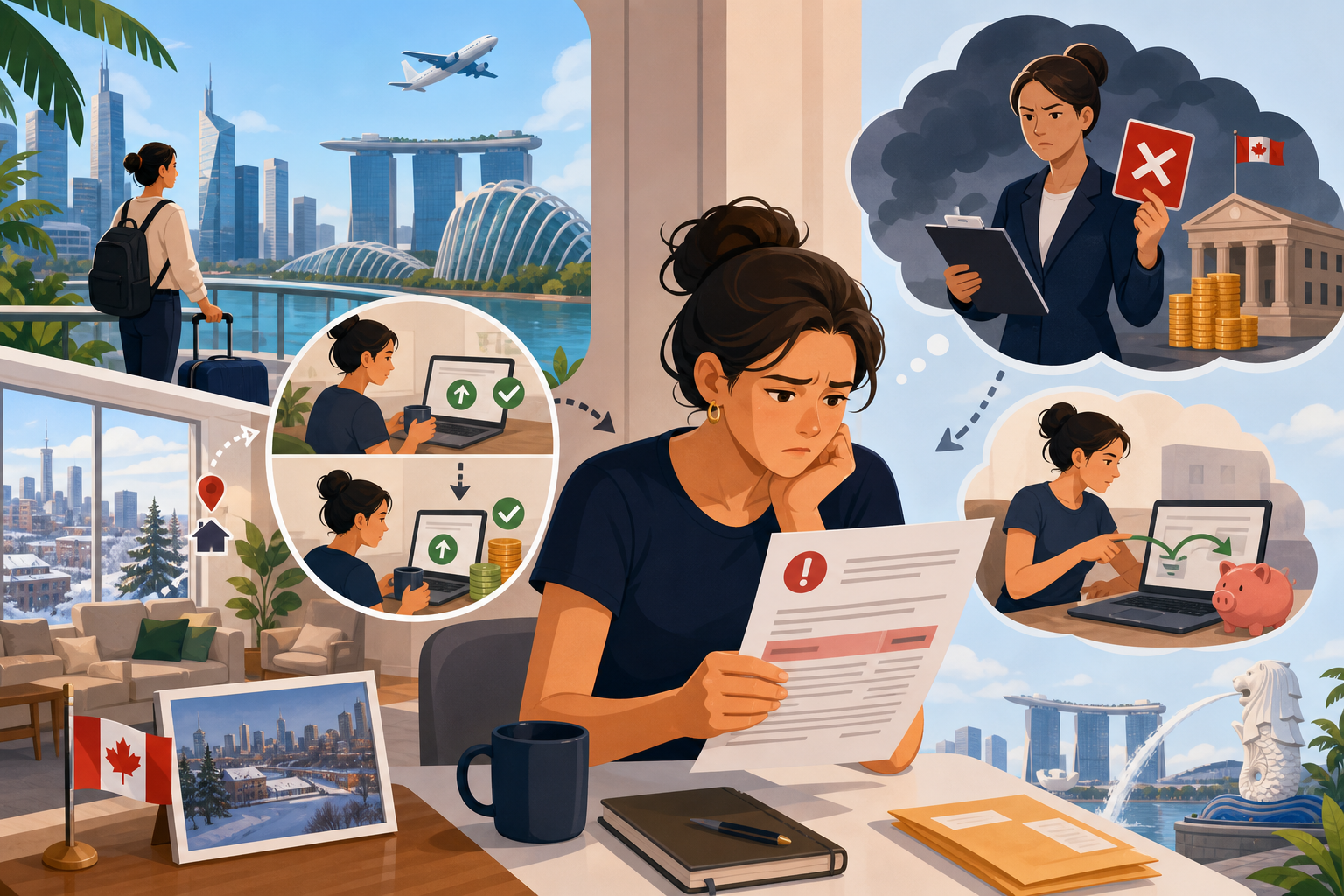

Joanna moved to Singapore in March 2022 for a four-year contract with an oil services company. She was 34, held a Canadian passport, kept her Edmonton condo as a rental, and checked her CRA My Account portal every January to see her TFSA™ contribution room update. In 2023, the portal showed $6,500 in new room. She contributed $6,500 through her TD account in February. In 2024, the same thing: $7,000 showed up, she contributed $7,000. The system accepted both deposits without flagging anything.
The penalty notice arrived in October 2024. The CRA assessed her $1,620 in tax on the combined $13,500 she had contributed while abroad, calculated at 1% per month from the date of each deposit until she withdrew the funds. The letter was clear: residents of Canada for tax purposes can contribute to a TFSA™. Non-residents cannot. Joanna had been a non-resident since April 2022, the month after she left. The contribution room shown in her My Account portal had been calculated on the assumption she still lived in Canada. That assumption was legally wrong.
Why the portal showed room she didn't have
The CRA's online systems generate TFSA™ room based on prior-year tax filings and age. They do not track residency status in real time. If you file as a non-resident, or if border-crossing data later flags you as living abroad, your actual entitlement to new room drops to zero for every year you're away. But the portal number doesn't adjust automatically. It keeps adding the annual limit, $7,000 in 2026, as if you never left. Joanna's mistake was trusting that number without confirming her residency status had been updated in the system.
The CRA determines non-resident status in Canada by residential ties: where your spouse and dependents live, where you maintain a home available for your use, and where your economic and social life is centered. Owning a rental property in Edmonton and keeping a Canadian bank account are secondary ties. They don't override the fact that Joanna's job, her apartment lease, and her day-to-day life were in Singapore. She was a non-resident the moment those primary ties moved.
What the penalty actually costs
The 1% monthly tax applies to the full amount of the prohibited contribution, not the gains. It accrues every month the money stays in the account. Joanna's $6,500 from February 2023 had been sitting there for 20 months by the time the CRA caught it. That's $1,300 in penalty on a contribution that had earned maybe $400 in growth. The penalty ran independent of performance. If the account had lost money, the tax would have been the same.
The CRA can waive the penalty, but the bar is high. You need to show the over-contribution was a reasonable error and that you removed the funds immediately upon learning of the mistake. "I didn't know the rule" rarely qualifies. "The portal told me I had room" has better odds, but only if you can demonstrate you filed correctly as a non-resident and the system still misled you. Joanna requested a waiver in November 2024. As of mid-2026, the file was still under review.
She pulled the $13,500 out within two weeks of receiving the notice, but the penalty clock had already run. The withdrawal created new contribution room, in theory, but she can't use it until she moves back to Canada and re-establishes residency. Non-residents can withdraw from a TFSA™ tax-free. They just can't put anything in.
Joanna's contract ends in 2027. She'll return to Edmonton, file as a resident again, and the room will become usable. Until then, the account sits empty and the penalty sits unpaid, waiting on the CRA's decision.
Read Next
A One-Time Capital Gain Can Trigger Alternative Minimum Tax Even for Average Canadians
The S&P Looks Stable Because You're Measuring the Wrong Volatility
Clearwater Seafoods Family Backs Prefab Housing as Construction Speed Solution
South Bow sees private equity interest in Prairie Connector following Carney's new mega-deduction announcement