Clearwater Seafoods Family Backs Prefab Housing as Construction Speed Solution
A company launched in 2024 with a straightforward thesis: Canada's housing shortage is a production problem, and production problems respond to factory discipline. The company builds laneway suites, garden homes, and mid-rise residential units in controlled facilities before trucking them to site. Where a conventional Edmonton infill might take eight months from permit to occupancy, the company targets six to twelve weeks of factory time, with site assembly adding another month.
The speed advantage isn't cosmetic. Modular construction—building homes in a factory instead of on-site—compresses timelines by 30% to 50% compared to stick-built methods, or homes built traditionally outdoors. The compression matters most where it's hardest to achieve: urban lots with no room for material staging, winter builds where weather stops work for weeks, and markets where skilled framers are booked six months out. Alberta has roughly 15,000 fewer residential tradespeople than the province needs to meet current demand, and Edmonton's push toward denser zoning under Bylaw 20001 has created infill opportunities faster than the labour market can fill them.
Why factories produce tighter buildings
Prefab units are built indoors, which means the framing lumber never sits in snow. That single fact eliminates the moisture-related failures that plague winter construction in Edmonton: warped studs, mold in wall cavities, and the need for remediation before drywall. A factory also allows for precision that's difficult to replicate on site. Wall panels are cut by CNC machines calibrated to tolerances measured in millimeters, and the joints are assembled on jigs that hold square. The result is an envelope tight enough that many prefab homes require mechanical ventilation to meet code, because natural air leakage is too low.
Tighter envelopes reduce heating costs. In a climate where a poorly sealed home can carry significantly higher natural gas costs over a winter, the difference between 3.0 air changes per hour and 1.5 becomes a recurring monthly expense. Buyers shopping for an accessory suite to rent out notice this: a prefab garden suite that costs $100,000 to $120,000 installed will often carry heating bills 40% lower than a comparable stick-built unit, and that gap shows up in the annual operating statement.
Where the model still needs translation
Factory efficiency doesn't eliminate the site work. A prefab home still requires excavation, a poured foundation, utility hookups for water and sewer, electrical panel upgrades, and gas line extensions. Those costs are locally determined, and in Edmonton they can run $30,000 to $50,000 depending on how far the new structure sits from existing service. The factory delivers a box. Turning that box into a livable, code-compliant unit requires the same local trades the conventional build would have used.
Financing remains uneven. Some Alberta lenders treat modular homes as equivalent to site-built and will release construction draws on a standard schedule. Others hesitate, particularly when the factory is out of province and wants payment before the unit ships. Buyers working with a mortgage broker who hasn't placed a prefab deal before should confirm the lender's position in writing before signing a factory contract.
The federal government has signaled support. CMHC's Housing Design Catalogue, released in 2024, provides pre-approved modular designs intended to streamline municipal permitting, and the Apartment Construction Loan Program now prioritizes projects using prefabricated methods. The $15 billion fund doesn't guarantee approval, but it creates a pathway for developers who can show faster delivery.
The bet is that housing will follow the path seafood did: from artisanal and inconsistent to industrialized and reliable. Whether the comparison holds depends on how quickly municipalities, lenders, and trades adapt to a model where the house shows up mostly finished.


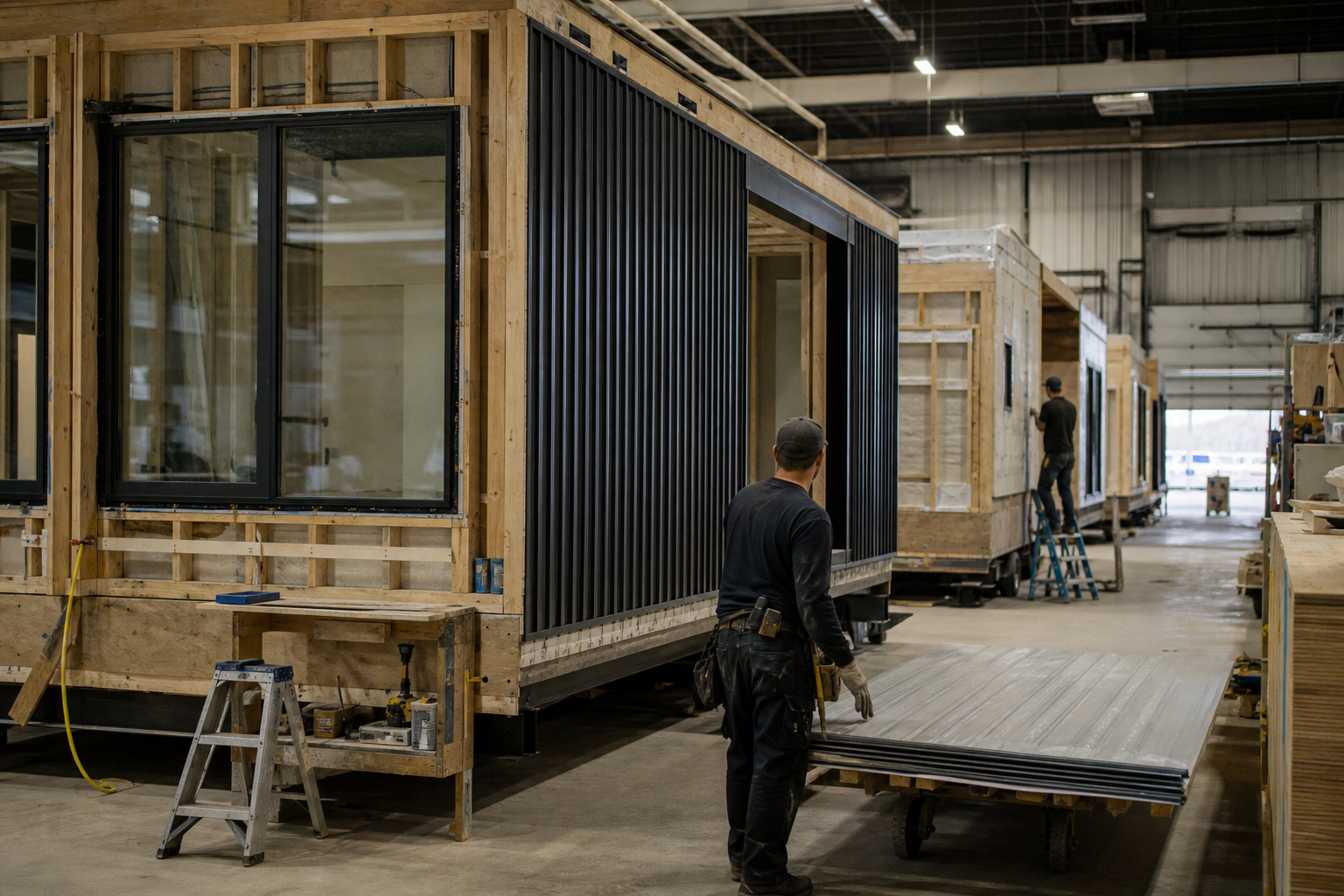

A company launched in 2024 with a straightforward thesis: Canada's housing shortage is a production problem, and production problems respond to factory discipline. The company builds laneway suites, garden homes, and mid-rise residential units in controlled facilities before trucking them to site. Where a conventional Edmonton infill might take eight months from permit to occupancy, the company targets six to twelve weeks of factory time, with site assembly adding another month.
The speed advantage isn't cosmetic. Modular construction—building homes in a factory instead of on-site—compresses timelines by 30% to 50% compared to stick-built methods, or homes built traditionally outdoors. The compression matters most where it's hardest to achieve: urban lots with no room for material staging, winter builds where weather stops work for weeks, and markets where skilled framers are booked six months out. Alberta has roughly 15,000 fewer residential tradespeople than the province needs to meet current demand, and Edmonton's push toward denser zoning under Bylaw 20001 has created infill opportunities faster than the labour market can fill them.
Why factories produce tighter buildings
Prefab units are built indoors, which means the framing lumber never sits in snow. That single fact eliminates the moisture-related failures that plague winter construction in Edmonton: warped studs, mold in wall cavities, and the need for remediation before drywall. A factory also allows for precision that's difficult to replicate on site. Wall panels are cut by CNC machines calibrated to tolerances measured in millimeters, and the joints are assembled on jigs that hold square. The result is an envelope tight enough that many prefab homes require mechanical ventilation to meet code, because natural air leakage is too low.
Tighter envelopes reduce heating costs. In a climate where a poorly sealed home can carry significantly higher natural gas costs over a winter, the difference between 3.0 air changes per hour and 1.5 becomes a recurring monthly expense. Buyers shopping for an accessory suite to rent out notice this: a prefab garden suite that costs $100,000 to $120,000 installed will often carry heating bills 40% lower than a comparable stick-built unit, and that gap shows up in the annual operating statement.
Where the model still needs translation
Factory efficiency doesn't eliminate the site work. A prefab home still requires excavation, a poured foundation, utility hookups for water and sewer, electrical panel upgrades, and gas line extensions. Those costs are locally determined, and in Edmonton they can run $30,000 to $50,000 depending on how far the new structure sits from existing service. The factory delivers a box. Turning that box into a livable, code-compliant unit requires the same local trades the conventional build would have used.
Financing remains uneven. Some Alberta lenders treat modular homes as equivalent to site-built and will release construction draws on a standard schedule. Others hesitate, particularly when the factory is out of province and wants payment before the unit ships. Buyers working with a mortgage broker who hasn't placed a prefab deal before should confirm the lender's position in writing before signing a factory contract.
The federal government has signaled support. CMHC's Housing Design Catalogue, released in 2024, provides pre-approved modular designs intended to streamline municipal permitting, and the Apartment Construction Loan Program now prioritizes projects using prefabricated methods. The $15 billion fund doesn't guarantee approval, but it creates a pathway for developers who can show faster delivery.
The bet is that housing will follow the path seafood did: from artisanal and inconsistent to industrialized and reliable. Whether the comparison holds depends on how quickly municipalities, lenders, and trades adapt to a model where the house shows up mostly finished.
Sources
Read Next
A One-Time Capital Gain Can Trigger Alternative Minimum Tax Even for Average Canadians
The S&P Looks Stable Because You're Measuring the Wrong Volatility
South Bow sees private equity interest in Prairie Connector following Carney's new mega-deduction announcement
Why One TSX Stock Gained 13% While Canadian Utilities and REITs Fell