CMHC's Latest Housing Supply Gap Report Shows Construction Slowing Faster Than Demand
CMHC Says Canada Needs 417,000–469,000 Units Annually to Restore Affordability by 2036: Construction Slows
The federal housing agency confirmed it needs approximately 3.5 million additional units by 2030, though recent data shows the gap narrowing slightly at the national level while widening in some provinces. Call it progress if you want. The agency's own data shows housing starts declining, not accelerating, and the arithmetic doesn't care about the optimism.
Canada historically completes 200,000 to 250,000 units annually. The CMHC now says Canada needs 417,000 to 469,000 units annually to restore affordability to pre-pandemic levels by 2036, when a household could spend roughly 30 percent of income on shelter. We're not halfway there. We've never been halfway there. The gap narrowed on paper because economists lowered their population projections and factored in higher interest rates dampening demand, not because construction caught up.
The Labour Problem No One Wants to Solve
Here's what actually limits how many units get built: the number of people who know how to build them. Canada's construction workforce is aging out. A significant portion of skilled tradespeople are reaching retirement age, and the replacement pipeline is thin. You can eliminate every zoning restriction in Toronto, streamline every approval process in Vancouver, and wave federal money at municipalities through the Housing Accelerator Fund. None of it adds a framer, a plumber, or an electrician to a job site.
Productivity in the construction sector has been flat for decades. Modular construction exists. Factory-built components exist. The industry largely ignores them because the current model, however slow, still generates predictable margins for developers who can afford the timeline. The constraint isn't technology. It's adoption.
The Missing Middle Stays Missing
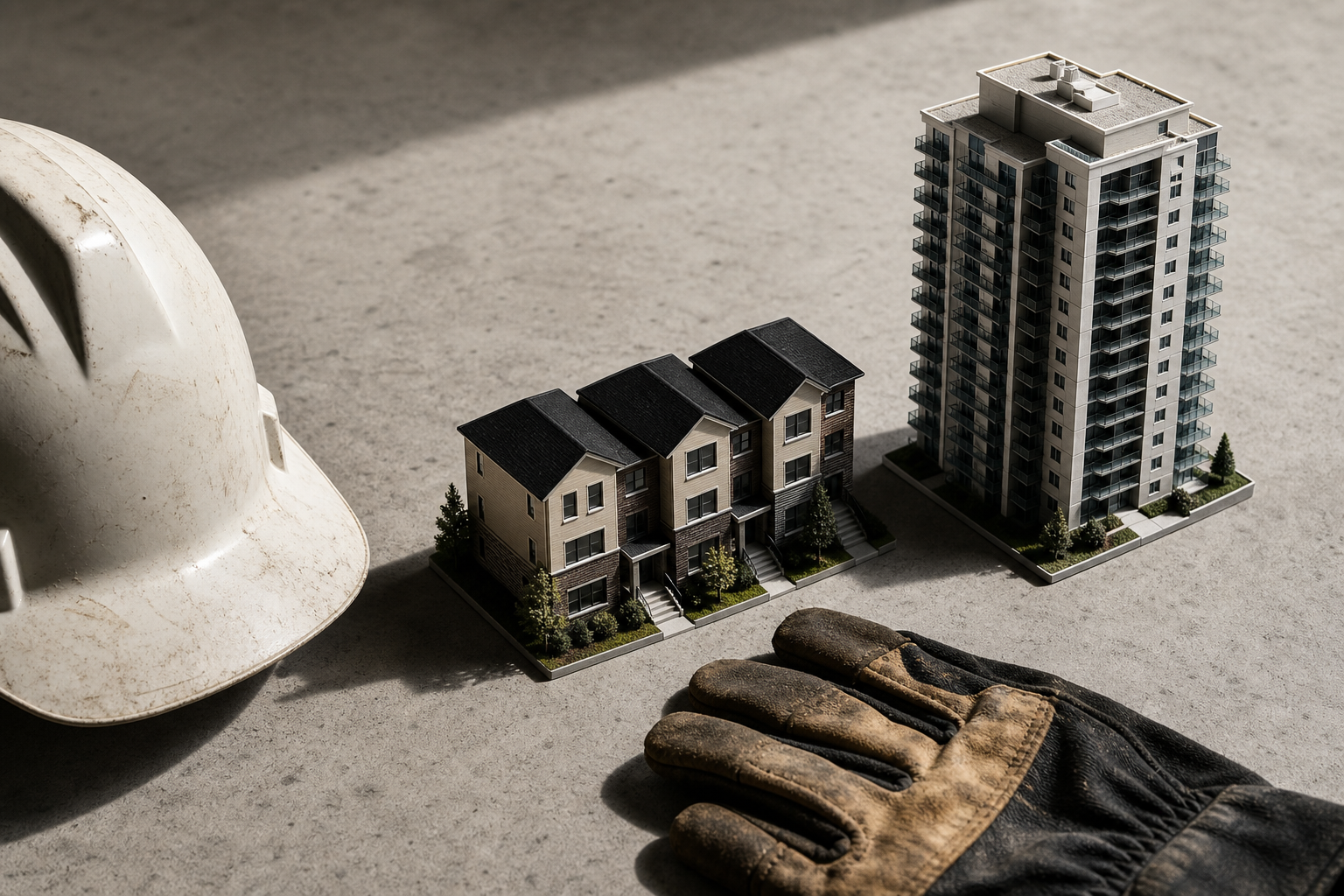
High-rise density is increasing in core urban areas. Detached home construction continues in the outer suburbs. The gap between them, the "missing middle" of townhomes, triplexes, and low-rise multi-family buildings, remains largely untouched. This is the housing type that families with children actually need and that zoning in most Canadian cities actively prohibits.
Ontario alone faces a shortfall exceeding 1.46 million units by 2030 under a business-as-usual scenario. British Columbia's deficit runs a similar direction. Meanwhile, the pressure is spilling into secondary markets. Calgary and Halifax are absorbing population outflows from Toronto and Vancouver, but their zoning rules, their approval processes, and their crews were never sized for this pace of growth. The gap isn't being closed. It's being exported.
The Trickle-Down That Doesn't
The current building mix skews heavily toward market-sale condos and high-end rentals. The theory is that adding supply at any price point eventually filters down to affordability. The timeline on that theory is measured in decades, and low-income renters do not have decades. Purpose-built rental construction has increased since the federal government removed the GST on new rental projects, but the lag time between policy, financing, construction, and occupancy is roughly three to four years. A renter priced out in 2026 does not benefit from a building that opens in 2029.
Interest rates began easing in 2024 and 2025 after the Bank of Canada's tightening cycle, but the "higher-for-longer" period left a backlog of unstarted projects. Developers who shelved plans in 2023 when financing costs spiked have not universally restarted them. The financial viability of multi-unit projects remains fragile, particularly in markets where land costs and municipal fees consume most of the margin before a shovel hits the ground.
The CMHC's revised target acknowledges economic reality. It does not solve the structural problem. Canada needs to double its annual housing output and sustain that for the rest of the decade. The workforce, the productivity, and the policy coordination required to do that are not in place. Narrowing the gap on a spreadsheet is not the same as closing it in the physical world.



CMHC Says Canada Needs 417,000–469,000 Units Annually to Restore Affordability by 2036: Construction Slows
The federal housing agency confirmed it needs approximately 3.5 million additional units by 2030, though recent data shows the gap narrowing slightly at the national level while widening in some provinces. Call it progress if you want. The agency's own data shows housing starts declining, not accelerating, and the arithmetic doesn't care about the optimism.
Canada historically completes 200,000 to 250,000 units annually. The CMHC now says Canada needs 417,000 to 469,000 units annually to restore affordability to pre-pandemic levels by 2036, when a household could spend roughly 30 percent of income on shelter. We're not halfway there. We've never been halfway there. The gap narrowed on paper because economists lowered their population projections and factored in higher interest rates dampening demand, not because construction caught up.
The Labour Problem No One Wants to Solve
Here's what actually limits how many units get built: the number of people who know how to build them. Canada's construction workforce is aging out. A significant portion of skilled tradespeople are reaching retirement age, and the replacement pipeline is thin. You can eliminate every zoning restriction in Toronto, streamline every approval process in Vancouver, and wave federal money at municipalities through the Housing Accelerator Fund. None of it adds a framer, a plumber, or an electrician to a job site.
Productivity in the construction sector has been flat for decades. Modular construction exists. Factory-built components exist. The industry largely ignores them because the current model, however slow, still generates predictable margins for developers who can afford the timeline. The constraint isn't technology. It's adoption.
The Missing Middle Stays Missing
High-rise density is increasing in core urban areas. Detached home construction continues in the outer suburbs. The gap between them, the "missing middle" of townhomes, triplexes, and low-rise multi-family buildings, remains largely untouched. This is the housing type that families with children actually need and that zoning in most Canadian cities actively prohibits.
Ontario alone faces a shortfall exceeding 1.46 million units by 2030 under a business-as-usual scenario. British Columbia's deficit runs a similar direction. Meanwhile, the pressure is spilling into secondary markets. Calgary and Halifax are absorbing population outflows from Toronto and Vancouver, but their zoning rules, their approval processes, and their crews were never sized for this pace of growth. The gap isn't being closed. It's being exported.
The Trickle-Down That Doesn't
The current building mix skews heavily toward market-sale condos and high-end rentals. The theory is that adding supply at any price point eventually filters down to affordability. The timeline on that theory is measured in decades, and low-income renters do not have decades. Purpose-built rental construction has increased since the federal government removed the GST on new rental projects, but the lag time between policy, financing, construction, and occupancy is roughly three to four years. A renter priced out in 2026 does not benefit from a building that opens in 2029.
Interest rates began easing in 2024 and 2025 after the Bank of Canada's tightening cycle, but the "higher-for-longer" period left a backlog of unstarted projects. Developers who shelved plans in 2023 when financing costs spiked have not universally restarted them. The financial viability of multi-unit projects remains fragile, particularly in markets where land costs and municipal fees consume most of the margin before a shovel hits the ground.
The CMHC's revised target acknowledges economic reality. It does not solve the structural problem. Canada needs to double its annual housing output and sustain that for the rest of the decade. The workforce, the productivity, and the policy coordination required to do that are not in place. Narrowing the gap on a spreadsheet is not the same as closing it in the physical world.
Sources
Read Next
Ohio Lost $4.8 Billion to Trump's Tariffs in 90 Days
How Much Identity Theft Coverage Your Family Needs, Based on Who's Actually at Risk
Birch Hill builds a regional aviation network in British Columbia through Harbour Air's Pacific Coastal acquisition
South Korea's Stock Market Has Become a National Liability