A 56-year-old paramedic dies in New Brunswick and P.E.I.'s first responders lose one of their own
The ambulance was heading eastbound on Route 2 near Salisbury when it collided with a westbound transport truck Tuesday morning. Kevin MacPhee, 56, died at the scene. His partner was injured. Island EMS crews who knew him spent Wednesday trying to hold themselves together for the next call.
MacPhee had been a paramedic for more than two decades, working mostly out of West Prince County. People who worked alongside him say he had that rare combination: technically sharp but also the kind of person who could steady a panicked patient just by the way he moved through a room. That matters more than most people understand. A paramedic who can keep a family calm during the worst hour of their lives is doing half the work before the stretcher rolls.
The geography of small-island EMS
Prince Edward Island has a population of about 175,000 spread across three counties. Island EMS operates 18 ambulances across 14 stations. That means everyone knows everyone. When a crew member dies, the grief does not stay compartmentalized. The loss ripples through the entire service within hours.
MacPhee lived in Tignish, a town of roughly 800 people at the island's northwestern tip. He was known there not just as a paramedic but as someone who coached youth sports, volunteered at community events, and showed up when people needed help even when he was off duty. Small-town EMS workers occupy a strange role. They are neighbors who also happen to have seen you at your most vulnerable. That dual identity creates trust, but it also means the boundary between professional grief and personal grief collapses fast.
What the crash tells us about rural cross-border transport
The collision happened on the Trans-Canada Highway in New Brunswick, about 30 kilometers west of Moncton. Island EMS regularly moves patients to New Brunswick for specialized care that is not available on P.E.I. The island has no neurosurgery, no cardiac surgery, no level-one trauma center. Critical patients go to Moncton or Halifax. That means paramedics spend significant time on two-lane highways in vehicles that, while purpose-built, are not armored.
Transport trucks and ambulances share that stretch of Route 2 constantly. The highway carries commercial freight between the Maritimes and the rest of the country. Mixing high-speed medical transports with heavy commercial traffic creates risk that does not get talked about much outside the first-responder community. Tuesday's collision is under investigation by RCMP. No charges have been filed. The transport driver was not injured.
The grief work that happens between calls
Island EMS announced MacPhee's death Wednesday morning and offered counseling services to staff. Several paramedics posted tributes online. The common thread: he was the kind of coworker who made hard shifts easier just by being there.
But the stations do not close. The shifts do not pause. When a paramedic dies, the remaining crews still have to respond to the next motor vehicle accident, the next cardiac arrest, the next overdose. Grief becomes something you carry between calls, not something you get time to process before going back to work.
P.E.I.'s paramedic workforce is small enough that losing one person is felt across the entire system. MacPhee's colleagues will spend the next weeks doing their jobs while also attending a funeral for someone they worked beside, learned from, and in many cases considered a friend. The service keeps running. The cost of that continuity does not show up in any budget line.


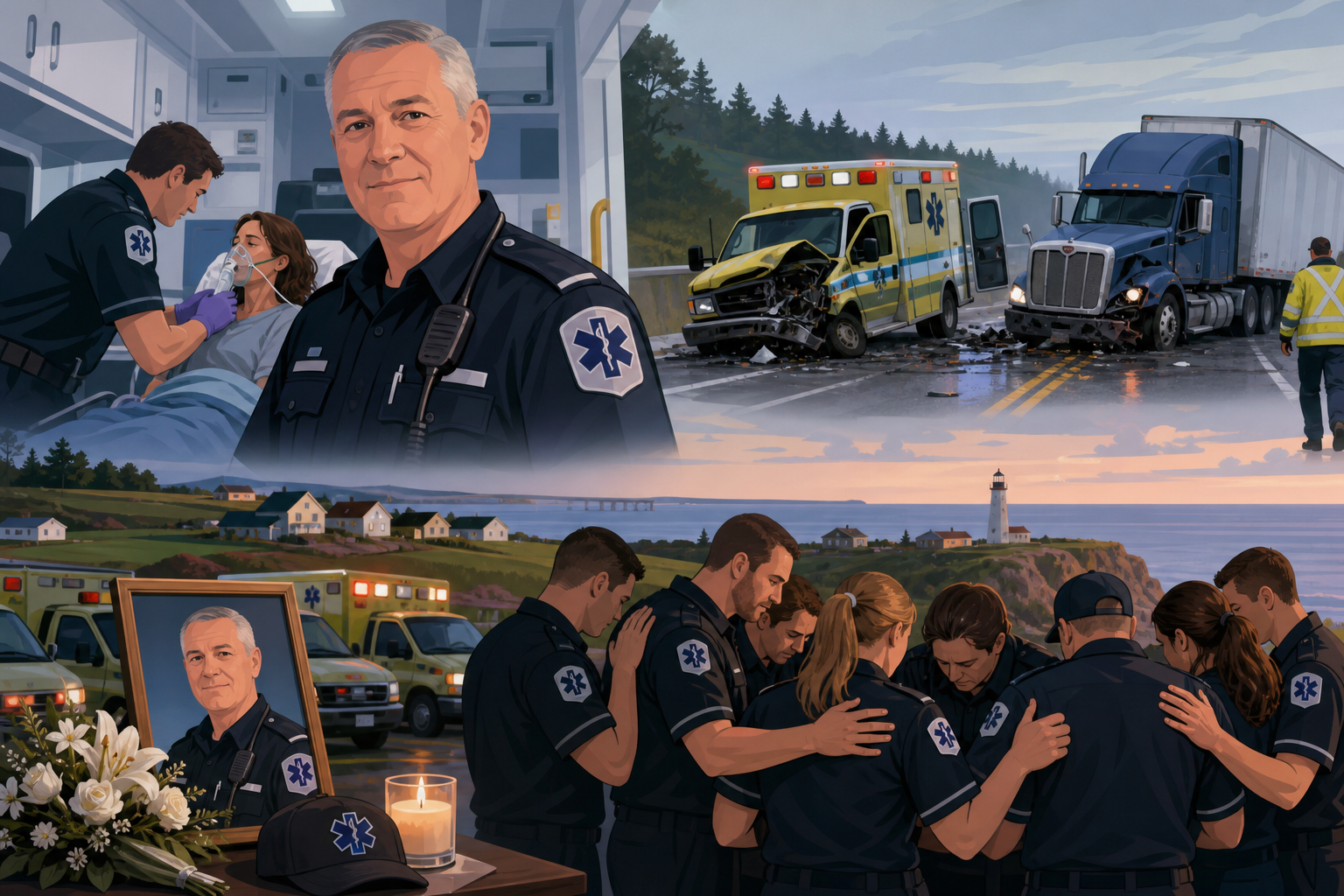

The ambulance was heading eastbound on Route 2 near Salisbury when it collided with a westbound transport truck Tuesday morning. Kevin MacPhee, 56, died at the scene. His partner was injured. Island EMS crews who knew him spent Wednesday trying to hold themselves together for the next call.
MacPhee had been a paramedic for more than two decades, working mostly out of West Prince County. People who worked alongside him say he had that rare combination: technically sharp but also the kind of person who could steady a panicked patient just by the way he moved through a room. That matters more than most people understand. A paramedic who can keep a family calm during the worst hour of their lives is doing half the work before the stretcher rolls.
The geography of small-island EMS
Prince Edward Island has a population of about 175,000 spread across three counties. Island EMS operates 18 ambulances across 14 stations. That means everyone knows everyone. When a crew member dies, the grief does not stay compartmentalized. The loss ripples through the entire service within hours.
MacPhee lived in Tignish, a town of roughly 800 people at the island's northwestern tip. He was known there not just as a paramedic but as someone who coached youth sports, volunteered at community events, and showed up when people needed help even when he was off duty. Small-town EMS workers occupy a strange role. They are neighbors who also happen to have seen you at your most vulnerable. That dual identity creates trust, but it also means the boundary between professional grief and personal grief collapses fast.
What the crash tells us about rural cross-border transport
The collision happened on the Trans-Canada Highway in New Brunswick, about 30 kilometers west of Moncton. Island EMS regularly moves patients to New Brunswick for specialized care that is not available on P.E.I. The island has no neurosurgery, no cardiac surgery, no level-one trauma center. Critical patients go to Moncton or Halifax. That means paramedics spend significant time on two-lane highways in vehicles that, while purpose-built, are not armored.
Transport trucks and ambulances share that stretch of Route 2 constantly. The highway carries commercial freight between the Maritimes and the rest of the country. Mixing high-speed medical transports with heavy commercial traffic creates risk that does not get talked about much outside the first-responder community. Tuesday's collision is under investigation by RCMP. No charges have been filed. The transport driver was not injured.
The grief work that happens between calls
Island EMS announced MacPhee's death Wednesday morning and offered counseling services to staff. Several paramedics posted tributes online. The common thread: he was the kind of coworker who made hard shifts easier just by being there.
But the stations do not close. The shifts do not pause. When a paramedic dies, the remaining crews still have to respond to the next motor vehicle accident, the next cardiac arrest, the next overdose. Grief becomes something you carry between calls, not something you get time to process before going back to work.
P.E.I.'s paramedic workforce is small enough that losing one person is felt across the entire system. MacPhee's colleagues will spend the next weeks doing their jobs while also attending a funeral for someone they worked beside, learned from, and in many cases considered a friend. The service keeps running. The cost of that continuity does not show up in any budget line.
Read Next
GIC rates stall as bonds retreat: why deposit accounts still lag
Why Your Employer's Life Insurance Probably Covers Less Than You Think
August Sales Fell 6.9%: What CREA's Numbers Actually Reveal About Buyer Hesitation
Canada's Resource Advantage: What Global Investors Are Betting On in 2026