6 Pigeon Deterrents for Condo Balconies, Ranked by What Actually Works
A condo board in Etobicoke shut down balcony furniture for 11 months last year because of pigeon waste. Not a ban on certain furniture, all of it. Residents stacked their chairs inside until the building hired a contractor in April. That's the kind of disruption pigeons cause when deterrent attempts fail repeatedly.
Here's what actually works, ranked by effectiveness. These aren't theory. They're what property managers and pest control operators in Ontario use after cheaper methods quit.
1. Physical netting installed by a professional
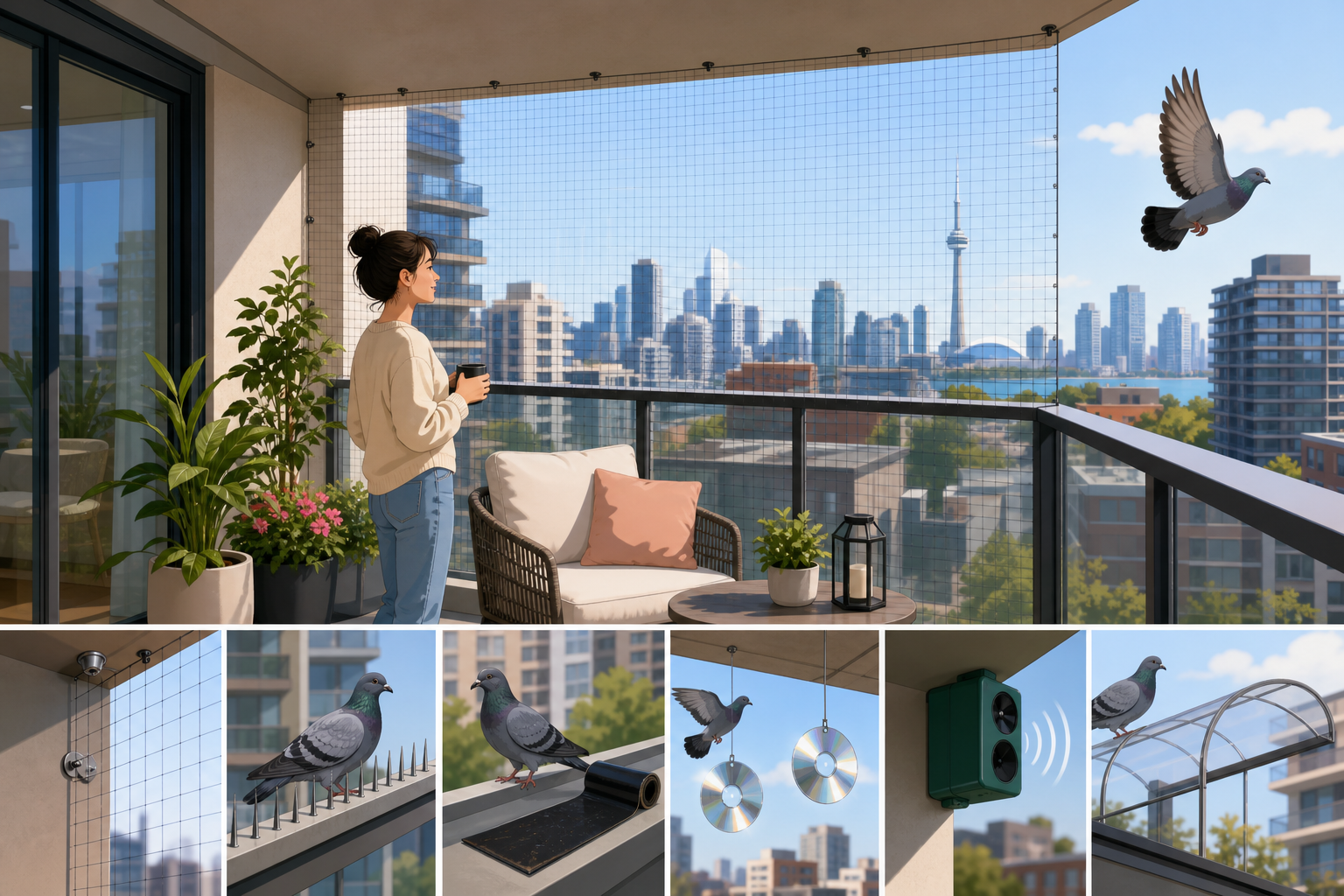
Properly installed netting blocks access completely. A contractor mounts anchor points to the balcony ceiling and sides, stretches UV-resistant polyethylene mesh across the open span, and tensions it so birds can't push through. The mesh is nearly invisible from 10 feet away.
Cost runs $800-$1,500 for a standard balcony in the GTA, installed. The netting lasts 7-10 years if installed correctly. This is the only method that removes the problem instead of managing it. Buildings in downtown Toronto with serious infestations, where pigeons roost in mechanical gaps and balconies offer secondary nesting sites, default to netting because it's the only thing property managers don't get called back about.
The failure mode is poor installation. Pigeons will exploit a 2-inch gap at the edge. DIY netting kits are available for $150-$300, but tensioning and anchor placement matter. If you can see sag or gaps, pigeons will find them.
2. Bird spikes on railings and ledges
Spikes prevent roosting on flat surfaces where pigeons land before moving to nest sites. Stainless steel or polycarbonate strips with 3-4 inch prongs install along railings, ledges, and AC unit tops.
Spikes work if the balcony problem is roosting, not nesting. If birds are already nesting in a corner or under furniture, spikes on the railing won't move them. They'll just skip the railing. Cost is $40-$80 for a 10-foot section. Installation takes 20 minutes with adhesive or zip ties.
Spikes are visible. Some condo boards restrict them under aesthetic rules. Check your declaration before buying.
3. Ultrasonic or motion-activated sound devices
These emit high-frequency noise or predator calls when motion is detected. Effectiveness drops after 2-3 weeks as birds habituate. Pigeons are urban-adapted, they ignore car alarms, construction noise, and fireworks. A recorded hawk call stops working once they learn it's not attached to an actual hawk.
Devices cost $30-$90. Battery life is 4-6 months. They buy time but are not solutions. Use them while waiting for a netting contractor or as a supplement to spikes.
4. Reflective tape, plastic owls, and windmills
Reflective ribbon and decoy predators rely on visual deterrence. Pigeons ignore them within days. A 2019 study from the University of Guelph found that urban pigeons habituate to static visual deterrents in under 72 hours. Decoys only work if moved daily, which no one does.
Tape costs $8. Plastic owls are $15-$25. Save the money.
5. Gel repellents
Sticky gels applied to surfaces are marketed as landing deterrents. They work briefly, then collect dust and lose tack. In summer heat, the gel liquefies and drips. In winter, it hardens and cracks. You're reapplying every 3-4 weeks, and it leaves residue that's difficult to remove from railings and concrete.
A tube costs $20-$30 and covers roughly 10 linear feet. Effective lifespan is under 30 days in Toronto weather.
6. Feeding pigeons to "make friends"
This is not a deterrent. It's the problem. Feeding pigeons attracts more pigeons, increases waste, and creates dependency. Toronto Municipal Code Chapter 349 prohibits feeding pigeons on private property if it creates a nuisance. Your condo board can fine you. Don't do this.
The fastest fix is netting. Everything else either fails after weeks or only works if the infestation is still light.



A condo board in Etobicoke shut down balcony furniture for 11 months last year because of pigeon waste. Not a ban on certain furniture, all of it. Residents stacked their chairs inside until the building hired a contractor in April. That's the kind of disruption pigeons cause when deterrent attempts fail repeatedly.
Here's what actually works, ranked by effectiveness. These aren't theory. They're what property managers and pest control operators in Ontario use after cheaper methods quit.
1. Physical netting installed by a professional
Properly installed netting blocks access completely. A contractor mounts anchor points to the balcony ceiling and sides, stretches UV-resistant polyethylene mesh across the open span, and tensions it so birds can't push through. The mesh is nearly invisible from 10 feet away.
Cost runs $800-$1,500 for a standard balcony in the GTA, installed. The netting lasts 7-10 years if installed correctly. This is the only method that removes the problem instead of managing it. Buildings in downtown Toronto with serious infestations, where pigeons roost in mechanical gaps and balconies offer secondary nesting sites, default to netting because it's the only thing property managers don't get called back about.
The failure mode is poor installation. Pigeons will exploit a 2-inch gap at the edge. DIY netting kits are available for $150-$300, but tensioning and anchor placement matter. If you can see sag or gaps, pigeons will find them.
2. Bird spikes on railings and ledges
Spikes prevent roosting on flat surfaces where pigeons land before moving to nest sites. Stainless steel or polycarbonate strips with 3-4 inch prongs install along railings, ledges, and AC unit tops.
Spikes work if the balcony problem is roosting, not nesting. If birds are already nesting in a corner or under furniture, spikes on the railing won't move them. They'll just skip the railing. Cost is $40-$80 for a 10-foot section. Installation takes 20 minutes with adhesive or zip ties.
Spikes are visible. Some condo boards restrict them under aesthetic rules. Check your declaration before buying.
3. Ultrasonic or motion-activated sound devices
These emit high-frequency noise or predator calls when motion is detected. Effectiveness drops after 2-3 weeks as birds habituate. Pigeons are urban-adapted, they ignore car alarms, construction noise, and fireworks. A recorded hawk call stops working once they learn it's not attached to an actual hawk.
Devices cost $30-$90. Battery life is 4-6 months. They buy time but are not solutions. Use them while waiting for a netting contractor or as a supplement to spikes.
4. Reflective tape, plastic owls, and windmills
Reflective ribbon and decoy predators rely on visual deterrence. Pigeons ignore them within days. A 2019 study from the University of Guelph found that urban pigeons habituate to static visual deterrents in under 72 hours. Decoys only work if moved daily, which no one does.
Tape costs $8. Plastic owls are $15-$25. Save the money.
5. Gel repellents
Sticky gels applied to surfaces are marketed as landing deterrents. They work briefly, then collect dust and lose tack. In summer heat, the gel liquefies and drips. In winter, it hardens and cracks. You're reapplying every 3-4 weeks, and it leaves residue that's difficult to remove from railings and concrete.
A tube costs $20-$30 and covers roughly 10 linear feet. Effective lifespan is under 30 days in Toronto weather.
6. Feeding pigeons to "make friends"
This is not a deterrent. It's the problem. Feeding pigeons attracts more pigeons, increases waste, and creates dependency. Toronto Municipal Code Chapter 349 prohibits feeding pigeons on private property if it creates a nuisance. Your condo board can fine you. Don't do this.
The fastest fix is netting. Everything else either fails after weeks or only works if the infestation is still light.
Read Next
GIC rates stall as bonds retreat: why deposit accounts still lag
Why Your Employer's Life Insurance Probably Covers Less Than You Think
August Sales Fell 6.9%: What CREA's Numbers Actually Reveal About Buyer Hesitation
Canada's Resource Advantage: What Global Investors Are Betting On in 2026