Why Mining Towns in Northern Ontario Are Outperforming the GTA in 2026
A 52-year-old architect in Etobicoke sold her three-bedroom semi last spring for $1.1 million and bought a waterfront house in Sault Ste. Marie for $380,000, mortgage-free. She's not retiring. She's still working, remotely, for the same Toronto firm. She just stopped paying $4,200 a month to service debt.
That story isn't an outlier anymore. It's the pattern that's quietly remaking housing demand across Northern Ontario while the GTA grinds through its third consecutive year of flat-to-negative price action. The surprise isn't that people are leaving expensive markets. The surprise is where the money is landing and why it's staying there.
The structural shift nobody planned for
The mining boom everyone expected in 2021 finally showed up in 2024, but it arrived with a different character than previous cycles. This isn't nickel for stainless steel. It's lithium, cobalt, and graphite for EV batteries, and the demand curve doesn't track commodity futures the way copper used to. It tracks the global vehicle fleet turning electric, which means the build-out has a 20-year horizon, not a five-year spike.
Ontario's Critical Minerals Strategy has funneled billions into mine development and processing infrastructure, particularly in the Ring of Fire region north of Thunder Bay. But mines take 10 to 15 years from discovery to operation, which means the current price pressure isn't from a temporary construction surge. It's from the early phase of a multi-decade industrial transformation that requires a permanent workforce in places that haven't had to house one at this scale since the 1970s.
Greater Sudbury added 2,400 direct mining and mining-services jobs between mid-2024 and early 2026. Timmins is building its first new subdivision in twelve years. Thunder Bay's rental vacancy rate dropped below 1.8 percent and hasn't recovered. These aren't boom-town dynamics. They're supply-demand imbalances in markets where housing starts stalled a generation ago and nobody built the buffer.
The math that makes Southern equity go further
The benchmark home price in Greater Sudbury sits around $420,000 as of mid-2026. That's 40 to 50 percent below the provincial average and roughly a third of what the same house costs in Mississauga. For someone carrying a $750,000 mortgage at 5.8 percent in the GTA, the monthly payment is over $4,800. Sell, move north, buy outright, and that household just freed $58,000 a year in after-tax cash flow.
The interest rate environment of the mid-2020s crushed affordability in markets where the average home costs seven figures, because the financing cost became unmanageable even for households with strong incomes. Northern Ontario, where prices still sit in the mid-six figures, has been far more resilient. The mortgage principal is smaller, so rate sensitivity matters less. A $300,000 mortgage at 5.8 percent is $1,900 a month. That's within range for a two-income household earning $110,000, which is below median in resource towns where skilled trades regularly pull $90,000 to $120,000.
The infrastructure lag is the risk
The counterargument isn't that the growth is fragile. It's that the municipalities can't absorb it. Timmins, Thunder Bay, and Sault Ste. Marie are all running on water, sewer, and road infrastructure built for populations that peaked decades ago. Rapid expansion means either significant property tax increases to fund upgrades or a decline in service quality that eventually makes these towns less attractive.
Sudbury has handled this better, partly because it diversified into mining technology and engineering services after the 2000s downturn, which gave it a tax base that isn't purely extraction-dependent. The smaller towns don't have that cushion. If commodity prices or project timelines shift and the labor demand softens before the housing supply catches up, the correction will be sharp.
But that's a future risk. Right now, the gap between what people can afford and what's available is wider in Timmins than in Toronto.


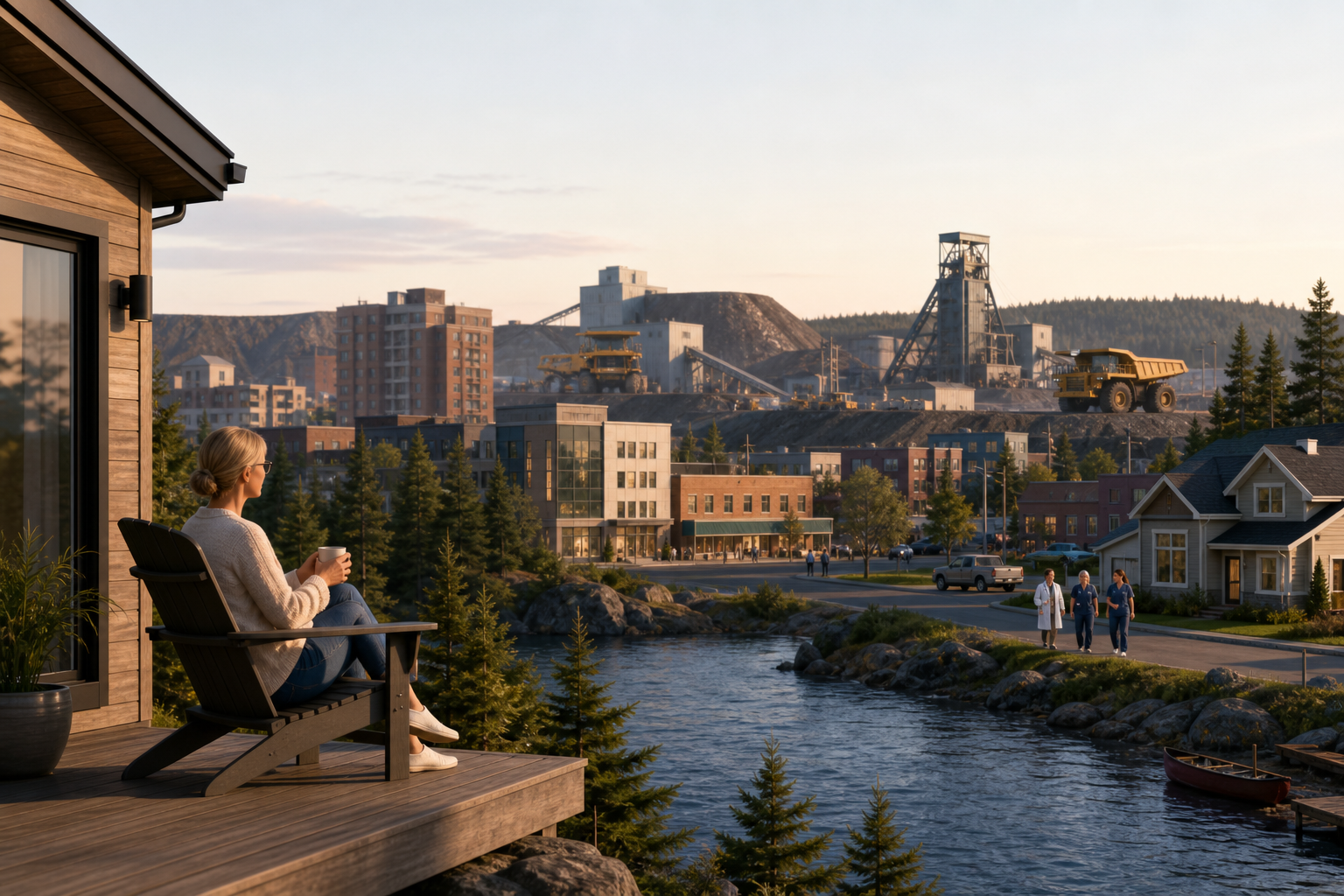

A 52-year-old architect in Etobicoke sold her three-bedroom semi last spring for $1.1 million and bought a waterfront house in Sault Ste. Marie for $380,000, mortgage-free. She's not retiring. She's still working, remotely, for the same Toronto firm. She just stopped paying $4,200 a month to service debt.
That story isn't an outlier anymore. It's the pattern that's quietly remaking housing demand across Northern Ontario while the GTA grinds through its third consecutive year of flat-to-negative price action. The surprise isn't that people are leaving expensive markets. The surprise is where the money is landing and why it's staying there.
The structural shift nobody planned for
The mining boom everyone expected in 2021 finally showed up in 2024, but it arrived with a different character than previous cycles. This isn't nickel for stainless steel. It's lithium, cobalt, and graphite for EV batteries, and the demand curve doesn't track commodity futures the way copper used to. It tracks the global vehicle fleet turning electric, which means the build-out has a 20-year horizon, not a five-year spike.
Ontario's Critical Minerals Strategy has funneled billions into mine development and processing infrastructure, particularly in the Ring of Fire region north of Thunder Bay. But mines take 10 to 15 years from discovery to operation, which means the current price pressure isn't from a temporary construction surge. It's from the early phase of a multi-decade industrial transformation that requires a permanent workforce in places that haven't had to house one at this scale since the 1970s.
Greater Sudbury added 2,400 direct mining and mining-services jobs between mid-2024 and early 2026. Timmins is building its first new subdivision in twelve years. Thunder Bay's rental vacancy rate dropped below 1.8 percent and hasn't recovered. These aren't boom-town dynamics. They're supply-demand imbalances in markets where housing starts stalled a generation ago and nobody built the buffer.
The math that makes Southern equity go further
The benchmark home price in Greater Sudbury sits around $420,000 as of mid-2026. That's 40 to 50 percent below the provincial average and roughly a third of what the same house costs in Mississauga. For someone carrying a $750,000 mortgage at 5.8 percent in the GTA, the monthly payment is over $4,800. Sell, move north, buy outright, and that household just freed $58,000 a year in after-tax cash flow.
The interest rate environment of the mid-2020s crushed affordability in markets where the average home costs seven figures, because the financing cost became unmanageable even for households with strong incomes. Northern Ontario, where prices still sit in the mid-six figures, has been far more resilient. The mortgage principal is smaller, so rate sensitivity matters less. A $300,000 mortgage at 5.8 percent is $1,900 a month. That's within range for a two-income household earning $110,000, which is below median in resource towns where skilled trades regularly pull $90,000 to $120,000.
The infrastructure lag is the risk
The counterargument isn't that the growth is fragile. It's that the municipalities can't absorb it. Timmins, Thunder Bay, and Sault Ste. Marie are all running on water, sewer, and road infrastructure built for populations that peaked decades ago. Rapid expansion means either significant property tax increases to fund upgrades or a decline in service quality that eventually makes these towns less attractive.
Sudbury has handled this better, partly because it diversified into mining technology and engineering services after the 2000s downturn, which gave it a tax base that isn't purely extraction-dependent. The smaller towns don't have that cushion. If commodity prices or project timelines shift and the labor demand softens before the housing supply catches up, the correction will be sharp.
But that's a future risk. Right now, the gap between what people can afford and what's available is wider in Timmins than in Toronto.
Read Next
GIC rates stall as bonds retreat: why deposit accounts still lag
Why Your Employer's Life Insurance Probably Covers Less Than You Think
August Sales Fell 6.9%: What CREA's Numbers Actually Reveal About Buyer Hesitation
Canada's Resource Advantage: What Global Investors Are Betting On in 2026