Why Finished Toronto Condos Are Landing in Receivership Before Anyone Moves In
The Manderley sits on Kingston Road in Scarborough's Birch Cliff neighborhood, finished, occupied by some residents, and locked in legal limbo. The eleven-storey building wasn't halted mid-construction or abandoned with bare rebar exposed to the sky. Construction wrapped. Units were built. And then the developer went insolvent anyway.
This is the new shape of failure in Toronto's condo market. The crisis has moved past the pre-construction phase, past the hole-in-the-ground receiverships that defined the early 2020s. Now it's hitting projects that made it all the way to the finish line but couldn't survive the last stretch: the period between substantial completion and final closing, when the developer still owns the building but can no longer afford to.
The Gap That Kills
Nova Ridge Development Partners, the firm behind The Manderley's 121 units, filed for receivership in Ontario Superior Court after senior lenders initiated action to recover outstanding debt. The building stands complete. What collapsed was the financing structure underneath it.
Here's the mechanics: a developer finances construction with a loan tied to milestones. When the building is substantially complete, that loan converts or gets refinanced into a different product while individual unit closings trickle in over months. During that window, the developer is paying interest on the construction loan, property taxes on a finished building, interim occupancy costs if residents have moved in early, and legal fees to manage the closing process. Revenue comes in unevenly as buyers close one by one. If the absorption rate is slow or if a handful of buyers walk away, the monthly burn becomes unsustainable.
Historically, developers bridged this gap with short-term loans. Lenders treated it as low-risk: the building is done, most buyers have already committed, closings are just paperwork. That stopped working in 2022. The Bank of Canada's rate hikes took the overnight rate from 0.25% to 5% in eighteen months. Bridge financing that might have cost 3% in 2020 was suddenly 8% or higher, if available at all. For a project like The Manderley, carrying costs that were manageable at 2% became a bleed at 7%.
The Zombie Building Problem
The Manderley is what the industry now calls a "zombie" development: physically alive, financially dead. The structure is safe. Units are habitable. Some residents have already moved in under interim occupancy agreements, paying what amounts to rent to a company that no longer exists as a going concern. They're now paying a court-appointed receiver, KSV Restructuring Inc., which has a legal duty to maximize asset value for the creditors, not to manage a functioning residential building.
This creates surreal outcomes. Buyers who signed agreements in 2020 or 2021, expecting to close in 2024, are now waiting for a receiver to either honor the purchase agreement or sell the unit to someone else at market value. Tarion warranty coverage, which protects buyers if a builder fails to complete deficiencies, becomes harder to enforce when the builder no longer exists and the receiver's mandate is liquidation, not customer service.
Why This Is the New Normal
The Manderley is not an outlier. Receivership filings in Ontario's real estate sector hit a multi-year high in 2024 and have continued into 2026. The pattern is consistent: projects conceived in the low-rate environment of 2019-2020, built through the supply-chain chaos of 2021-2022, and finished just as interest rates made the final mile financially impossible.
The systemic issue is that lenders have stopped treating "substantially complete" as low-risk. They've seen too many developers miss closing deadlines, too many buyers walk on deposits, too many buildings sit with 20% unsold inventory while carrying costs compound. The safety net is gone. Developers who would have limped across the finish line five years ago now hit receivership two months before the final closing was supposed to happen.
For Birch Cliff, that means a brand-new building sitting in court supervision while the neighborhood watches. Finished, but not done.


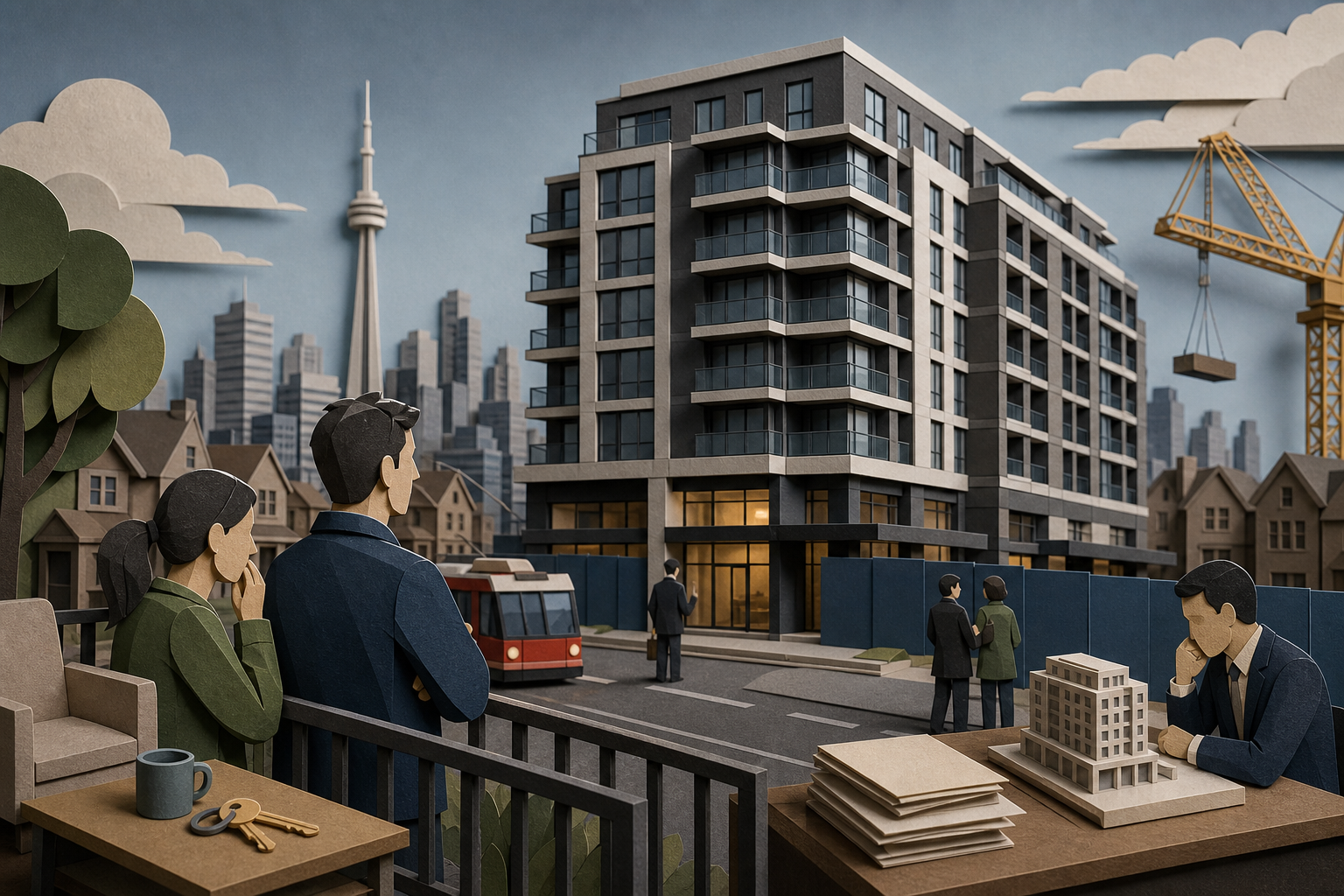

The Manderley sits on Kingston Road in Scarborough's Birch Cliff neighborhood, finished, occupied by some residents, and locked in legal limbo. The eleven-storey building wasn't halted mid-construction or abandoned with bare rebar exposed to the sky. Construction wrapped. Units were built. And then the developer went insolvent anyway.
This is the new shape of failure in Toronto's condo market. The crisis has moved past the pre-construction phase, past the hole-in-the-ground receiverships that defined the early 2020s. Now it's hitting projects that made it all the way to the finish line but couldn't survive the last stretch: the period between substantial completion and final closing, when the developer still owns the building but can no longer afford to.
The Gap That Kills
Nova Ridge Development Partners, the firm behind The Manderley's 121 units, filed for receivership in Ontario Superior Court after senior lenders initiated action to recover outstanding debt. The building stands complete. What collapsed was the financing structure underneath it.
Here's the mechanics: a developer finances construction with a loan tied to milestones. When the building is substantially complete, that loan converts or gets refinanced into a different product while individual unit closings trickle in over months. During that window, the developer is paying interest on the construction loan, property taxes on a finished building, interim occupancy costs if residents have moved in early, and legal fees to manage the closing process. Revenue comes in unevenly as buyers close one by one. If the absorption rate is slow or if a handful of buyers walk away, the monthly burn becomes unsustainable.
Historically, developers bridged this gap with short-term loans. Lenders treated it as low-risk: the building is done, most buyers have already committed, closings are just paperwork. That stopped working in 2022. The Bank of Canada's rate hikes took the overnight rate from 0.25% to 5% in eighteen months. Bridge financing that might have cost 3% in 2020 was suddenly 8% or higher, if available at all. For a project like The Manderley, carrying costs that were manageable at 2% became a bleed at 7%.
The Zombie Building Problem
The Manderley is what the industry now calls a "zombie" development: physically alive, financially dead. The structure is safe. Units are habitable. Some residents have already moved in under interim occupancy agreements, paying what amounts to rent to a company that no longer exists as a going concern. They're now paying a court-appointed receiver, KSV Restructuring Inc., which has a legal duty to maximize asset value for the creditors, not to manage a functioning residential building.
This creates surreal outcomes. Buyers who signed agreements in 2020 or 2021, expecting to close in 2024, are now waiting for a receiver to either honor the purchase agreement or sell the unit to someone else at market value. Tarion warranty coverage, which protects buyers if a builder fails to complete deficiencies, becomes harder to enforce when the builder no longer exists and the receiver's mandate is liquidation, not customer service.
Why This Is the New Normal
The Manderley is not an outlier. Receivership filings in Ontario's real estate sector hit a multi-year high in 2024 and have continued into 2026. The pattern is consistent: projects conceived in the low-rate environment of 2019-2020, built through the supply-chain chaos of 2021-2022, and finished just as interest rates made the final mile financially impossible.
The systemic issue is that lenders have stopped treating "substantially complete" as low-risk. They've seen too many developers miss closing deadlines, too many buyers walk on deposits, too many buildings sit with 20% unsold inventory while carrying costs compound. The safety net is gone. Developers who would have limped across the finish line five years ago now hit receivership two months before the final closing was supposed to happen.
For Birch Cliff, that means a brand-new building sitting in court supervision while the neighborhood watches. Finished, but not done.
Read Next
GIC rates stall as bonds retreat: why deposit accounts still lag
Why Your Employer's Life Insurance Probably Covers Less Than You Think
August Sales Fell 6.9%: What CREA's Numbers Actually Reveal About Buyer Hesitation
Canada's Resource Advantage: What Global Investors Are Betting On in 2026