Why Alberta Tradespeople Have 90 Days to Restructure Their Mortgage Before the Pipeline Bid Goes Federal
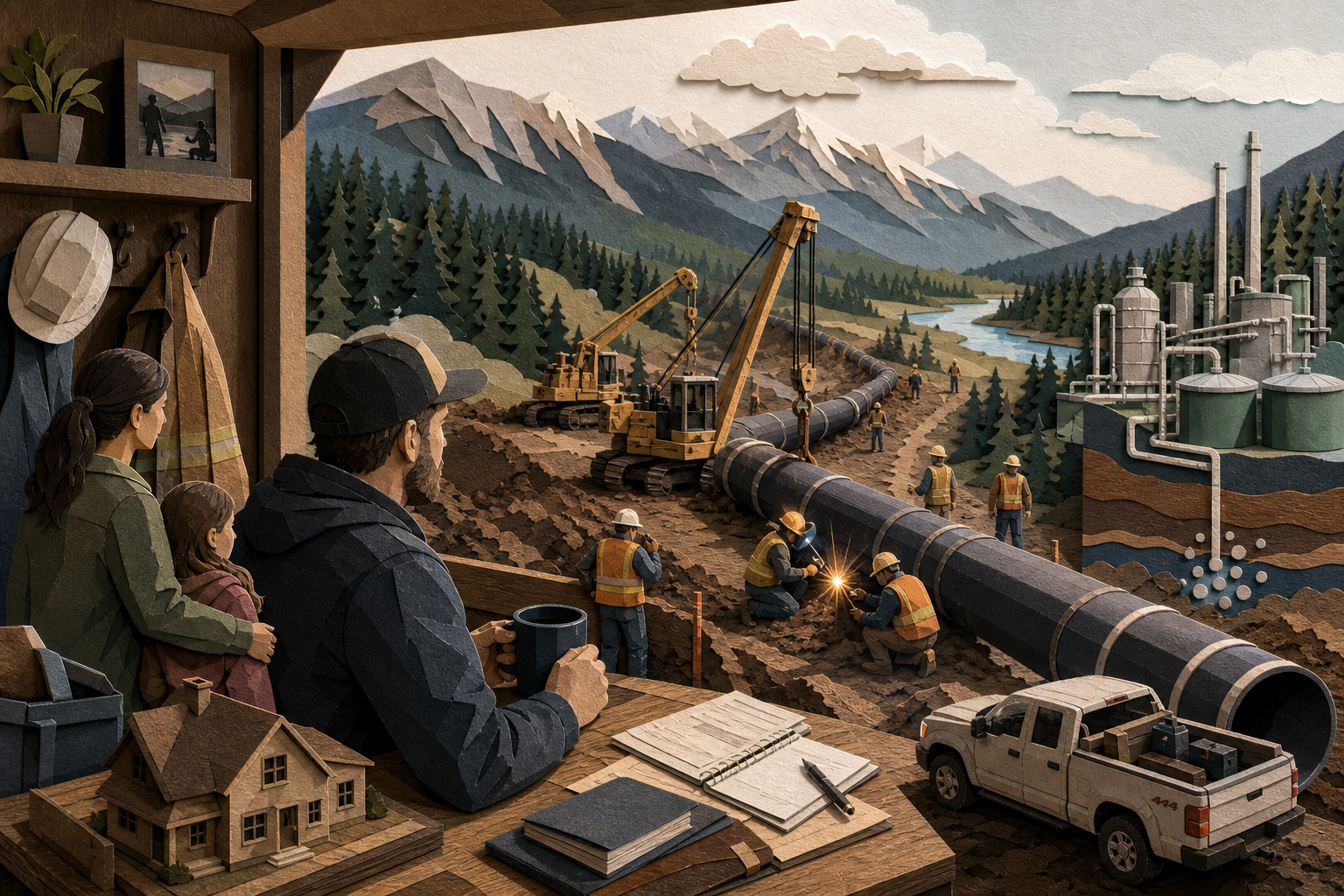
The announcement drops July 2. Premier Danielle Smith will submit Alberta's West Coast pipeline proposal to Ottawa, a 1 million barrel per day line tied to Pathways Plus carbon capture and a $130/tonne carbon price by 2040. For pipe fitters, welders, heavy equipment operators, and project supervisors across Alberta, this represents something most didn't think they'd see again: a decade-plus runway of stable, high-wage work with a defined endpoint.
That endpoint matters. If this project moves forward under the Canada-Alberta energy memorandum of understanding signed late last year, you're looking at construction phase-in starting 2028, peak build from 2030 to 2034, and commissioning work stretching into 2037. Add another three to five years of maintenance contracts, expansions, and tie-ins. A 47-year-old journeyman today could work this project to age 60 and retire with a pension twice what current assumptions allow.
But only if the financial structure changes now. Not after the federal approval. Not A welder in Grande Prairie just called his mortgage broker before his shift supervisor did. That's the wrong order.
The submission goes to Ottawa in 90 days. Between now and then, the project is still "probable" in the language lenders care about. After the federal Major Projects Office accepts the Northern Path proposal, it becomes "approved pending assessment," which changes your mortgage terms in ways that sound good but actually lock you into the wrong structure for the next decade.
Here's what most people will do wrong: refinance into a lower rate, stretch the amortization to 30 years, and treat the pipeline work like any other contract. That worked when oil projects were three-year bursts followed by EI. This one runs 2028 to 2037 minimum, with maintenance and tie-in work extending into the early 2040s. The math that made sense for Fort Mac in 2011 does not apply.
What Actually Changes After Federal Approval
Once the Major Projects Office accepts the submission, banks start pricing Alberta energy-sector mortgages differently. Not worse. Differently. They'll offer you longer terms at slightly better rates because they can model your income more confidently over 10 years instead of guessing at three-year oil price cycles.
Sounds good. It's not. A 30-year amortization at 4.8% on a $420,000 mortgage costs you $390,000 in interest over the full term. A 20-year at 5.1% costs you $280,000. The monthly payment gap is $340. If you're earning $110,000 now and the pipeline adds another $18,000 to $25,000 in annual wages during peak build years, you can afford the 20-year. But only if you lock that structure before the approval changes what the bank will offer you by default.
The Three Moves That Matter This Summer
1. Recast your mortgage to a 15- or 20-year amortization before the federal submission goes in. You want this done by late September. After the submission, lenders start pricing in the project's income stability, which paradoxically makes them more willing to extend your repayment timeline. That's good for their risk model. It's bad for your net worth at age 58.
Call your broker. Ask for a recast, not a refinance. A recast keeps your existing rate and term but recalculates your payment based on a shorter amortization. If your mortgage is under 3.5% and you locked it in 2020 or 2021, refinancing into today's 5% range is expensive. Recasting costs you $150 to $400 depending on the lender.
2. Max your RRSP before the first pipeline paycheque hits. The construction phase-in starts 2028. Peak earnings hit 2030 to 2034. If you're 42 today and earning $105,000, your RRSP contribution room is roughly $18,900 annually. Over the next four years, that's $75,600 you can shelter before the big cheques arrive. Once you're earning $130,000 during peak build, you'll want that room to absorb the top-bracket income. Front-loading now, while you're still in a lower bracket, is backwards. Counterintuitive, but true.
Instead: contribute enough to stay in your current bracket, then ramp contributions in 2029 and 2030 when the marginal benefit is highest. The mistake is blowing your contribution room in 2026 and 2027 when your taxable income is $105,000, then having no room left when it's $135,000.
3. If you're incorporated, dividend yourself in 2026 and 2027, not 2030. Personal Real Estate Corporations and contractor corps should be pulling income forward, not deferring it. The carbon price schedule hits $130/tonne by 2040, but it ramps hardest between 2028 and 2035. Corporate tax rates aren't changing, but the political price of high income in the energy sector will. Get paid before the backlash.
The Thing Nobody Is Saying
The pipeline's viability is tied to the same carbon price most Alberta workers opposed in 2019. The $130/tonne target is what makes the project politically defensible in Ottawa and financially viable under the Pathways Plus framework. The tradeoff is real: you get 15 years of high-wage work because the province agreed to carbon sequestration targets that survive future federal elections.
That's the insurance. It also means this project is more durable than anything since the original oil sands build-out. A 47-year-old journeyman pipefitter can work this to age 60 and retire with a defined-benefit pension funded by contributions nobody thought would happen. But only if the mortgage is structured to let you put an extra $1,200 a month toward principal during the peak years, and only if the RRSP room is there when the income spikes.
Run the mortgage recast this summer. The federal submission is July 2. The approval timeline is 18 to 24 months, but your loan structure will be harder to change once the project moves from "proposed" to "accepted." Get it done while it's still speculative in the paperwork.



The announcement drops July 2. Premier Danielle Smith will submit Alberta's West Coast pipeline proposal to Ottawa, a 1 million barrel per day line tied to Pathways Plus carbon capture and a $130/tonne carbon price by 2040. For pipe fitters, welders, heavy equipment operators, and project supervisors across Alberta, this represents something most didn't think they'd see again: a decade-plus runway of stable, high-wage work with a defined endpoint.
That endpoint matters. If this project moves forward under the Canada-Alberta energy memorandum of understanding signed late last year, you're looking at construction phase-in starting 2028, peak build from 2030 to 2034, and commissioning work stretching into 2037. Add another three to five years of maintenance contracts, expansions, and tie-ins. A 47-year-old journeyman today could work this project to age 60 and retire with a pension twice what current assumptions allow.
But only if the financial structure changes now. Not after the federal approval. Not A welder in Grande Prairie just called his mortgage broker before his shift supervisor did. That's the wrong order.
The submission goes to Ottawa in 90 days. Between now and then, the project is still "probable" in the language lenders care about. After the federal Major Projects Office accepts the Northern Path proposal, it becomes "approved pending assessment," which changes your mortgage terms in ways that sound good but actually lock you into the wrong structure for the next decade.
Here's what most people will do wrong: refinance into a lower rate, stretch the amortization to 30 years, and treat the pipeline work like any other contract. That worked when oil projects were three-year bursts followed by EI. This one runs 2028 to 2037 minimum, with maintenance and tie-in work extending into the early 2040s. The math that made sense for Fort Mac in 2011 does not apply.
What Actually Changes After Federal Approval
Once the Major Projects Office accepts the submission, banks start pricing Alberta energy-sector mortgages differently. Not worse. Differently. They'll offer you longer terms at slightly better rates because they can model your income more confidently over 10 years instead of guessing at three-year oil price cycles.
Sounds good. It's not. A 30-year amortization at 4.8% on a $420,000 mortgage costs you $390,000 in interest over the full term. A 20-year at 5.1% costs you $280,000. The monthly payment gap is $340. If you're earning $110,000 now and the pipeline adds another $18,000 to $25,000 in annual wages during peak build years, you can afford the 20-year. But only if you lock that structure before the approval changes what the bank will offer you by default.
The Three Moves That Matter This Summer
1. Recast your mortgage to a 15- or 20-year amortization before the federal submission goes in. You want this done by late September. After the submission, lenders start pricing in the project's income stability, which paradoxically makes them more willing to extend your repayment timeline. That's good for their risk model. It's bad for your net worth at age 58.
Call your broker. Ask for a recast, not a refinance. A recast keeps your existing rate and term but recalculates your payment based on a shorter amortization. If your mortgage is under 3.5% and you locked it in 2020 or 2021, refinancing into today's 5% range is expensive. Recasting costs you $150 to $400 depending on the lender.
2. Max your RRSP before the first pipeline paycheque hits. The construction phase-in starts 2028. Peak earnings hit 2030 to 2034. If you're 42 today and earning $105,000, your RRSP contribution room is roughly $18,900 annually. Over the next four years, that's $75,600 you can shelter before the big cheques arrive. Once you're earning $130,000 during peak build, you'll want that room to absorb the top-bracket income. Front-loading now, while you're still in a lower bracket, is backwards. Counterintuitive, but true.
Instead: contribute enough to stay in your current bracket, then ramp contributions in 2029 and 2030 when the marginal benefit is highest. The mistake is blowing your contribution room in 2026 and 2027 when your taxable income is $105,000, then having no room left when it's $135,000.
3. If you're incorporated, dividend yourself in 2026 and 2027, not 2030. Personal Real Estate Corporations and contractor corps should be pulling income forward, not deferring it. The carbon price schedule hits $130/tonne by 2040, but it ramps hardest between 2028 and 2035. Corporate tax rates aren't changing, but the political price of high income in the energy sector will. Get paid before the backlash.
The Thing Nobody Is Saying
The pipeline's viability is tied to the same carbon price most Alberta workers opposed in 2019. The $130/tonne target is what makes the project politically defensible in Ottawa and financially viable under the Pathways Plus framework. The tradeoff is real: you get 15 years of high-wage work because the province agreed to carbon sequestration targets that survive future federal elections.
That's the insurance. It also means this project is more durable than anything since the original oil sands build-out. A 47-year-old journeyman pipefitter can work this to age 60 and retire with a defined-benefit pension funded by contributions nobody thought would happen. But only if the mortgage is structured to let you put an extra $1,200 a month toward principal during the peak years, and only if the RRSP room is there when the income spikes.
Run the mortgage recast this summer. The federal submission is July 2. The approval timeline is 18 to 24 months, but your loan structure will be harder to change once the project moves from "proposed" to "accepted." Get it done while it's still speculative in the paperwork.
Read Next
GIC rates stall as bonds retreat: why deposit accounts still lag
Why Your Employer's Life Insurance Probably Covers Less Than You Think
August Sales Fell 6.9%: What CREA's Numbers Actually Reveal About Buyer Hesitation
Canada's Resource Advantage: What Global Investors Are Betting On in 2026