UHN Says Canada's Life Sciences Funding Gap Threatens Economic Sovereignty During U.S. Trade War
A 50% tariff on Canadian goods crossing into the U.S. means roughly C$1.8 billion in daily trade friction. University Health Network released a blueprint last month arguing that the fastest route out from under that pressure isn't negotiation, it's building domestic capacity in the one sector where Canada still holds intellectual property it hasn't sold off yet.
The proposal targets life sciences: drugs, devices, diagnostics. UHN's argument is structural. Canada funds the early research through grants and tax credits. American venture capital funds the clinical trials. American pharmaceutical companies buy the patents. Canada then imports the finished product at retail markup, often paying more for drugs invented in Toronto than Boston pays.
The cycle has been visible for years. What's new is the explicit claim that fixing it is a sovereignty issue.
Why the Series B gap matters
Canadian biotech firms routinely clear proof-of-concept and early animal trials on federal grants and SR&ED credits. The funding gap opens at Series B, when a company needs $7 million to $20 million to run Phase II human trials. Domestic venture capital in Canada tends to exit or stall at that stage. U.S. funds step in, take majority equity, and within eighteen months the intellectual property is domiciled in Delaware.
UHN's blueprint calls this the "commercialization chasm." The term has been around since the early 2010s. The difference now is that the federal government, facing a 50% tariff wall and a multi-billion-dollar retaliatory trade fight, is treating industrial policy as a near-term necessity rather than a long-term ambition.
The proposal is a dual-track model: federal first-loss capital to de-risk private investment, plus streamlined Health Canada pathways to cut the twelve-to-eighteen-month lag between FDA approval and Canadian market entry. The first piece is designed to pull in pension funds. The second is designed to retain the firms long enough that they don't need to move south for faster regulatory clearance.
Toronto's Discovery District and the Boston problem
The Discovery District, hospitals, universities, and labs clustered in a six-block radius downtown, already functions as an incubator. UHN's own spinouts have included companies working on CAR-T therapies, AI-based imaging diagnostics, and point-of-care sensors for sepsis. Most are no longer Canadian-owned.
The comparison UHN makes is to Boston's Kendall Square and San Francisco's Mission Bay. Those clusters didn't grow by accident. They grew because late-stage capital stayed local, because regulatory bodies moved fast, and because the domestic market was large enough that companies didn't need to internationalize just to reach revenue.
Canada has the first piece. It does not have the second or third, and UHN's position is that without government intervention to create both, the Discovery District will keep producing intellectual property for foreign buyers.
The fiscal constraint and the trade retaliation risk
The counterargument is fiscal. Canada's debt-to-GDP ratio stands at approximately 114% as of mid-2026, inflation pressures remain, and committing billions to subsidize private biotech companies is a harder sell than roads, bridges, or housing.
The second risk is trade retaliation. Aggressive domestic subsidies under the current or successor USMCA framework could be flagged as protectionism, inviting further U.S. tariffs. UHN's response is that the alternative, continued reliance on imported pharmaceuticals and foreign-owned supply chains, costs more in the long run, especially when those supply chains are subject to export controls during the next pandemic or trade spasm.
The blueprint doesn't answer whether Canada can outspend the U.S. venture capital market. It argues the country doesn't need to. It just needs to stop losing the companies it already incubated. That's a lower bar, but it still requires capital most Canadian institutions have been unwilling to deploy at the risk level required. The trade war is being used as the forcing function.


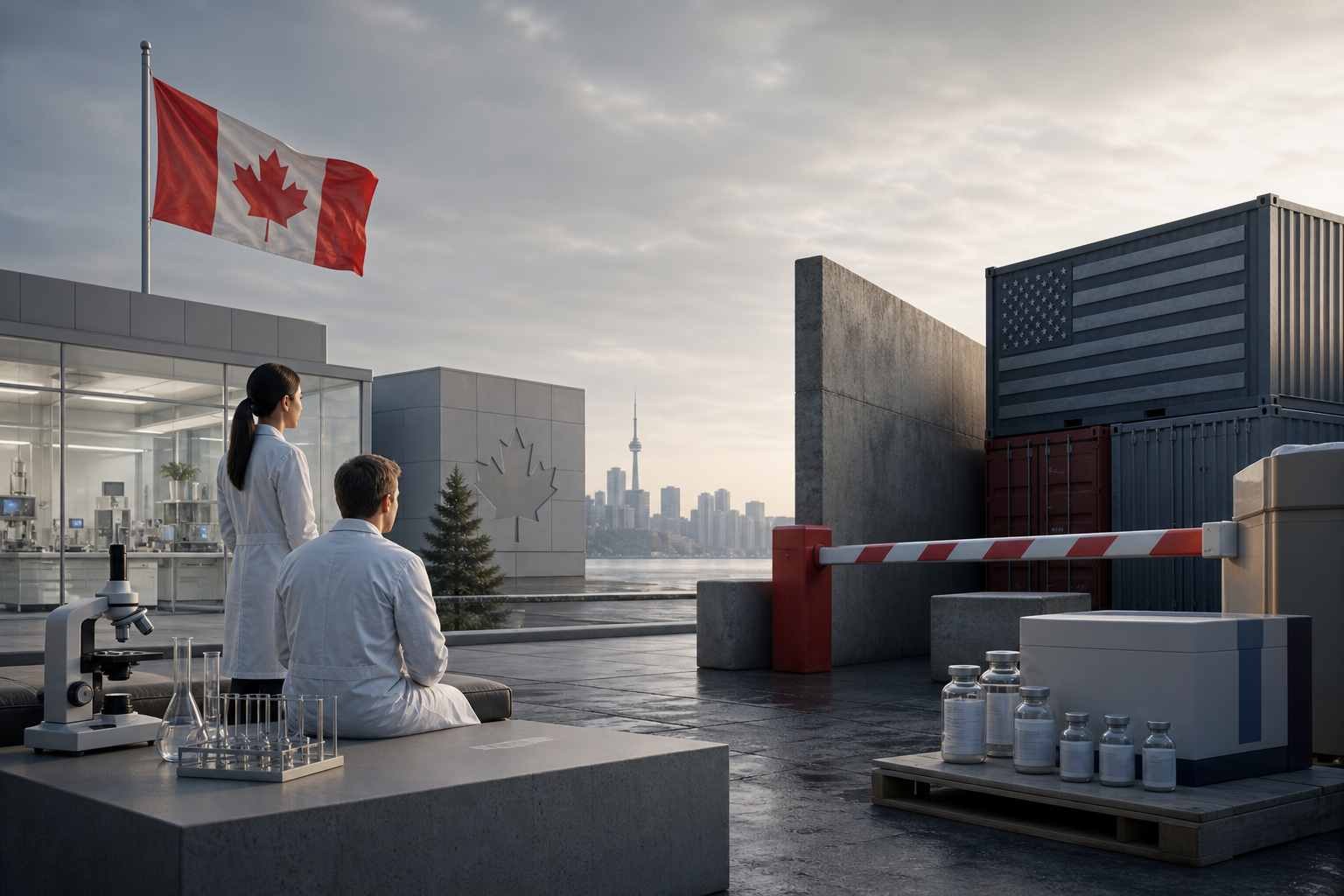

A 50% tariff on Canadian goods crossing into the U.S. means roughly C$1.8 billion in daily trade friction. University Health Network released a blueprint last month arguing that the fastest route out from under that pressure isn't negotiation, it's building domestic capacity in the one sector where Canada still holds intellectual property it hasn't sold off yet.
The proposal targets life sciences: drugs, devices, diagnostics. UHN's argument is structural. Canada funds the early research through grants and tax credits. American venture capital funds the clinical trials. American pharmaceutical companies buy the patents. Canada then imports the finished product at retail markup, often paying more for drugs invented in Toronto than Boston pays.
The cycle has been visible for years. What's new is the explicit claim that fixing it is a sovereignty issue.
Why the Series B gap matters
Canadian biotech firms routinely clear proof-of-concept and early animal trials on federal grants and SR&ED credits. The funding gap opens at Series B, when a company needs $7 million to $20 million to run Phase II human trials. Domestic venture capital in Canada tends to exit or stall at that stage. U.S. funds step in, take majority equity, and within eighteen months the intellectual property is domiciled in Delaware.
UHN's blueprint calls this the "commercialization chasm." The term has been around since the early 2010s. The difference now is that the federal government, facing a 50% tariff wall and a multi-billion-dollar retaliatory trade fight, is treating industrial policy as a near-term necessity rather than a long-term ambition.
The proposal is a dual-track model: federal first-loss capital to de-risk private investment, plus streamlined Health Canada pathways to cut the twelve-to-eighteen-month lag between FDA approval and Canadian market entry. The first piece is designed to pull in pension funds. The second is designed to retain the firms long enough that they don't need to move south for faster regulatory clearance.
Toronto's Discovery District and the Boston problem
The Discovery District, hospitals, universities, and labs clustered in a six-block radius downtown, already functions as an incubator. UHN's own spinouts have included companies working on CAR-T therapies, AI-based imaging diagnostics, and point-of-care sensors for sepsis. Most are no longer Canadian-owned.
The comparison UHN makes is to Boston's Kendall Square and San Francisco's Mission Bay. Those clusters didn't grow by accident. They grew because late-stage capital stayed local, because regulatory bodies moved fast, and because the domestic market was large enough that companies didn't need to internationalize just to reach revenue.
Canada has the first piece. It does not have the second or third, and UHN's position is that without government intervention to create both, the Discovery District will keep producing intellectual property for foreign buyers.
The fiscal constraint and the trade retaliation risk
The counterargument is fiscal. Canada's debt-to-GDP ratio stands at approximately 114% as of mid-2026, inflation pressures remain, and committing billions to subsidize private biotech companies is a harder sell than roads, bridges, or housing.
The second risk is trade retaliation. Aggressive domestic subsidies under the current or successor USMCA framework could be flagged as protectionism, inviting further U.S. tariffs. UHN's response is that the alternative, continued reliance on imported pharmaceuticals and foreign-owned supply chains, costs more in the long run, especially when those supply chains are subject to export controls during the next pandemic or trade spasm.
The blueprint doesn't answer whether Canada can outspend the U.S. venture capital market. It argues the country doesn't need to. It just needs to stop losing the companies it already incubated. That's a lower bar, but it still requires capital most Canadian institutions have been unwilling to deploy at the risk level required. The trade war is being used as the forcing function.
Sources
Read Next
Birch Hill builds a regional aviation network in British Columbia through Harbour Air's Pacific Coastal acquisition
South Korea's Stock Market Has Become a National Liability
Tech CEOs Walk the Investor Tightrope: Signal AI Risk Without Cutting Off Billions in Funding
Canada Child Benefit Payments Arrive Early This September, Here's What Changed in July