Trump's Forced Labour Tariffs Hit Canada Despite Minimal Uyghur Supply Chain Exposure
A new trade barrier drops this week with Canada squarely in the crosshairs, despite evidence showing the country's negligible exposure to Xinjiang cotton and polysilicon, the two materials at the heart of Uyghur forced labor concerns. Friday marks the formal expiration of a 10 per cent global duty, replaced now by levies explicitly framed as punishment for nations failing to police forced labor in their supply chains. The stated justification is human rights. The structural effect is protectionism wearing a moral badge.
The Mismatch Between Policy and Footprint
Canada imported roughly $8 million in cotton and cotton products from China in 2024, according to Statistics Canada, a rounding error in a bilateral trade relationship worth over $900 billion. Polysilicon, the other major Xinjiang export tied to forced labor allegations, flows primarily into solar panel production. Canada's solar supply chain pulls predominantly from Southeast Asian assemblers, not directly from Chinese raw material suppliers. Where forced labor risk does exist in Canadian imports, electronics, apparel, certain agricultural goods, the nexus isn't Xinjiang. It's dispersed across multiple jurisdictions where enforcement gaps are real but unrelated to Uyghur labor camps.
The tariff regime doesn't differentiate. It applies at the national level, hitting compliant companies alongside violators because the lever is jurisdiction, not supply chain forensics. A Toronto-based automaker sourcing zero inputs from Xinjiang pays the same penalty as a firm with direct exposure. The policy punishes the country, not the conduct.
Legislative Asymmetry as a Trade Weapon
What the U.S. is demanding, in practical terms, is that Canada replicate the enforcement architecture of the Uyghur Forced Labor Prevention Act: a "rebuttable presumption" model where goods from Xinjiang are seized by default unless the importer can prove clean origin. Canada's Bill S-211, effective since 2024, mandates disclosure. Over 2,000 entities now file annual reports detailing supply chain risks. But disclosure isn't seizure. Reporting isn't interdiction.
That gap is the justification Washington is using to bypass CUSMA. Under the trade agreement, Canada is shielded from unilateral tariffs except where national security or enforcement exceptions apply. The Trump administration has categorized forced labor duties as enforcement actions, not protectionism, a classification that nullifies treaty protections while placing the burden on Canada to prove it's doing enough. Enough, in this case, means matching U.S. law on U.S. terms.
The 2026 CUSMA review adds pressure. These tariffs aren't permanent policy so much as bargaining chips stacked in advance of renegotiation. Canada enters those talks now defending its regulatory framework under the threat of escalating duties, a stance that forces concessions before the first session convenes.
The Inflationary Trade-Off
Retaliation would be politically satisfying and economically messy. Countervailing duties on U.S. goods, steel, agriculture, consumer electronics, would spike costs for Canadian buyers at a moment when the Bank of Canada is trying to stabilize inflation in the low twos. The math on tariffs is brutal both ways. If Canada retaliates, it imports inflation. If it doesn't, it accepts the trade imbalance and waits for the damage to compound.
The auto sector illustrates the vulnerability. Components cross the border six or seven times during assembly under just-in-time manufacturing schedules. A tariff applied at each crossing doesn't just raise costs, it destabilizes timing, inventory planning, and the logistical choreography that keeps plants running. For sectors where margins are already thin, the tariff becomes the thing that flips viability.
Where the Justification Breaks
The forced labor framing makes opposition difficult. No Canadian official will publicly argue against cracking down on human rights abuses. But the policy isn't designed to stop forced labor, it's designed to create leverage. Proof: the tariff applies to countries, not companies. It penalizes compliance and non-compliance identically. It offers no off-ramp for firms that can demonstrate clean sourcing because the target isn't supply chain integrity. The target is the negotiating table.
Canada's actual Uyghur exposure is minimal. The tariff lands anyway. That gap is the tells you everything about intent.


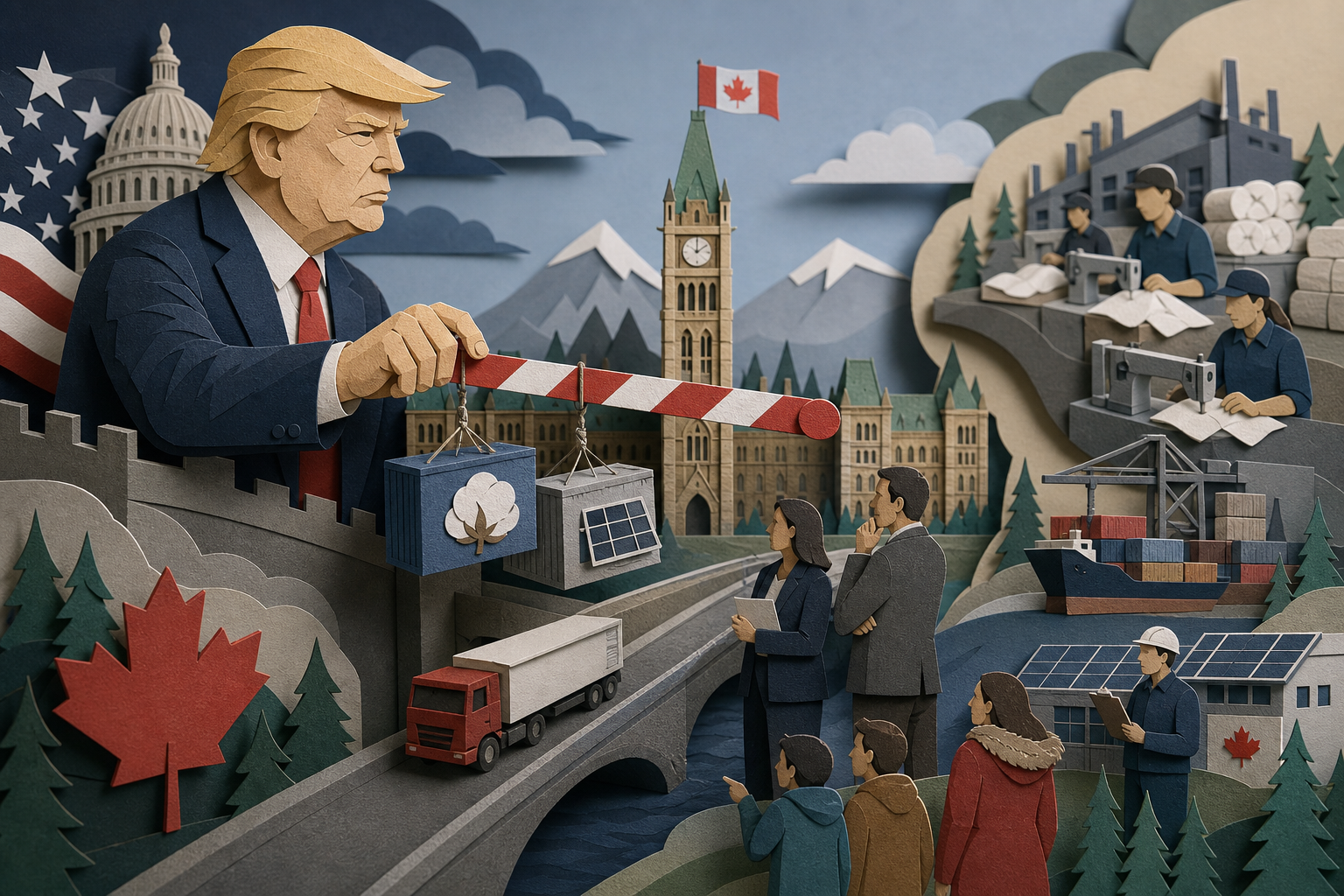

A new trade barrier drops this week with Canada squarely in the crosshairs, despite evidence showing the country's negligible exposure to Xinjiang cotton and polysilicon, the two materials at the heart of Uyghur forced labor concerns. Friday marks the formal expiration of a 10 per cent global duty, replaced now by levies explicitly framed as punishment for nations failing to police forced labor in their supply chains. The stated justification is human rights. The structural effect is protectionism wearing a moral badge.
The Mismatch Between Policy and Footprint
Canada imported roughly $8 million in cotton and cotton products from China in 2024, according to Statistics Canada, a rounding error in a bilateral trade relationship worth over $900 billion. Polysilicon, the other major Xinjiang export tied to forced labor allegations, flows primarily into solar panel production. Canada's solar supply chain pulls predominantly from Southeast Asian assemblers, not directly from Chinese raw material suppliers. Where forced labor risk does exist in Canadian imports, electronics, apparel, certain agricultural goods, the nexus isn't Xinjiang. It's dispersed across multiple jurisdictions where enforcement gaps are real but unrelated to Uyghur labor camps.
The tariff regime doesn't differentiate. It applies at the national level, hitting compliant companies alongside violators because the lever is jurisdiction, not supply chain forensics. A Toronto-based automaker sourcing zero inputs from Xinjiang pays the same penalty as a firm with direct exposure. The policy punishes the country, not the conduct.
Legislative Asymmetry as a Trade Weapon
What the U.S. is demanding, in practical terms, is that Canada replicate the enforcement architecture of the Uyghur Forced Labor Prevention Act: a "rebuttable presumption" model where goods from Xinjiang are seized by default unless the importer can prove clean origin. Canada's Bill S-211, effective since 2024, mandates disclosure. Over 2,000 entities now file annual reports detailing supply chain risks. But disclosure isn't seizure. Reporting isn't interdiction.
That gap is the justification Washington is using to bypass CUSMA. Under the trade agreement, Canada is shielded from unilateral tariffs except where national security or enforcement exceptions apply. The Trump administration has categorized forced labor duties as enforcement actions, not protectionism, a classification that nullifies treaty protections while placing the burden on Canada to prove it's doing enough. Enough, in this case, means matching U.S. law on U.S. terms.
The 2026 CUSMA review adds pressure. These tariffs aren't permanent policy so much as bargaining chips stacked in advance of renegotiation. Canada enters those talks now defending its regulatory framework under the threat of escalating duties, a stance that forces concessions before the first session convenes.
The Inflationary Trade-Off
Retaliation would be politically satisfying and economically messy. Countervailing duties on U.S. goods, steel, agriculture, consumer electronics, would spike costs for Canadian buyers at a moment when the Bank of Canada is trying to stabilize inflation in the low twos. The math on tariffs is brutal both ways. If Canada retaliates, it imports inflation. If it doesn't, it accepts the trade imbalance and waits for the damage to compound.
The auto sector illustrates the vulnerability. Components cross the border six or seven times during assembly under just-in-time manufacturing schedules. A tariff applied at each crossing doesn't just raise costs, it destabilizes timing, inventory planning, and the logistical choreography that keeps plants running. For sectors where margins are already thin, the tariff becomes the thing that flips viability.
Where the Justification Breaks
The forced labor framing makes opposition difficult. No Canadian official will publicly argue against cracking down on human rights abuses. But the policy isn't designed to stop forced labor, it's designed to create leverage. Proof: the tariff applies to countries, not companies. It penalizes compliance and non-compliance identically. It offers no off-ramp for firms that can demonstrate clean sourcing because the target isn't supply chain integrity. The target is the negotiating table.
Canada's actual Uyghur exposure is minimal. The tariff lands anyway. That gap is the tells you everything about intent.
Read Next
GIC rates stall as bonds retreat: why deposit accounts still lag
Why Your Employer's Life Insurance Probably Covers Less Than You Think
August Sales Fell 6.9%: What CREA's Numbers Actually Reveal About Buyer Hesitation
Canada's Resource Advantage: What Global Investors Are Betting On in 2026