Trump's 50% Tariff Isn't a Negotiation, It's a Demolition
The average American refinery in the Gulf Coast processes roughly 60% Canadian heavy crude. That percentage doesn't exist because refiners are being nice to Canada. It exists because those facilities were purpose-built to crack heavy sour crude, and the U.S. doesn't produce enough of it domestically. A 50% tariff on Canadian oil means those refineries either eat a cost spike that shows up at every pump from Houston to Miami, or they idle capacity and wait for someone in Washington to admit the arithmetic doesn't work.
That's the tell. This isn't a negotiation. Negotiations have offramps. They're designed to extract concessions without breaking the thing you're negotiating over. A 50% blanket tariff on $500 billion in annual exports breaks the thing. It kills integrated supply chains in automotive and aerospace, where components cross the border four or five times before a finished product rolls off the line. It turns Ontario's just-in-time manufacturing model into a just-in-case model, which is another way of saying it turns it off.
The legal mechanism is the giveaway
The tariff bypasses the USMCA entirely. Section 232 or Section 301, both executive tools originally written to address genuine national security threats or unfair trade practices, become the cover. But Canada isn't dumping state-subsidized steel or hiding intellectual property theft. The 50% rate is punitive without predicate. It's the kind of number you use when you want the other side to capitulate on something unrelated to trade entirely: border security spending, dairy market restructuring, NATO contribution pledges.
The structure clarifies the strategy. Tariffs are legally a tax paid by U.S. importers, not the Canadian government. Every American company buying Canadian lumber, aluminum, auto parts, or electricity will immediately face a 50% cost increase. Some will try to pass it to consumers. Most can't, because their competitors haven't all been hit the same way, or because demand is elastic enough that a price hike just kills volume. Either way, the cost shows up domestically before it shows up in Ottawa.
Retaliation doesn't balance the scale
Canada's most likely response is dollar-for-dollar retaliatory tariffs, the same playbook used in 2018 during the steel-and-aluminum fight. Fine. But Canada's import market is one-tenth the size of the U.S. market. A matching tariff on American goods hurts specific sectors, bourbon, orange juice, certain agricultural products, but it doesn't create the same systemic pressure. The asymmetry is the point. The U.S. can tolerate more economic pain than Canada can, so the retaliation becomes performative rather than deterrent.
The currency adjustment complicates everything. If the Canadian dollar drops 8 to 10% in response to tanking export competitiveness, which is what currency markets are already pricing in, then Canadian goods become cheaper to buy in USD terms, partially offsetting the tariff for American importers. That doesn't help the Canadian economy. It just means the destruction gets distributed differently: exporters see margin compression instead of volume collapse, and Canadian consumers pay more for imports because their currency is worth less.
The energy contradiction
If the tariff applies to crude oil, which hasn't been exempted in the announcement, then refiners in Texas and Louisiana face a binary choice: pay the tariff and pass the cost to drivers, or shut down units that can't run profitably on domestic light sweet crude. U.S. gasoline prices would spike within weeks. That creates an immediate domestic constituency against the policy, which is why energy exemptions usually appear quickly in these scenarios. But if exemptions start rolling out, energy today, auto parts tomorrow, aluminum the day after, then the "50%" becomes theatre, and the real negotiation is about who gets carved out and what they have to give up for it.
The USMCA review is scheduled for 2026. This tariff lands nine months ahead of that. So the target isn't trade rebalancing. The target is the review itself. Force Canada to agree to terms Washington wants before the formal process even starts, or walk into 2026 with the trade relationship already fractured and no agreement to extend. That's demolition with a cover story.


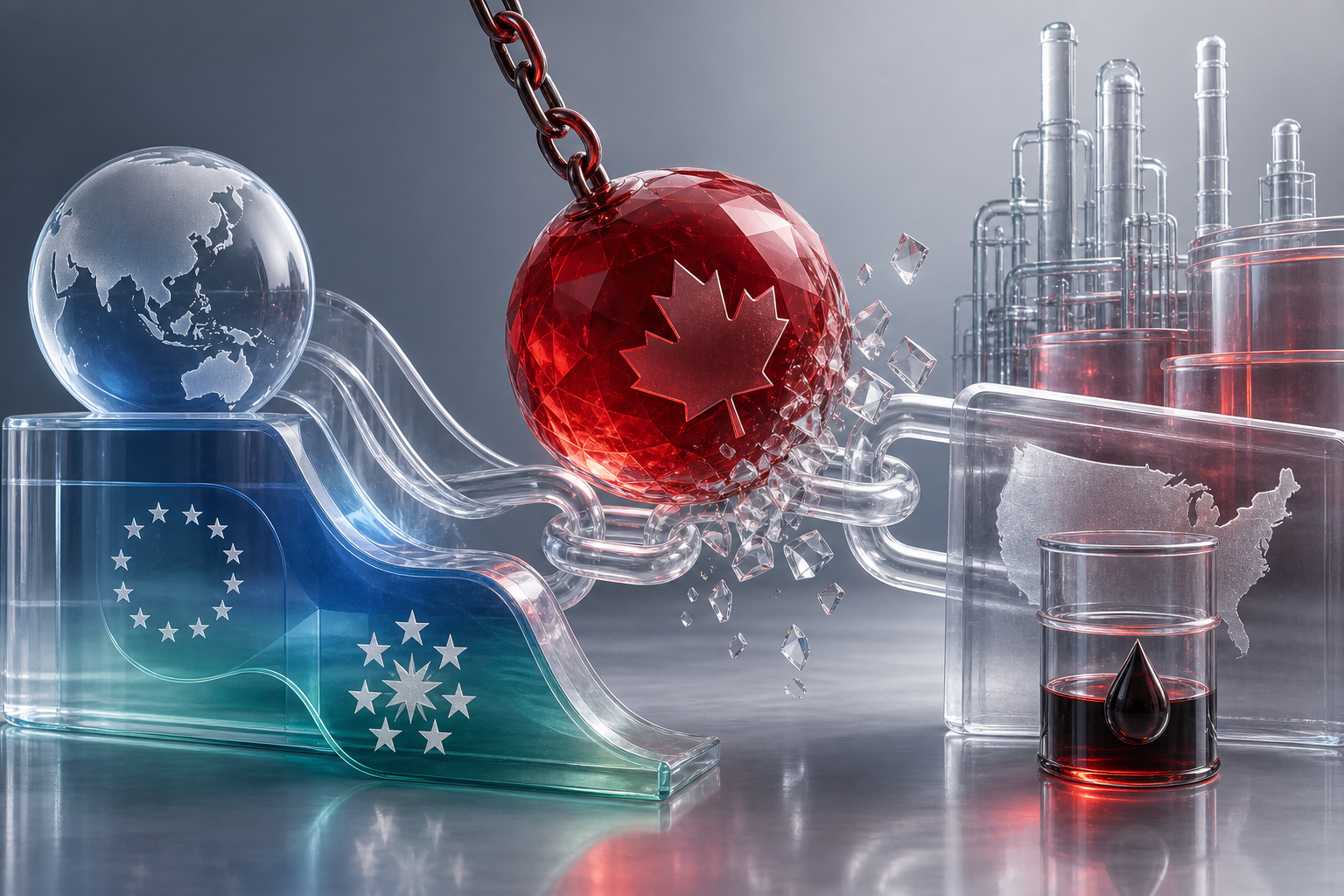

The average American refinery in the Gulf Coast processes roughly 60% Canadian heavy crude. That percentage doesn't exist because refiners are being nice to Canada. It exists because those facilities were purpose-built to crack heavy sour crude, and the U.S. doesn't produce enough of it domestically. A 50% tariff on Canadian oil means those refineries either eat a cost spike that shows up at every pump from Houston to Miami, or they idle capacity and wait for someone in Washington to admit the arithmetic doesn't work.
That's the tell. This isn't a negotiation. Negotiations have offramps. They're designed to extract concessions without breaking the thing you're negotiating over. A 50% blanket tariff on $500 billion in annual exports breaks the thing. It kills integrated supply chains in automotive and aerospace, where components cross the border four or five times before a finished product rolls off the line. It turns Ontario's just-in-time manufacturing model into a just-in-case model, which is another way of saying it turns it off.
The legal mechanism is the giveaway
The tariff bypasses the USMCA entirely. Section 232 or Section 301, both executive tools originally written to address genuine national security threats or unfair trade practices, become the cover. But Canada isn't dumping state-subsidized steel or hiding intellectual property theft. The 50% rate is punitive without predicate. It's the kind of number you use when you want the other side to capitulate on something unrelated to trade entirely: border security spending, dairy market restructuring, NATO contribution pledges.
The structure clarifies the strategy. Tariffs are legally a tax paid by U.S. importers, not the Canadian government. Every American company buying Canadian lumber, aluminum, auto parts, or electricity will immediately face a 50% cost increase. Some will try to pass it to consumers. Most can't, because their competitors haven't all been hit the same way, or because demand is elastic enough that a price hike just kills volume. Either way, the cost shows up domestically before it shows up in Ottawa.
Retaliation doesn't balance the scale
Canada's most likely response is dollar-for-dollar retaliatory tariffs, the same playbook used in 2018 during the steel-and-aluminum fight. Fine. But Canada's import market is one-tenth the size of the U.S. market. A matching tariff on American goods hurts specific sectors, bourbon, orange juice, certain agricultural products, but it doesn't create the same systemic pressure. The asymmetry is the point. The U.S. can tolerate more economic pain than Canada can, so the retaliation becomes performative rather than deterrent.
The currency adjustment complicates everything. If the Canadian dollar drops 8 to 10% in response to tanking export competitiveness, which is what currency markets are already pricing in, then Canadian goods become cheaper to buy in USD terms, partially offsetting the tariff for American importers. That doesn't help the Canadian economy. It just means the destruction gets distributed differently: exporters see margin compression instead of volume collapse, and Canadian consumers pay more for imports because their currency is worth less.
The energy contradiction
If the tariff applies to crude oil, which hasn't been exempted in the announcement, then refiners in Texas and Louisiana face a binary choice: pay the tariff and pass the cost to drivers, or shut down units that can't run profitably on domestic light sweet crude. U.S. gasoline prices would spike within weeks. That creates an immediate domestic constituency against the policy, which is why energy exemptions usually appear quickly in these scenarios. But if exemptions start rolling out, energy today, auto parts tomorrow, aluminum the day after, then the "50%" becomes theatre, and the real negotiation is about who gets carved out and what they have to give up for it.
The USMCA review is scheduled for 2026. This tariff lands nine months ahead of that. So the target isn't trade rebalancing. The target is the review itself. Force Canada to agree to terms Washington wants before the formal process even starts, or walk into 2026 with the trade relationship already fractured and no agreement to extend. That's demolition with a cover story.
Read Next
GIC rates stall as bonds retreat: why deposit accounts still lag
Why Your Employer's Life Insurance Probably Covers Less Than You Think
August Sales Fell 6.9%: What CREA's Numbers Actually Reveal About Buyer Hesitation
Canada's Resource Advantage: What Global Investors Are Betting On in 2026