Trump visits Michigan as tariffs strain cross-border projects and trade
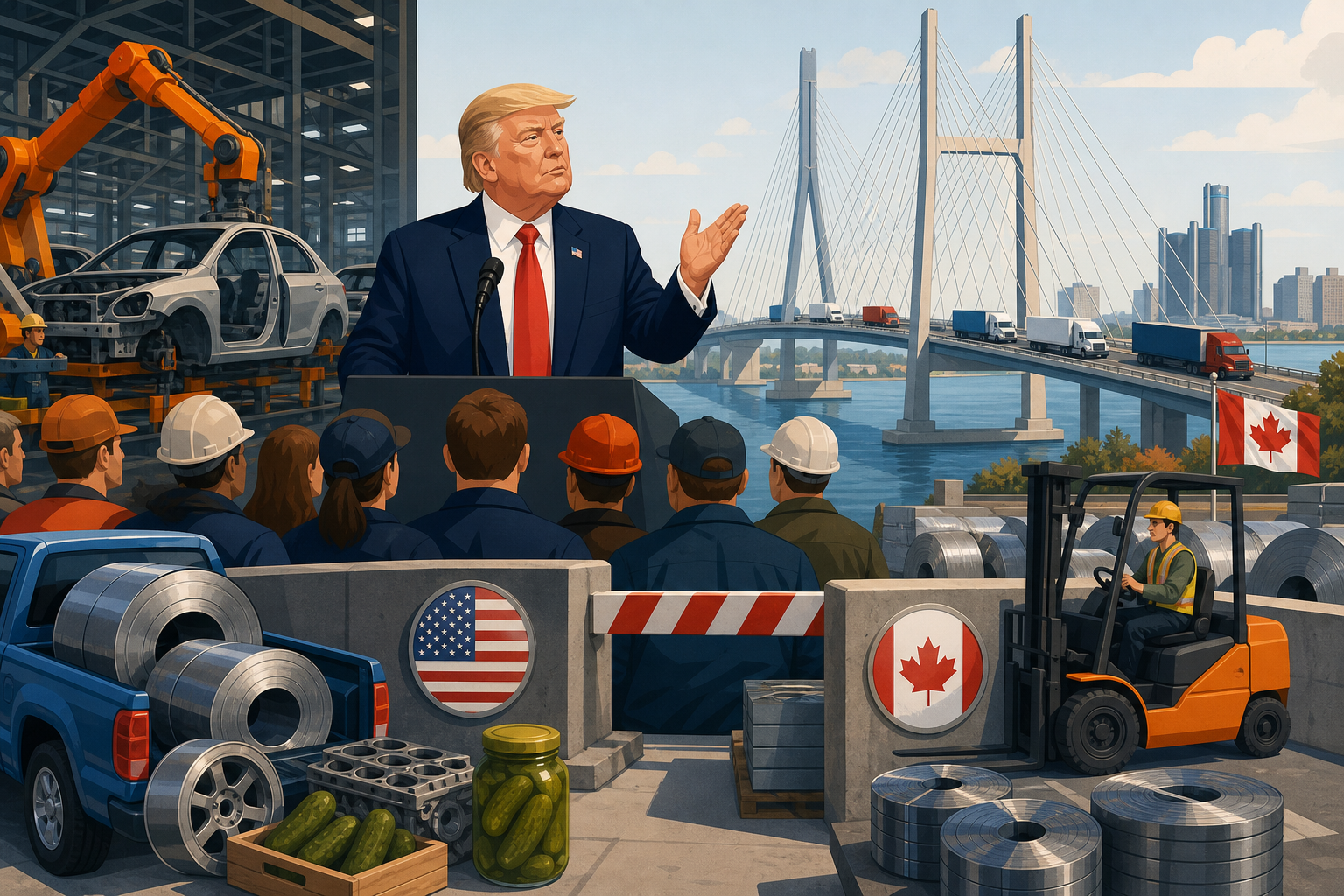
The Gordie Howe International Bridge opened in late 2025 with trucks rolling across six lanes of concrete linking Windsor and Detroit, a $6-billion monument to cooperation that arrived during the worst trade climate between Canada and the United States in decades. The timing wasn't lost on anyone who watched President Trump defend his tariff agenda in Michigan this week while the physical infrastructure meant to deepen integration sat ready to carry freight through a policy environment designed to do the opposite.
Trump's appearance in Michigan wasn't scheduled around the bridge opening. It was scheduled around Michigan. The state remains one of three "Blue Wall" battlegrounds where labor unions still hold enough sway to tilt federal elections, and tariffs are the lever both parties use to signal commitment to manufacturing jobs. The President framed his 10% universal baseline tariff, with higher sectoral rates on steel and aluminum, as protection for workers whose plants compete with Canadian and Mexican imports. What he didn't frame was the dependency: Michigan's auto sector is structured around components crossing the Canada-U.S. border as many as seven times before a vehicle reaches final assembly. The tariffs he's defending act as a tax on the supply chain his audience relies on to stay employed.
The 2026 review looms larger than the current rates
The tariffs generating headlines now are less important than what's scheduled for mid-2026. The United States-Mexico-Canada Agreement includes a mandatory review clause that year, effectively a renegotiation window the U.S. administration is treating as leverage. Current tariff measures, especially those imposed under Section 232 national security provisions, function as pre-negotiation pressure. Canada's federal government has already signaled it will apply dollar-for-dollar retaliatory tariffs on U.S. goods if Washington doesn't pull back, and those retaliations are calibrated to hurt. When the U.S. targets Canadian steel, Canada doesn't just hit American steel. It targets Michigan-manufactured products, pickles, car parts, specific consumer goods, to turn voters in swing districts against the federal policy creating the pain.
This is trade policy as electoral engineering. Michigan workers want the protection tariffs theoretically provide, but their jobs depend on the low-friction flow of components those tariffs directly impede.
The bridge is a bet on a future that isn't arriving
The Gordie Howe Bridge was designed to handle thousands of trucks daily and relieve congestion at the aging Ambassador Bridge, which carries roughly 25% of all Canada-U.S. goods trade. It's a capacity upgrade for a corridor that is among the most integrated in the world. Southern Ontario and Michigan don't just trade with each other, they share a single automotive production system. A slowdown at the border isn't an inconvenience. It's a structural cost that shows up as delayed shipments, higher inventory buffers, and manufacturers shifting sourcing to avoid the crossing entirely.
Canada funded most of the bridge as an investment in that integrated future. The opening happened during a week when the President of the United States stood in Michigan and defended policies that make integration more expensive. The infrastructure is ready. The policy environment is moving in the opposite direction.
What this means for cross-border manufacturers
Firms operating in the Windsor-Detroit corridor are now managing two simultaneous problems: the tariffs themselves, which raise input costs, and the uncertainty about what those tariffs will look like after the 2026 USMCA review. Uncertainty has a cost that doesn't show up in tariff-rate tables. Companies delay capital investment. They build redundancy into supply chains. They renegotiate contracts with penalty clauses tied to border delays or tariff changes.
The Gordie Howe Bridge reduces physical friction. It does nothing about policy friction, and right now, policy friction is the variable that matters. Michigan got a presidential visit and a defense of tariffs. Windsor got a bridge that opened into a trade war. Both are dealing with the gap.



The Gordie Howe International Bridge opened in late 2025 with trucks rolling across six lanes of concrete linking Windsor and Detroit, a $6-billion monument to cooperation that arrived during the worst trade climate between Canada and the United States in decades. The timing wasn't lost on anyone who watched President Trump defend his tariff agenda in Michigan this week while the physical infrastructure meant to deepen integration sat ready to carry freight through a policy environment designed to do the opposite.
Trump's appearance in Michigan wasn't scheduled around the bridge opening. It was scheduled around Michigan. The state remains one of three "Blue Wall" battlegrounds where labor unions still hold enough sway to tilt federal elections, and tariffs are the lever both parties use to signal commitment to manufacturing jobs. The President framed his 10% universal baseline tariff, with higher sectoral rates on steel and aluminum, as protection for workers whose plants compete with Canadian and Mexican imports. What he didn't frame was the dependency: Michigan's auto sector is structured around components crossing the Canada-U.S. border as many as seven times before a vehicle reaches final assembly. The tariffs he's defending act as a tax on the supply chain his audience relies on to stay employed.
The 2026 review looms larger than the current rates
The tariffs generating headlines now are less important than what's scheduled for mid-2026. The United States-Mexico-Canada Agreement includes a mandatory review clause that year, effectively a renegotiation window the U.S. administration is treating as leverage. Current tariff measures, especially those imposed under Section 232 national security provisions, function as pre-negotiation pressure. Canada's federal government has already signaled it will apply dollar-for-dollar retaliatory tariffs on U.S. goods if Washington doesn't pull back, and those retaliations are calibrated to hurt. When the U.S. targets Canadian steel, Canada doesn't just hit American steel. It targets Michigan-manufactured products, pickles, car parts, specific consumer goods, to turn voters in swing districts against the federal policy creating the pain.
This is trade policy as electoral engineering. Michigan workers want the protection tariffs theoretically provide, but their jobs depend on the low-friction flow of components those tariffs directly impede.
The bridge is a bet on a future that isn't arriving
The Gordie Howe Bridge was designed to handle thousands of trucks daily and relieve congestion at the aging Ambassador Bridge, which carries roughly 25% of all Canada-U.S. goods trade. It's a capacity upgrade for a corridor that is among the most integrated in the world. Southern Ontario and Michigan don't just trade with each other, they share a single automotive production system. A slowdown at the border isn't an inconvenience. It's a structural cost that shows up as delayed shipments, higher inventory buffers, and manufacturers shifting sourcing to avoid the crossing entirely.
Canada funded most of the bridge as an investment in that integrated future. The opening happened during a week when the President of the United States stood in Michigan and defended policies that make integration more expensive. The infrastructure is ready. The policy environment is moving in the opposite direction.
What this means for cross-border manufacturers
Firms operating in the Windsor-Detroit corridor are now managing two simultaneous problems: the tariffs themselves, which raise input costs, and the uncertainty about what those tariffs will look like after the 2026 USMCA review. Uncertainty has a cost that doesn't show up in tariff-rate tables. Companies delay capital investment. They build redundancy into supply chains. They renegotiate contracts with penalty clauses tied to border delays or tariff changes.
The Gordie Howe Bridge reduces physical friction. It does nothing about policy friction, and right now, policy friction is the variable that matters. Michigan got a presidential visit and a defense of tariffs. Windsor got a bridge that opened into a trade war. Both are dealing with the gap.
Read Next
GIC rates stall as bonds retreat: why deposit accounts still lag
Why Your Employer's Life Insurance Probably Covers Less Than You Think
August Sales Fell 6.9%: What CREA's Numbers Actually Reveal About Buyer Hesitation
Canada's Resource Advantage: What Global Investors Are Betting On in 2026