A 47-year-old couple sold their 8,000-square-foot Bridle Path estate in November 2025 and moved into a 4,000-square-foot penthouse at One Bloor West. They paid $12.3 million. The building has a concierge, underground valet, and a private elevator that opens directly into their unit. They don't own a lawnmower anymore.
That transaction is one of roughly 200 others like it in the past year. Sales of residential properties priced above $10 million in the Greater Toronto Area increased by approximately 200% year-over-year through late 2024 and into 2025. The rest of the Toronto condo market saw inventory climb past 10,000 active listings, with average days-on-market hovering around 25 to 30 days. Penthouses in trophy buildings like Four Seasons, Shangri-La, and No. 1 Yorkville were moving in under two weeks, often with pre-market offers.
The investment thesis everyone spent 2023 arguing about was whether Toronto real estate would survive higher rates. The question assumed Toronto had one real estate market. It has two.
The Commodity Condo Glut Nobody Wanted
The 500-square-foot one-bedroom investor unit is drowning. High carrying costs, stagnant rent growth, and a pullback in speculative demand have created a glut of interchangeable units that all compete on price. Developers kept building them because the pro formas worked in 2019. Buyers kept flipping them because the math worked in 2021. By 2024, the math stopped working and the supply didn't stop arriving.
TRREB data shows more than 10,000 condos listed across the GTA in mid-2025. Most are small units in mid-tier buildings where the amenities are nice but not differentiated and the address doesn't carry weight. The penthouse buyer and the one-bedroom flipper are not in the same market. They aren't even in the same asset class.
The Scarcity Play at the Top
A penthouse in Yorkville priced at $10 million is not being compared to another penthouse in Yorkville priced at $10 million. There are maybe five of those per year. It's being compared to a Rosedale detached home priced at $9 million and a Forest Hill estate priced at $11 million. The buyer is choosing between three scarce assets in three different formats, all of which deliver privacy, status, and a hedge against currency risk.
The 200% jump in sales above $10 million tells you what happened when rates stabilized and wealth started moving again. The sample size is small, likely 15 to 20 sales in a quarter compared to 5 to 7 the prior year, but the direction is clear. The top end didn't care about rates because the top end wasn't financing.
Yorkville penthouses were trading between $2,500 and $4,000 per square foot in early 2025. The city's graduated Municipal Land Transfer Tax, which hits 7.5% on properties over $20 million, was supposed to cool this segment. It didn't. The $10 million buyer has already priced in the tax. A $750,000 land transfer payment on a $10 million purchase is a rounding error in a portfolio where the alternative is holding cash in a currency that's been depreciating against hard assets for a decade.
What the Bifurcation Means for Positioning
If you're advising a client on Toronto real estate in 2025, the first question is which market they're actually in. The penthouse market operates on scarcity, brand, and service. The commodity condo market operates on yield and price. Mixing the two analyses produces garbage recommendations.
The penthouse thesis was always about durability, not momentum. Yorkville is to Toronto what the Upper East Side is to New York. It holds value through cycles because the supply is capped and the buyer pool is global. The condo thesis was about leveraging a growing rental base and riding appreciation in a supply-constrained city. That worked until supply stopped being constrained and yields compressed.
Toronto still has a housing shortage. It just doesn't have a shortage of 500-square-foot investment units in buildings with no brand. The shortage is in the 3,000-square-foot full-floor penthouse with a private elevator and a view of the lake. There were never enough of those, and there still aren't.
The market everyone thought would collapse in 2023 is the market that doubled in 2025. The market everyone thought was safe is the one sitting with 30 days on market and falling. If your investment thesis didn't account for that split, you weren't watching the right buildings.


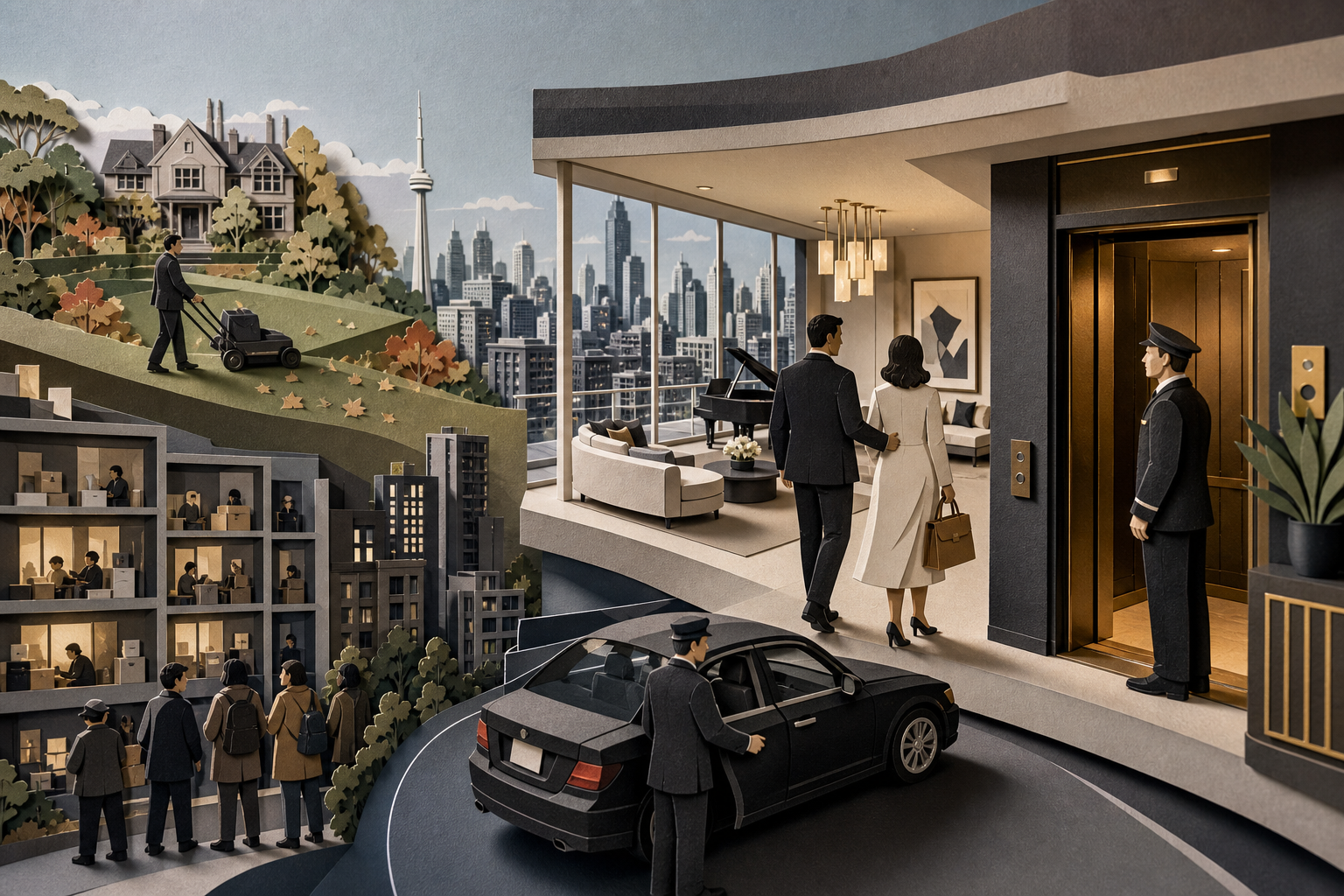

A 47-year-old couple sold their 8,000-square-foot Bridle Path estate in November 2025 and moved into a 4,000-square-foot penthouse at One Bloor West. They paid $12.3 million. The building has a concierge, underground valet, and a private elevator that opens directly into their unit. They don't own a lawnmower anymore.
That transaction is one of roughly 200 others like it in the past year. Sales of residential properties priced above $10 million in the Greater Toronto Area increased by approximately 200% year-over-year through late 2024 and into 2025. The rest of the Toronto condo market saw inventory climb past 10,000 active listings, with average days-on-market hovering around 25 to 30 days. Penthouses in trophy buildings like Four Seasons, Shangri-La, and No. 1 Yorkville were moving in under two weeks, often with pre-market offers.
The investment thesis everyone spent 2023 arguing about was whether Toronto real estate would survive higher rates. The question assumed Toronto had one real estate market. It has two.
The Commodity Condo Glut Nobody Wanted
The 500-square-foot one-bedroom investor unit is drowning. High carrying costs, stagnant rent growth, and a pullback in speculative demand have created a glut of interchangeable units that all compete on price. Developers kept building them because the pro formas worked in 2019. Buyers kept flipping them because the math worked in 2021. By 2024, the math stopped working and the supply didn't stop arriving.
TRREB data shows more than 10,000 condos listed across the GTA in mid-2025. Most are small units in mid-tier buildings where the amenities are nice but not differentiated and the address doesn't carry weight. The penthouse buyer and the one-bedroom flipper are not in the same market. They aren't even in the same asset class.
The Scarcity Play at the Top
A penthouse in Yorkville priced at $10 million is not being compared to another penthouse in Yorkville priced at $10 million. There are maybe five of those per year. It's being compared to a Rosedale detached home priced at $9 million and a Forest Hill estate priced at $11 million. The buyer is choosing between three scarce assets in three different formats, all of which deliver privacy, status, and a hedge against currency risk.
The 200% jump in sales above $10 million tells you what happened when rates stabilized and wealth started moving again. The sample size is small, likely 15 to 20 sales in a quarter compared to 5 to 7 the prior year, but the direction is clear. The top end didn't care about rates because the top end wasn't financing.
Yorkville penthouses were trading between $2,500 and $4,000 per square foot in early 2025. The city's graduated Municipal Land Transfer Tax, which hits 7.5% on properties over $20 million, was supposed to cool this segment. It didn't. The $10 million buyer has already priced in the tax. A $750,000 land transfer payment on a $10 million purchase is a rounding error in a portfolio where the alternative is holding cash in a currency that's been depreciating against hard assets for a decade.
What the Bifurcation Means for Positioning
If you're advising a client on Toronto real estate in 2025, the first question is which market they're actually in. The penthouse market operates on scarcity, brand, and service. The commodity condo market operates on yield and price. Mixing the two analyses produces garbage recommendations.
The penthouse thesis was always about durability, not momentum. Yorkville is to Toronto what the Upper East Side is to New York. It holds value through cycles because the supply is capped and the buyer pool is global. The condo thesis was about leveraging a growing rental base and riding appreciation in a supply-constrained city. That worked until supply stopped being constrained and yields compressed.
Toronto still has a housing shortage. It just doesn't have a shortage of 500-square-foot investment units in buildings with no brand. The shortage is in the 3,000-square-foot full-floor penthouse with a private elevator and a view of the lake. There were never enough of those, and there still aren't.
The market everyone thought would collapse in 2023 is the market that doubled in 2025. The market everyone thought was safe is the one sitting with 30 days on market and falling. If your investment thesis didn't account for that split, you weren't watching the right buildings.
Read Next
GIC rates stall as bonds retreat: why deposit accounts still lag
Why Your Employer's Life Insurance Probably Covers Less Than You Think
August Sales Fell 6.9%: What CREA's Numbers Actually Reveal About Buyer Hesitation
Canada's Resource Advantage: What Global Investors Are Betting On in 2026