The Bank of Canada Just Named the Two Risks That Could Derail Your Financial Plan
The central bank held its overnight rate at 2.25% in September 2026, but the decision came with a warning that has less to do with inflation than with events thousands of kilometres away.
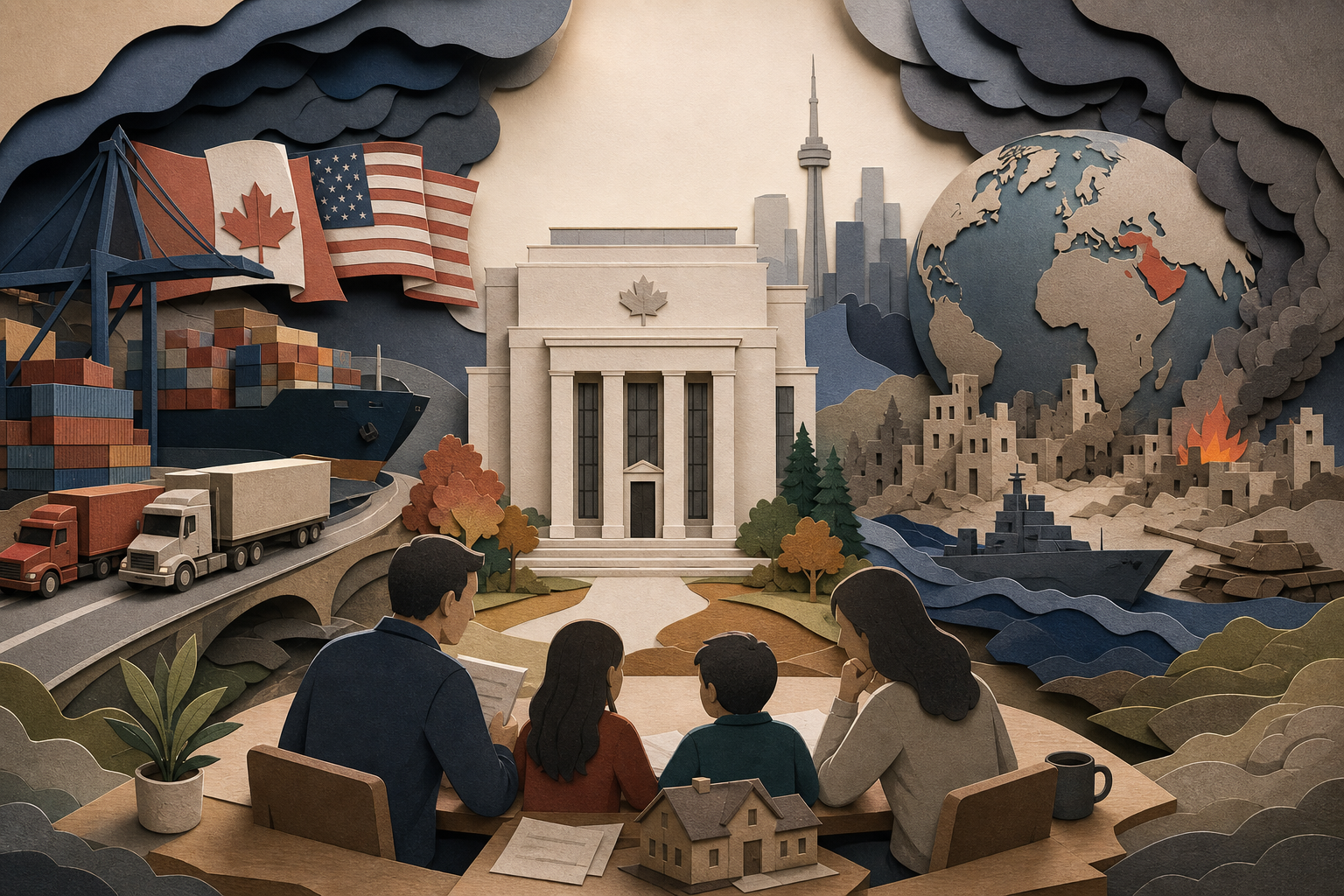
Governor Tiff Macklem and the Governing Council identified two external threats capable of unravelling the domestic recovery: escalating trade protectionism and instability in the Middle East. Neither appears on a typical household balance sheet. Both can rewrite one.
Trade instability hits business investment first
The first risk is tariff-driven trade conflict. Canada sends roughly 75% of its exports to the United States, and a meaningful portion of that trade moves through integrated supply chains in manufacturing and automotive production. When the U.S. threatens or imposes tariffs, most recently a 50% duty on certain Canadian goods announced in August 2026, business investment freezes before consumer prices respond.
Firms delay capital spending when cross-border terms are uncertain. A manufacturer deciding whether to expand a facility in Ontario does not commit $40 million when next year's tariff regime is unknown. The lag between trade policy announcements and frozen investment decisions stretches across weeks. By the time household income feels the downstream effects, fewer jobs posted, wage growth stalling, the damage to the business sector is already done.
The Bank of Canada does not control tariffs. It controls the cost of borrowing. Holding the rate steady at 2.25% is an acknowledgment that domestic monetary policy cannot stabilize an economy where external trade policy is the primary variable.
Energy prices carry a double edge
Middle East instability operates differently. Canada is a net oil exporter, which means higher crude prices can strengthen the Canadian dollar and boost fiscal revenues in energy-producing provinces. In isolation, that looks like a positive shock.
The complication is that energy price volatility driven by geopolitical risk tends to coincide with broader risk-off sentiment in global markets. When oil spikes because of conflict rather than demand growth, equity markets typically sell off, credit spreads widen, and capital flows toward safe-haven assets. For Canadian households holding equity-heavy portfolios or renewing mortgages in a credit-tightening environment, the benefit of a stronger loonie does not offset the cost of repricing risk across all other asset classes.
A significant portion of five-year fixed-rate mortgages signed in 2021 are renewing in 2026. Those borrowers locked in rates near 1.6%. The current policy rate of 2.25% translates to renewal rates in the 4% to 5% range for insured mortgages, depending on the lender and the borrower's loan-to-value ratio. That is a meaningful payment increase, but it is manageable if employment holds and wages keep pace. If a trade war reduces business investment and Middle East conflict triggers a broader market correction, the same renewal becomes a squeeze point.
The shadow of the neutral rate
Economists are now debating whether 2.25% represents the final destination for this cycle or a waypoint. The neutral rate, the level at which borrowing costs neither stimulate nor restrain the economy, cannot be observed directly but is inferred from outcomes.
If the Bank of Canada believed 2.25% was safely below neutral, it would cut further to support growth. If it believed the rate was above neutral, it would hold to avoid overheating. The decision to pause suggests the Governing Council sees 2.25% as close to neutral, with the outcome hinging on factors beyond the Bank's control.
Canadian households face a faster pace of change in the information underlying their decisions than the speed at which those decisions can adjust.



The central bank held its overnight rate at 2.25% in September 2026, but the decision came with a warning that has less to do with inflation than with events thousands of kilometres away.
Governor Tiff Macklem and the Governing Council identified two external threats capable of unravelling the domestic recovery: escalating trade protectionism and instability in the Middle East. Neither appears on a typical household balance sheet. Both can rewrite one.
Trade instability hits business investment first
The first risk is tariff-driven trade conflict. Canada sends roughly 75% of its exports to the United States, and a meaningful portion of that trade moves through integrated supply chains in manufacturing and automotive production. When the U.S. threatens or imposes tariffs, most recently a 50% duty on certain Canadian goods announced in August 2026, business investment freezes before consumer prices respond.
Firms delay capital spending when cross-border terms are uncertain. A manufacturer deciding whether to expand a facility in Ontario does not commit $40 million when next year's tariff regime is unknown. The lag between trade policy announcements and frozen investment decisions stretches across weeks. By the time household income feels the downstream effects, fewer jobs posted, wage growth stalling, the damage to the business sector is already done.
The Bank of Canada does not control tariffs. It controls the cost of borrowing. Holding the rate steady at 2.25% is an acknowledgment that domestic monetary policy cannot stabilize an economy where external trade policy is the primary variable.
Energy prices carry a double edge
Middle East instability operates differently. Canada is a net oil exporter, which means higher crude prices can strengthen the Canadian dollar and boost fiscal revenues in energy-producing provinces. In isolation, that looks like a positive shock.
The complication is that energy price volatility driven by geopolitical risk tends to coincide with broader risk-off sentiment in global markets. When oil spikes because of conflict rather than demand growth, equity markets typically sell off, credit spreads widen, and capital flows toward safe-haven assets. For Canadian households holding equity-heavy portfolios or renewing mortgages in a credit-tightening environment, the benefit of a stronger loonie does not offset the cost of repricing risk across all other asset classes.
A significant portion of five-year fixed-rate mortgages signed in 2021 are renewing in 2026. Those borrowers locked in rates near 1.6%. The current policy rate of 2.25% translates to renewal rates in the 4% to 5% range for insured mortgages, depending on the lender and the borrower's loan-to-value ratio. That is a meaningful payment increase, but it is manageable if employment holds and wages keep pace. If a trade war reduces business investment and Middle East conflict triggers a broader market correction, the same renewal becomes a squeeze point.
The shadow of the neutral rate
Economists are now debating whether 2.25% represents the final destination for this cycle or a waypoint. The neutral rate, the level at which borrowing costs neither stimulate nor restrain the economy, cannot be observed directly but is inferred from outcomes.
If the Bank of Canada believed 2.25% was safely below neutral, it would cut further to support growth. If it believed the rate was above neutral, it would hold to avoid overheating. The decision to pause suggests the Governing Council sees 2.25% as close to neutral, with the outcome hinging on factors beyond the Bank's control.
Canadian households face a faster pace of change in the information underlying their decisions than the speed at which those decisions can adjust.
Read Next
Birch Hill builds a regional aviation network in British Columbia through Harbour Air's Pacific Coastal acquisition
South Korea's Stock Market Has Become a National Liability
Tech CEOs Walk the Investor Tightrope: Signal AI Risk Without Cutting Off Billions in Funding
Canada Child Benefit Payments Arrive Early This September, Here's What Changed in July