TD Bank Just Took Control of a 27-Storey Burlington Condo Project. That Almost Never Happens.
The summer of 2024, KSV Restructuring got a call that almost nobody in Canadian real estate sees anymore. TD Bank wanted to put a major urban development project into receivership. Not a credit union nursing a single bad loan. Not a private mortgage fund trying to salvage a portfolio. One of the Big Six.
That changes the math. When a bank with TD's balance sheet pulls the trigger on receivership rather than extending forbearance, it means the calculation that has governed most lender behavior since late 2022, "rates will drop, sales will recover, we'll ride this out", has been retired. The project in question is the Burlington Waterfront, a 27-storey mixed-use condominium tower that Core Development Group was assembling on Old Lakeshore Road. KSV was appointed receiver by the Ontario Superior Court in mid-2024, and the case has been working its way through liquidation discussions into 2025.
Why big banks don't usually do this
The standard playbook for institutional lenders in a down cycle is forbearance. Modify the loan terms. Extend the maturity. Accept interest-only payments. The reasoning is structural: receivership crystallizes a loss immediately. It forces a sale into a buyer's market, and the bank takes a public markdown on a secured loan it previously classified as performing or near-performing. That damages the loan book, triggers reserve requirements, and signals to the market that similar assets might be in trouble. Credit unions and private lenders pull the receivership lever more quickly because they have smaller portfolios and less to lose from signaling. The big banks have institutional reasons to wait.
TD didn't wait. The Burlington site is a multi-parcel assembly centered on 2093 and 2101 Old Lakeshore Road, prime waterfront land in one of Southern Ontario's more affluent submarkets. If forbearance made sense anywhere, it was here. High-income market. Transit access. Waterfront. The kind of project that could plausibly recover if rates dropped another 75 basis points and pre-construction sales resumed. But land assemblies have a structural vulnerability that single-parcel projects don't. The value is in the unified site. If the assembly breaks apart in a distressed sale, if one parcel gets picked off separately, the rest of the land loses the density potential that justified the original acquisition price. TD likely ran that scenario and decided the risk of waiting outweighed the cost of moving now.
What this tells you about the cycle
The insolvency itself isn't the story. Development projects have been failing steadily since interest rates started climbing in 2022. According to Statistics Canada's monthly insolvency data, construction-sector insolvencies in 2024 ran roughly 40% above the 2019 baseline. Most of those involved smaller private developers and secondary lenders. What makes the Burlington case notable is the creditor taking action. When TD decides the extend-and-pretend window has closed, that's a signal that other institutional lenders are likely running the same math on their own exposure.
The receivership doesn't mean the tower won't get built. Receivership is a financial restructuring tool, not a demolition order. A well-capitalized buyer, likely a pension fund or REIT, can acquire the site through the court process at a price that reflects current financing costs rather than the 2021 pro forma that Core was working from. That buyer steps into a de-risked position: the previous developer's debt overhang is gone, and the zoning entitlements are already in place.
But for developers holding similar land assemblies financed in the low-rate era, the Burlington case is a reference point. The big banks are no longer waiting.


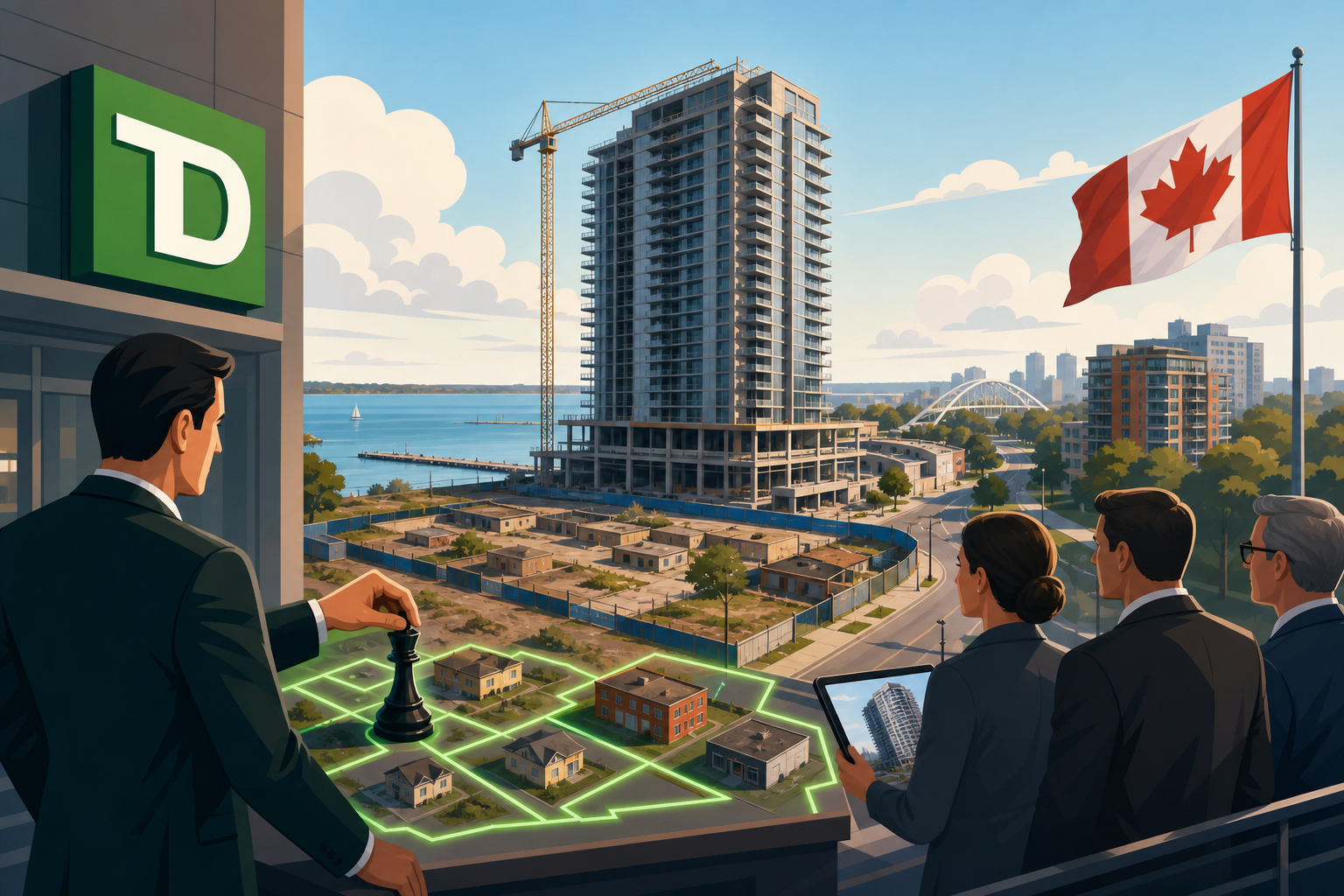

The summer of 2024, KSV Restructuring got a call that almost nobody in Canadian real estate sees anymore. TD Bank wanted to put a major urban development project into receivership. Not a credit union nursing a single bad loan. Not a private mortgage fund trying to salvage a portfolio. One of the Big Six.
That changes the math. When a bank with TD's balance sheet pulls the trigger on receivership rather than extending forbearance, it means the calculation that has governed most lender behavior since late 2022, "rates will drop, sales will recover, we'll ride this out", has been retired. The project in question is the Burlington Waterfront, a 27-storey mixed-use condominium tower that Core Development Group was assembling on Old Lakeshore Road. KSV was appointed receiver by the Ontario Superior Court in mid-2024, and the case has been working its way through liquidation discussions into 2025.
Why big banks don't usually do this
The standard playbook for institutional lenders in a down cycle is forbearance. Modify the loan terms. Extend the maturity. Accept interest-only payments. The reasoning is structural: receivership crystallizes a loss immediately. It forces a sale into a buyer's market, and the bank takes a public markdown on a secured loan it previously classified as performing or near-performing. That damages the loan book, triggers reserve requirements, and signals to the market that similar assets might be in trouble. Credit unions and private lenders pull the receivership lever more quickly because they have smaller portfolios and less to lose from signaling. The big banks have institutional reasons to wait.
TD didn't wait. The Burlington site is a multi-parcel assembly centered on 2093 and 2101 Old Lakeshore Road, prime waterfront land in one of Southern Ontario's more affluent submarkets. If forbearance made sense anywhere, it was here. High-income market. Transit access. Waterfront. The kind of project that could plausibly recover if rates dropped another 75 basis points and pre-construction sales resumed. But land assemblies have a structural vulnerability that single-parcel projects don't. The value is in the unified site. If the assembly breaks apart in a distressed sale, if one parcel gets picked off separately, the rest of the land loses the density potential that justified the original acquisition price. TD likely ran that scenario and decided the risk of waiting outweighed the cost of moving now.
What this tells you about the cycle
The insolvency itself isn't the story. Development projects have been failing steadily since interest rates started climbing in 2022. According to Statistics Canada's monthly insolvency data, construction-sector insolvencies in 2024 ran roughly 40% above the 2019 baseline. Most of those involved smaller private developers and secondary lenders. What makes the Burlington case notable is the creditor taking action. When TD decides the extend-and-pretend window has closed, that's a signal that other institutional lenders are likely running the same math on their own exposure.
The receivership doesn't mean the tower won't get built. Receivership is a financial restructuring tool, not a demolition order. A well-capitalized buyer, likely a pension fund or REIT, can acquire the site through the court process at a price that reflects current financing costs rather than the 2021 pro forma that Core was working from. That buyer steps into a de-risked position: the previous developer's debt overhang is gone, and the zoning entitlements are already in place.
But for developers holding similar land assemblies financed in the low-rate era, the Burlington case is a reference point. The big banks are no longer waiting.
Read Next
GIC rates stall as bonds retreat: why deposit accounts still lag
Why Your Employer's Life Insurance Probably Covers Less Than You Think
August Sales Fell 6.9%: What CREA's Numbers Actually Reveal About Buyer Hesitation
Canada's Resource Advantage: What Global Investors Are Betting On in 2026