Single-Wide vs. Double-Wide: How Loan Terms Add $47,000 to Your Total Cost
A $65,000 single-wide in a Tennessee park and a $120,000 double-wide on a half-acre lot in the same county can both hit monthly payments around $850. The gap isn't in the sticker price or the interest rate. It's in which lender is willing to touch the deal.
The Classification Game Costs More Than the House
Single-wides are almost always financed as personal property, not real estate. That classification changes everything. Personal property loans (chattel loans) carry interest rates 100 to 500 basis points above conventional mortgages. In 2026, that means chattel at 7.5-12% while conventional mortgages sit at 6.5-7%. The reason: you're borrowing against a depreciating asset that can be towed away, not land that holds value.
A $65,000 single-wide financed at 10% over 15 years costs roughly $698/month. Total paid: $125,640. Interest alone is $60,640 on a purchase that started at $65,000. Meanwhile, a $120,000 double-wide on owned land at 6.8% over 30 years runs $783/month. Total paid: $281,880. Interest is $161,880, which sounds worse until you run the equity curve. After 10 years, the single-wide buyer has paid down about $32,000 of principal and owns an asset that has likely depreciated to $45,000 or less. The double-wide buyer has paid down $28,000 of principal but owns an asset on land that has probably appreciated to $140,000.
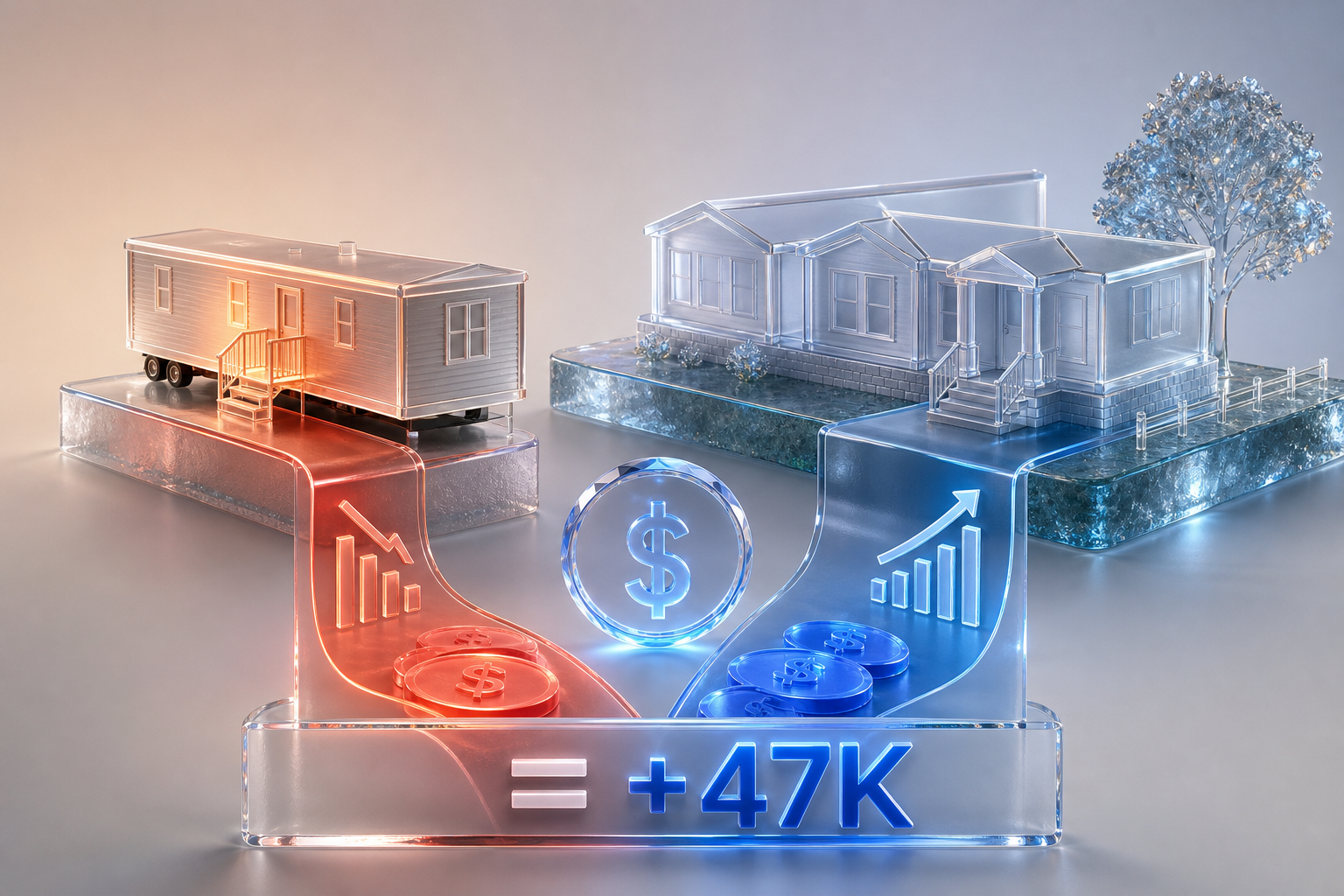
The $47,000 difference in the title is conservative. It's the gap in interest paid on comparable loan amounts over 15 years when one borrower gets chattel terms and the other gets real estate terms. Stretch the timeline or include depreciation, and the gap widens past $80,000.
Why Double-Wides Escape the Penalty
The double-wide on owned land qualifies for a conventional mortgage because it meets Fannie Mae's definition of real property: permanently affixed to a foundation you own. Permanent foundation means concrete or reinforced piers, not blocks. Owned land means a deed in your name, not a lease in a manufactured home park. Meet both tests and you can access FHA Title II loans or conventional conforming mortgages. Miss either one and you're back in chattel territory.
Single-wides rarely meet the test. Even when placed on private land, many lenders classify them as vehicles because they were towed as a single unit and remain structurally portable. That portability kills the financing. Lenders price for the risk that the borrower will default, the home will be moved, and the collateral will vanish. It happens often enough that the rate reflects it.
Where the Conventional Advice Breaks
The usual guidance is to buy what you can afford and upgrade later. For manufactured housing, that's backward. Buying the single-wide because it's cheaper up front locks you into a loan structure that costs more than the difference in purchase price. The single-wide at $65,000 with chattel financing costs you more over 15 years than the double-wide at $120,000 with real estate financing costs you over the same period, even though you borrowed nearly twice as much.
The math flips only in two cases. First, if you're buying cash and plan to sell within five years, the single-wide avoids the interest trap entirely. Second, if you can secure an FHA Title II loan on the single-wide by placing it on owned land with a permanent foundation. The vast majority of single-wide purchases do not meet those conditions.
For the other 85%, the financing structure is the decision. Not the home size, not the layout, not the park fees. If the cheaper home forces you into chattel lending, the savings are a lie.



A $65,000 single-wide in a Tennessee park and a $120,000 double-wide on a half-acre lot in the same county can both hit monthly payments around $850. The gap isn't in the sticker price or the interest rate. It's in which lender is willing to touch the deal.
The Classification Game Costs More Than the House
Single-wides are almost always financed as personal property, not real estate. That classification changes everything. Personal property loans (chattel loans) carry interest rates 100 to 500 basis points above conventional mortgages. In 2026, that means chattel at 7.5-12% while conventional mortgages sit at 6.5-7%. The reason: you're borrowing against a depreciating asset that can be towed away, not land that holds value.
A $65,000 single-wide financed at 10% over 15 years costs roughly $698/month. Total paid: $125,640. Interest alone is $60,640 on a purchase that started at $65,000. Meanwhile, a $120,000 double-wide on owned land at 6.8% over 30 years runs $783/month. Total paid: $281,880. Interest is $161,880, which sounds worse until you run the equity curve. After 10 years, the single-wide buyer has paid down about $32,000 of principal and owns an asset that has likely depreciated to $45,000 or less. The double-wide buyer has paid down $28,000 of principal but owns an asset on land that has probably appreciated to $140,000.
The $47,000 difference in the title is conservative. It's the gap in interest paid on comparable loan amounts over 15 years when one borrower gets chattel terms and the other gets real estate terms. Stretch the timeline or include depreciation, and the gap widens past $80,000.
Why Double-Wides Escape the Penalty
The double-wide on owned land qualifies for a conventional mortgage because it meets Fannie Mae's definition of real property: permanently affixed to a foundation you own. Permanent foundation means concrete or reinforced piers, not blocks. Owned land means a deed in your name, not a lease in a manufactured home park. Meet both tests and you can access FHA Title II loans or conventional conforming mortgages. Miss either one and you're back in chattel territory.
Single-wides rarely meet the test. Even when placed on private land, many lenders classify them as vehicles because they were towed as a single unit and remain structurally portable. That portability kills the financing. Lenders price for the risk that the borrower will default, the home will be moved, and the collateral will vanish. It happens often enough that the rate reflects it.
Where the Conventional Advice Breaks
The usual guidance is to buy what you can afford and upgrade later. For manufactured housing, that's backward. Buying the single-wide because it's cheaper up front locks you into a loan structure that costs more than the difference in purchase price. The single-wide at $65,000 with chattel financing costs you more over 15 years than the double-wide at $120,000 with real estate financing costs you over the same period, even though you borrowed nearly twice as much.
The math flips only in two cases. First, if you're buying cash and plan to sell within five years, the single-wide avoids the interest trap entirely. Second, if you can secure an FHA Title II loan on the single-wide by placing it on owned land with a permanent foundation. The vast majority of single-wide purchases do not meet those conditions.
For the other 85%, the financing structure is the decision. Not the home size, not the layout, not the park fees. If the cheaper home forces you into chattel lending, the savings are a lie.
Sources
Read Next
GIC rates stall as bonds retreat: why deposit accounts still lag
Why Your Employer's Life Insurance Probably Covers Less Than You Think
August Sales Fell 6.9%: What CREA's Numbers Actually Reveal About Buyer Hesitation
Canada's Resource Advantage: What Global Investors Are Betting On in 2026