Prices Are Down 20%: 7 Underwriting Checks Before Your Next Rental Build
The line most rental pro formas leave blank is the month the building is finished and only a few suites are leased. That's the month a falling market collects its bill, because it's when the lender re-checks the value, your construction loan converts, and the rent hasn't caught up yet.
National home prices are down roughly 20% from their early-2022 peak, and Build Canada Homes, the new federal housing agency, says it will keep pushing purpose-built rentals anyway. Both things can be true for your project. A rental build in Alberta can still work through a downturn, as long as the numbers survive a lower appraisal, a discounted rent figure and a slow lease-up. Run these seven checks before you commit to land or a lender.
Re-appraise the finished building at today's values. Lenders lend against what the property is worth, and that figure comes from recent sales, not the price you paid for the lot. If comparable values have slipped, the loan shrinks and you cover the difference in cash. People skip this because the land deal was signed when the numbers looked better.
Cut your rent to the figure the lender will actually use. CMHC and most lenders count only 50% to 80% of gross rental income toward qualifying. As a simple example, a suite renting at $2,000 a month may be credited at somewhere between $1,000 and $1,600. Build your debt coverage on the low end and you won't be surprised at approval.
Price construction as if costs never came down. Labour and materials stay stubborn even when home values fall, and they set a floor under what a new unit can cost. If your margin depends on trades getting cheaper next spring, your margin is a guess.
Fund a lease-up reserve before you break ground. Set aside enough cash to pay the mortgage, taxes, insurance and utilities for the months the building isn't full. As an illustration, if carrying costs run $15,000 a month and you expect six slow months, that's $90,000 you need on hand. This is the item people drop first when the budget gets tight, and it's the one that decides whether you keep the building.
Test the payment at a higher renewal rate. The Bank of Canada has moved toward a more neutral stance in 2026, which helps. Your term will still renew in a different market. Run the payment at a rate meaningfully above today's and confirm the rent still covers it. Interest on money borrowed to earn rental income is deductible under section 20(1)(c) of the Income Tax Act, but that only lowers your tax. It doesn't pay the lender.
Read the Edmonton numbers on their own. A national average is pulled hard by Toronto and Vancouver, and Edmonton has historically moved less in both directions. The city's 2024 zoning changes allow row housing, duplexes and other small multi-unit builds on most residential lots, and Alberta has no provincial land transfer tax, which keeps closing costs down. Pull local sales and local rents before you let a national headline set your assumptions.
Ask about federal rental financing before you choose a lender. Build Canada Homes was set up to offer lower-cost financing and open federal land for rental density, and CMHC has its own rental programs. Terms and eligibility shift, so confirm what applies to your unit count and timeline early. The right financing can change which of the checks above pass.
Why the downturn and the shortage live side by side
CMHC estimates Canada needs up to 4.69 million more homes by 2036. The country started 259,028 homes in 2025, and in August 2026 the Canadian Real Estate Association reported sales down 0.7% from July. Prices and sales move month to month. A building takes 12 to 18 months or more to finish, so the supply you start this fall arrives into whatever market exists then, and the shortage underneath hasn't gone anywhere.
Run your deal with the lower appraisal, the discounted rent and six slow months all at once. If it still carries itself, a falling market may be giving you better land and less competition. If it only works when everything goes right, change the deal before you sign.


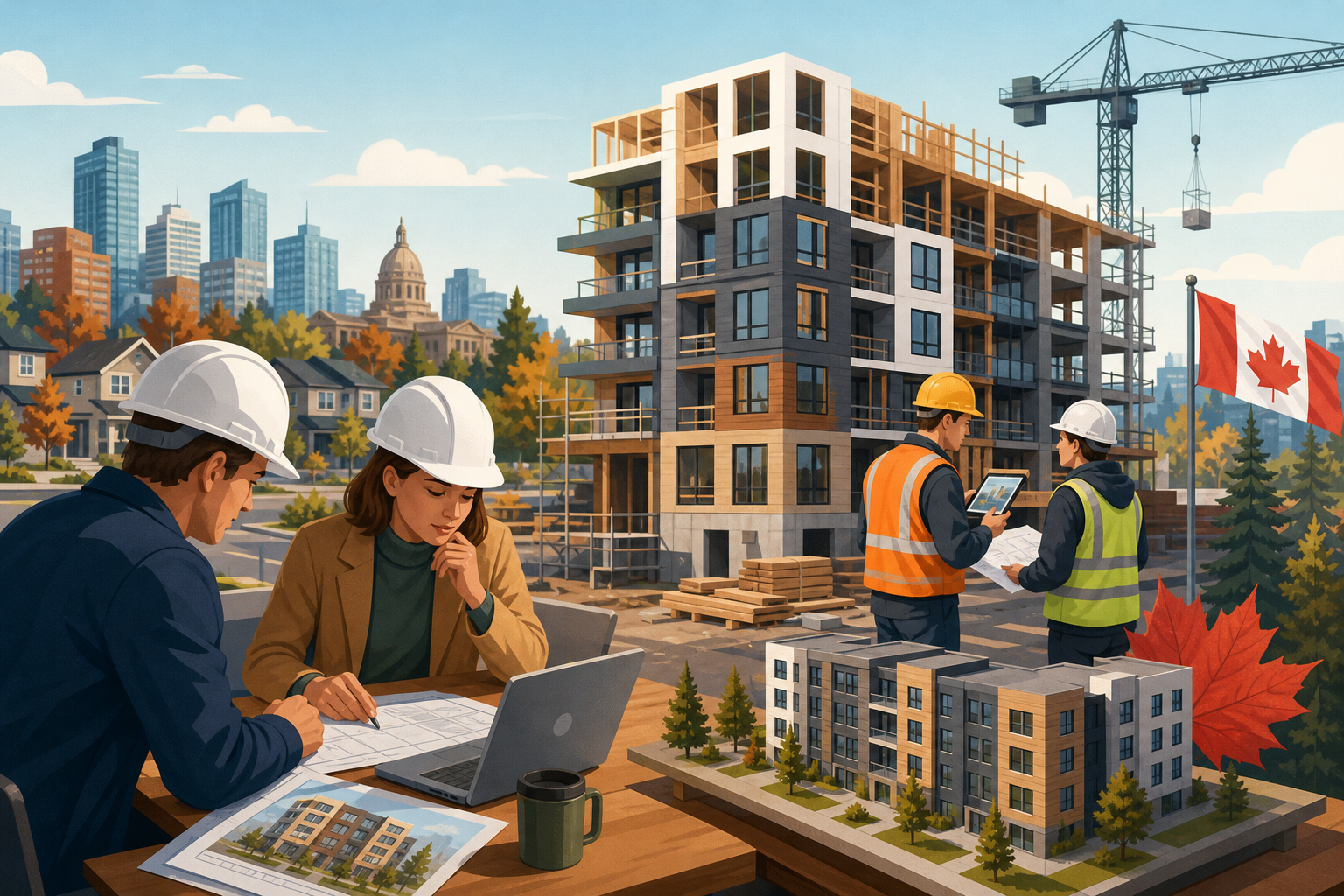

The line most rental pro formas leave blank is the month the building is finished and only a few suites are leased. That's the month a falling market collects its bill, because it's when the lender re-checks the value, your construction loan converts, and the rent hasn't caught up yet.
National home prices are down roughly 20% from their early-2022 peak, and Build Canada Homes, the new federal housing agency, says it will keep pushing purpose-built rentals anyway. Both things can be true for your project. A rental build in Alberta can still work through a downturn, as long as the numbers survive a lower appraisal, a discounted rent figure and a slow lease-up. Run these seven checks before you commit to land or a lender.
Why the downturn and the shortage live side by side
CMHC estimates Canada needs up to 4.69 million more homes by 2036. The country started 259,028 homes in 2025, and in August 2026 the Canadian Real Estate Association reported sales down 0.7% from July. Prices and sales move month to month. A building takes 12 to 18 months or more to finish, so the supply you start this fall arrives into whatever market exists then, and the shortage underneath hasn't gone anywhere.
Run your deal with the lower appraisal, the discounted rent and six slow months all at once. If it still carries itself, a falling market may be giving you better land and less competition. If it only works when everything goes right, change the deal before you sign.
Sources
Read Next
Three 2026 Mortgage Hall of Fame Careers Trace How Canadian Lending Changed
Why Commercial Insolvencies Peaked Before Rates Started Falling: A Timing Problem
A Tesla and SpaceX Merger Solves Musk's Problems and Hands Shareholders His Risks
Prem Watsa's IDBI Bet Tests What Foreign Capital Can Do in Indian Banking