Kelowna Now Ranks First in Canada for Wildfire Risk, What Condo Buyers Need to Know
A concrete mid-rise in downtown Kelowna and a wood-frame walkup in the Upper Mission both carry the label "condo," but they do not carry the same fire profile. The difference matters more now than it did two years ago, because the relationship between structure type, location, and insurability has tightened.
Natural Resources Canada's 2026 assessment ranks Kelowna first nationally for wildfire risk. The ranking reflects probability modeling that weighs topography, fuel density, wind patterns, and development proximity to forested slopes. Kelowna scores high on all four. The Wildland-Urban Interface, the zone where subdivision meets forest, runs through the city in a way that creates exposure other high-growth markets don't have. A buyer comparing two otherwise identical units needs to know which side of that line the building sits on.
What the Risk Score Actually Measures
The score is not a statement about whether a fire will happen. It is a statement about the potential for loss if one does. The model treats Kelowna's steep terrain, seasonal drought cycle, and prevailing winds as structural conditions, not temporary ones. The 2003 Okanagan Mountain Park fire and the 2023 McDougall Creek fire were not anomalies in the model's view. They were confirmations.
For condo buyers, the practical consequence shows up in two places: strata insurance premiums and the contingency reserve fund. High-risk designations have pushed strata deductibles for fire and water claims into the $25,000 to $100,000 range across parts of the Okanagan. A building's ability to absorb that, or pass it to owners as a special levy, depends entirely on the health of the reserve fund and the strata council's willingness to plan for it.
Concrete Versus Wood-Frame, and Why It Shows Up in Pricing
Not all condos in a high-risk region carry equal exposure. A six-storey concrete tower with non-combustible cladding, tempered windows, and centralized HVAC filtration for smoke sits in a different risk category than a three-storey wood-frame building clad in vinyl with cedar landscaping 20 meters from a treeline. The BC Building Code now integrates wildfire-resistant construction standards into municipal bylaws for new builds in Interface Zones, but older stock was built under different rules.
Some wood-frame buildings in high-hazard zones are finding that their insurer will not renew, or will renew only at premiums the strata cannot sustain without major fee increases. This is not hypothetical. Buildings have shifted carriers mid-year. A few have gone dark on coverage temporarily while shopping. The "resilience premium", the price gap between buildings that meet modern fire standards and those that don't, is starting to show in resale comps.
What FireSmart Means in Practice
FireSmart Canada sets the mitigation standard Kelowna developers and stratas use to reduce ignition risk. The guidelines are specific: rock mulch instead of bark, deciduous trees instead of cedars, ember-resistant vents, non-combustible decking. A buyer should ask the strata whether the property has been FireSmart-assessed and whether the council has budgeted for retrofits.
The City of Kelowna's Community Wildfire Resiliency Plan identifies high-hazard areas and funds fuel reduction work on public land. Individual homeowners in participating municipalities can access $500 to $1,000 rebates for mitigation work through the BC FireSmart program. Strata owners don't control exterior maintenance individually, which makes the strata's governance more important than it would be for a detached home.
The Smoke Factor Nobody Prices In
Direct fire damage gets attention. Smoke does not, until it forces the question of whether you can live in the unit for three weeks in July. Kelowna's "smoke days", days when air quality hits hazardous levels, have increased. The short-term rental market adjusts for this faster than the resale market does, because renters cancel. Owners hold.
A building with HVAC filtration rated for wildfire smoke has an edge during those windows. Most older buildings do not have it. Retrofitting costs money and strata approval. A buyer financing with less than 20% down should confirm the building is insurable at rates the strata can carry, because the lender will.


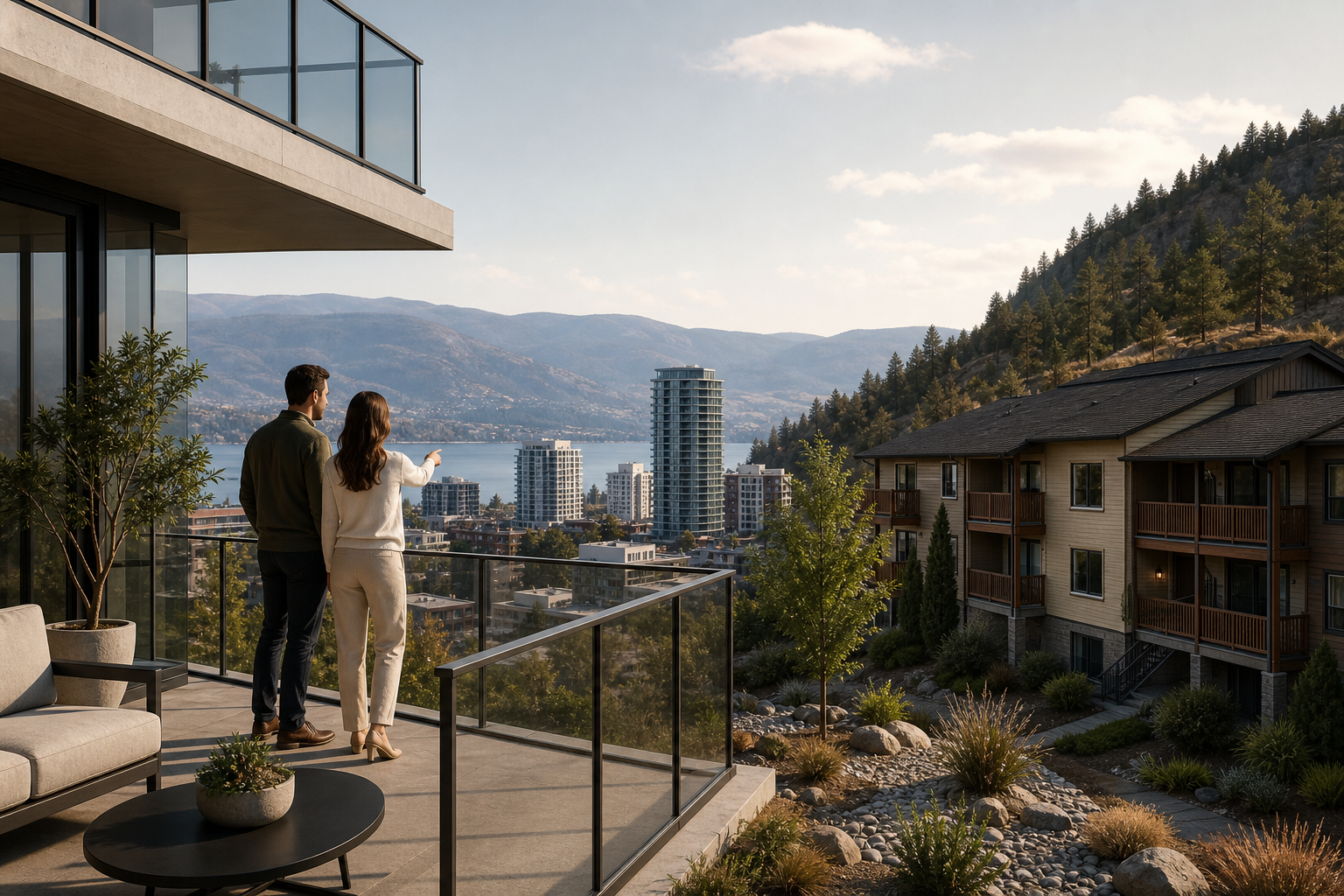

A concrete mid-rise in downtown Kelowna and a wood-frame walkup in the Upper Mission both carry the label "condo," but they do not carry the same fire profile. The difference matters more now than it did two years ago, because the relationship between structure type, location, and insurability has tightened.
Natural Resources Canada's 2026 assessment ranks Kelowna first nationally for wildfire risk. The ranking reflects probability modeling that weighs topography, fuel density, wind patterns, and development proximity to forested slopes. Kelowna scores high on all four. The Wildland-Urban Interface, the zone where subdivision meets forest, runs through the city in a way that creates exposure other high-growth markets don't have. A buyer comparing two otherwise identical units needs to know which side of that line the building sits on.
What the Risk Score Actually Measures
The score is not a statement about whether a fire will happen. It is a statement about the potential for loss if one does. The model treats Kelowna's steep terrain, seasonal drought cycle, and prevailing winds as structural conditions, not temporary ones. The 2003 Okanagan Mountain Park fire and the 2023 McDougall Creek fire were not anomalies in the model's view. They were confirmations.
For condo buyers, the practical consequence shows up in two places: strata insurance premiums and the contingency reserve fund. High-risk designations have pushed strata deductibles for fire and water claims into the $25,000 to $100,000 range across parts of the Okanagan. A building's ability to absorb that, or pass it to owners as a special levy, depends entirely on the health of the reserve fund and the strata council's willingness to plan for it.
Concrete Versus Wood-Frame, and Why It Shows Up in Pricing
Not all condos in a high-risk region carry equal exposure. A six-storey concrete tower with non-combustible cladding, tempered windows, and centralized HVAC filtration for smoke sits in a different risk category than a three-storey wood-frame building clad in vinyl with cedar landscaping 20 meters from a treeline. The BC Building Code now integrates wildfire-resistant construction standards into municipal bylaws for new builds in Interface Zones, but older stock was built under different rules.
Some wood-frame buildings in high-hazard zones are finding that their insurer will not renew, or will renew only at premiums the strata cannot sustain without major fee increases. This is not hypothetical. Buildings have shifted carriers mid-year. A few have gone dark on coverage temporarily while shopping. The "resilience premium", the price gap between buildings that meet modern fire standards and those that don't, is starting to show in resale comps.
What FireSmart Means in Practice
FireSmart Canada sets the mitigation standard Kelowna developers and stratas use to reduce ignition risk. The guidelines are specific: rock mulch instead of bark, deciduous trees instead of cedars, ember-resistant vents, non-combustible decking. A buyer should ask the strata whether the property has been FireSmart-assessed and whether the council has budgeted for retrofits.
The City of Kelowna's Community Wildfire Resiliency Plan identifies high-hazard areas and funds fuel reduction work on public land. Individual homeowners in participating municipalities can access $500 to $1,000 rebates for mitigation work through the BC FireSmart program. Strata owners don't control exterior maintenance individually, which makes the strata's governance more important than it would be for a detached home.
The Smoke Factor Nobody Prices In
Direct fire damage gets attention. Smoke does not, until it forces the question of whether you can live in the unit for three weeks in July. Kelowna's "smoke days", days when air quality hits hazardous levels, have increased. The short-term rental market adjusts for this faster than the resale market does, because renters cancel. Owners hold.
A building with HVAC filtration rated for wildfire smoke has an edge during those windows. Most older buildings do not have it. Retrofitting costs money and strata approval. A buyer financing with less than 20% down should confirm the building is insurable at rates the strata can carry, because the lender will.
Read Next
GIC rates stall as bonds retreat: why deposit accounts still lag
Why Your Employer's Life Insurance Probably Covers Less Than You Think
August Sales Fell 6.9%: What CREA's Numbers Actually Reveal About Buyer Hesitation
Canada's Resource Advantage: What Global Investors Are Betting On in 2026