Gold Prices Lift TSX While AI Stock Weakness Drags Down U.S. Markets
Barrick Gold added 2.7% by mid-morning Tuesday while NVIDIA shed 3.1%, and that split tells you everything about where money is moving right now.
The S&P/TSX Composite climbed 140 points while the S&P 500 and Nasdaq both slipped into the red, a divergence driven entirely by what's underneath each index. Canada's market is 45% materials and financials. The U.S. benchmark is 30% tech. When gold rallies and AI enthusiasm cools, those weightings stop being background trivia and start being the explanation for everything.
Gold is trading around $2,450 USD per ounce as of June 2026, up roughly 8% from the start of the year. That's not speculative froth. Central banks in emerging markets added a record 1,136 tonnes of bullion to reserves in 2023, and the pace hasn't slowed. The World Gold Council tracks this closely: sovereign buyers are diversifying away from the USD, and that creates a floor under the metal that retail sentiment alone never could. For the TSX, which hosts nearly half of the world's publicly traded mining and exploration companies, a $2,400+ gold price is structural support.
The Bank of Canada's overnight rate sits at 3.75%, down from 5.00% a year ago. Lower rates reduce the opportunity cost of holding non-yielding assets like gold. The Federal Reserve, meanwhile, is still signaling a "higher for longer" stance, keeping U.S. rates elevated. That divergence matters. Canadian miners benefit from easing domestic borrowing costs while the commodity they extract gains value as global investors hunt for hedges against sticky inflation and geopolitical instability. Trade tensions haven't disappeared; they've just shifted from tariff threats to rare earth supply chain fights. Gold doesn't care about the narrative. It cares about uncertainty.
Why tech fell while materials climbed
The AI trade isn't dead. It's getting repriced. Investors spent 18 months bidding up companies on the promise of future earnings from generative AI tools. Now they want proof. Microsoft, Alphabet, and Meta all beat earnings last quarter, but forward guidance disappointed analysts looking for AI revenue to show up in concrete line items. NVIDIA's share price is off 11% from its March peak. That's not a crash, it's a valuation correction when the market decides software projections aren't worth 40x revenue multiples anymore.
The rotation out of tech isn't scattering randomly. Some of it is landing in gold miners, which are now using windfall profits to fund copper and lithium exploration. The green energy transition needs both: copper for wiring, lithium for batteries. Teck Resources reported that copper demand from electric vehicle manufacturers is up 23% year-over-year in North America. Gold pays the bills, but miners are positioning for what comes next.
Canadian equities benefit from what they lack. The TSX has almost no exposure to high-growth software or semiconductors, which historically makes it a laggard during long bull markets. When those sectors stumble, though, the absence becomes an advantage. A portfolio manager in Toronto holding Canadian Natural Resources and Agnico Eagle doesn't wake up worried about whether ChatGPT subscriptions are converting at the rate analysts projected.
The cost that doesn't show up in the headlines
Gold's rally isn't cost-free for miners. Diesel fuel, specialized labor, and heavy equipment are all up 12-18% over the past two years. Mining margins have improved because gold prices rose faster than input costs, but inflation hasn't disappeared. A $2,450 gold price sounds strong until you subtract $1,800 in all-in sustaining costs, which is the current industry average for mid-tier producers. The real margin is narrower than the headline suggests.
The stronger Canadian dollar, up 4% against the USD since January, also mutes some of the gain. Gold is priced in USD, so when the loonie strengthens, Canadian producers receive less revenue per ounce in domestic currency terms. Not enough to erase the rally, but enough to shave 2-3% off the nominal gain.
Still, the math works. The TSX is up, tech is down, and the explanation is simpler than most market commentary makes it sound: the index that owns the mines wins when the metal they dig up becomes more valuable. No thesis required.


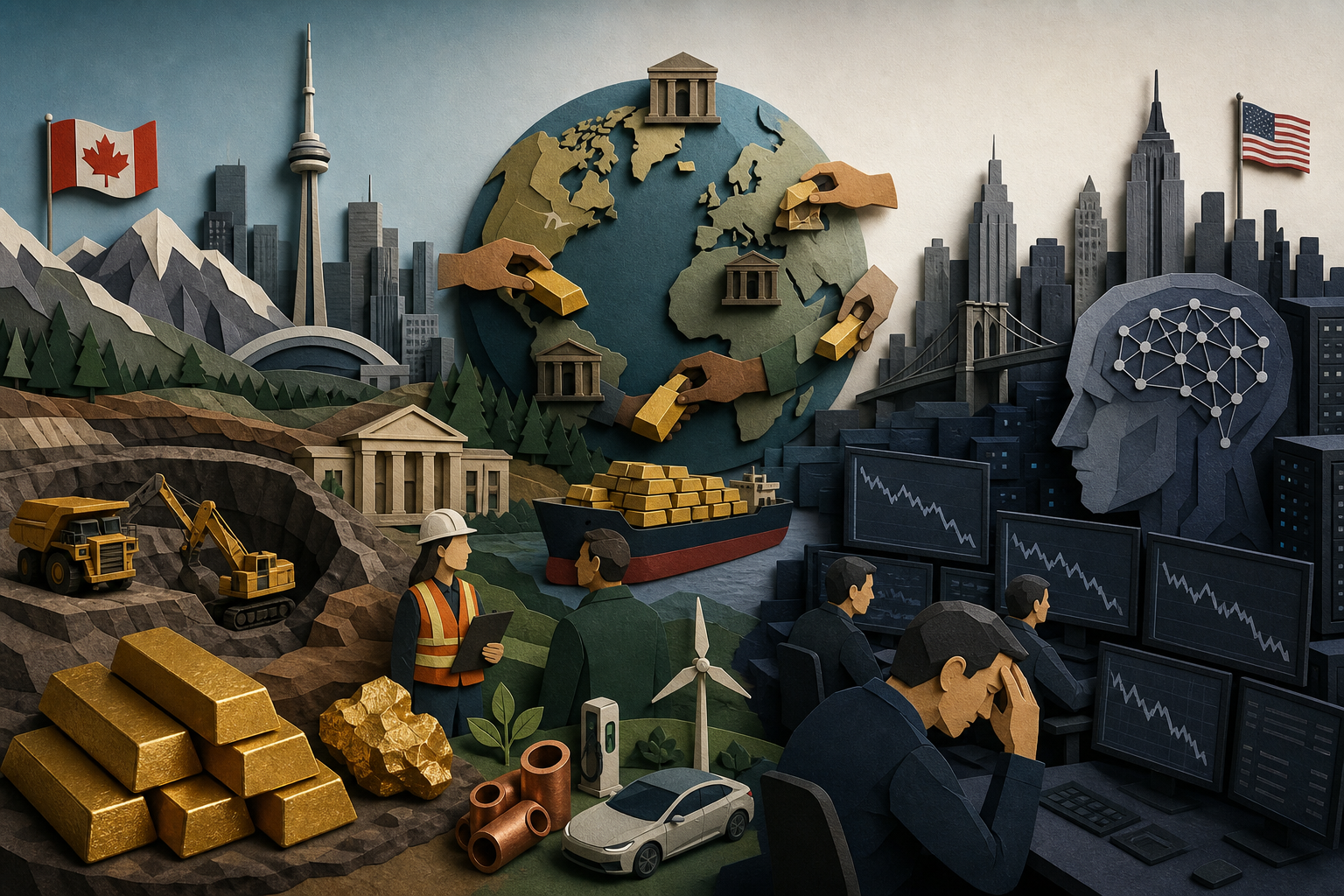

Barrick Gold added 2.7% by mid-morning Tuesday while NVIDIA shed 3.1%, and that split tells you everything about where money is moving right now.
The S&P/TSX Composite climbed 140 points while the S&P 500 and Nasdaq both slipped into the red, a divergence driven entirely by what's underneath each index. Canada's market is 45% materials and financials. The U.S. benchmark is 30% tech. When gold rallies and AI enthusiasm cools, those weightings stop being background trivia and start being the explanation for everything.
Gold is trading around $2,450 USD per ounce as of June 2026, up roughly 8% from the start of the year. That's not speculative froth. Central banks in emerging markets added a record 1,136 tonnes of bullion to reserves in 2023, and the pace hasn't slowed. The World Gold Council tracks this closely: sovereign buyers are diversifying away from the USD, and that creates a floor under the metal that retail sentiment alone never could. For the TSX, which hosts nearly half of the world's publicly traded mining and exploration companies, a $2,400+ gold price is structural support.
The Bank of Canada's overnight rate sits at 3.75%, down from 5.00% a year ago. Lower rates reduce the opportunity cost of holding non-yielding assets like gold. The Federal Reserve, meanwhile, is still signaling a "higher for longer" stance, keeping U.S. rates elevated. That divergence matters. Canadian miners benefit from easing domestic borrowing costs while the commodity they extract gains value as global investors hunt for hedges against sticky inflation and geopolitical instability. Trade tensions haven't disappeared; they've just shifted from tariff threats to rare earth supply chain fights. Gold doesn't care about the narrative. It cares about uncertainty.
Why tech fell while materials climbed
The AI trade isn't dead. It's getting repriced. Investors spent 18 months bidding up companies on the promise of future earnings from generative AI tools. Now they want proof. Microsoft, Alphabet, and Meta all beat earnings last quarter, but forward guidance disappointed analysts looking for AI revenue to show up in concrete line items. NVIDIA's share price is off 11% from its March peak. That's not a crash, it's a valuation correction when the market decides software projections aren't worth 40x revenue multiples anymore.
The rotation out of tech isn't scattering randomly. Some of it is landing in gold miners, which are now using windfall profits to fund copper and lithium exploration. The green energy transition needs both: copper for wiring, lithium for batteries. Teck Resources reported that copper demand from electric vehicle manufacturers is up 23% year-over-year in North America. Gold pays the bills, but miners are positioning for what comes next.
Canadian equities benefit from what they lack. The TSX has almost no exposure to high-growth software or semiconductors, which historically makes it a laggard during long bull markets. When those sectors stumble, though, the absence becomes an advantage. A portfolio manager in Toronto holding Canadian Natural Resources and Agnico Eagle doesn't wake up worried about whether ChatGPT subscriptions are converting at the rate analysts projected.
The cost that doesn't show up in the headlines
Gold's rally isn't cost-free for miners. Diesel fuel, specialized labor, and heavy equipment are all up 12-18% over the past two years. Mining margins have improved because gold prices rose faster than input costs, but inflation hasn't disappeared. A $2,450 gold price sounds strong until you subtract $1,800 in all-in sustaining costs, which is the current industry average for mid-tier producers. The real margin is narrower than the headline suggests.
The stronger Canadian dollar, up 4% against the USD since January, also mutes some of the gain. Gold is priced in USD, so when the loonie strengthens, Canadian producers receive less revenue per ounce in domestic currency terms. Not enough to erase the rally, but enough to shave 2-3% off the nominal gain.
Still, the math works. The TSX is up, tech is down, and the explanation is simpler than most market commentary makes it sound: the index that owns the mines wins when the metal they dig up becomes more valuable. No thesis required.
Read Next
GIC rates stall as bonds retreat: why deposit accounts still lag
Why Your Employer's Life Insurance Probably Covers Less Than You Think
August Sales Fell 6.9%: What CREA's Numbers Actually Reveal About Buyer Hesitation
Canada's Resource Advantage: What Global Investors Are Betting On in 2026