CMHC's 2026 Forecast Contradicts the 'Housing Always Recovers Quickly' Assumption
A 47-year-old homeowner in Etobicoke who bought in 2021 has spent the last four years hearing that any price softness would be brief. Housing always bounces back. It's Canada. We have scarcity. Immigration. Geography. The argument isn't even really an argument anymore, it's an assumption baked into household balance sheets and retirement planning across the country.
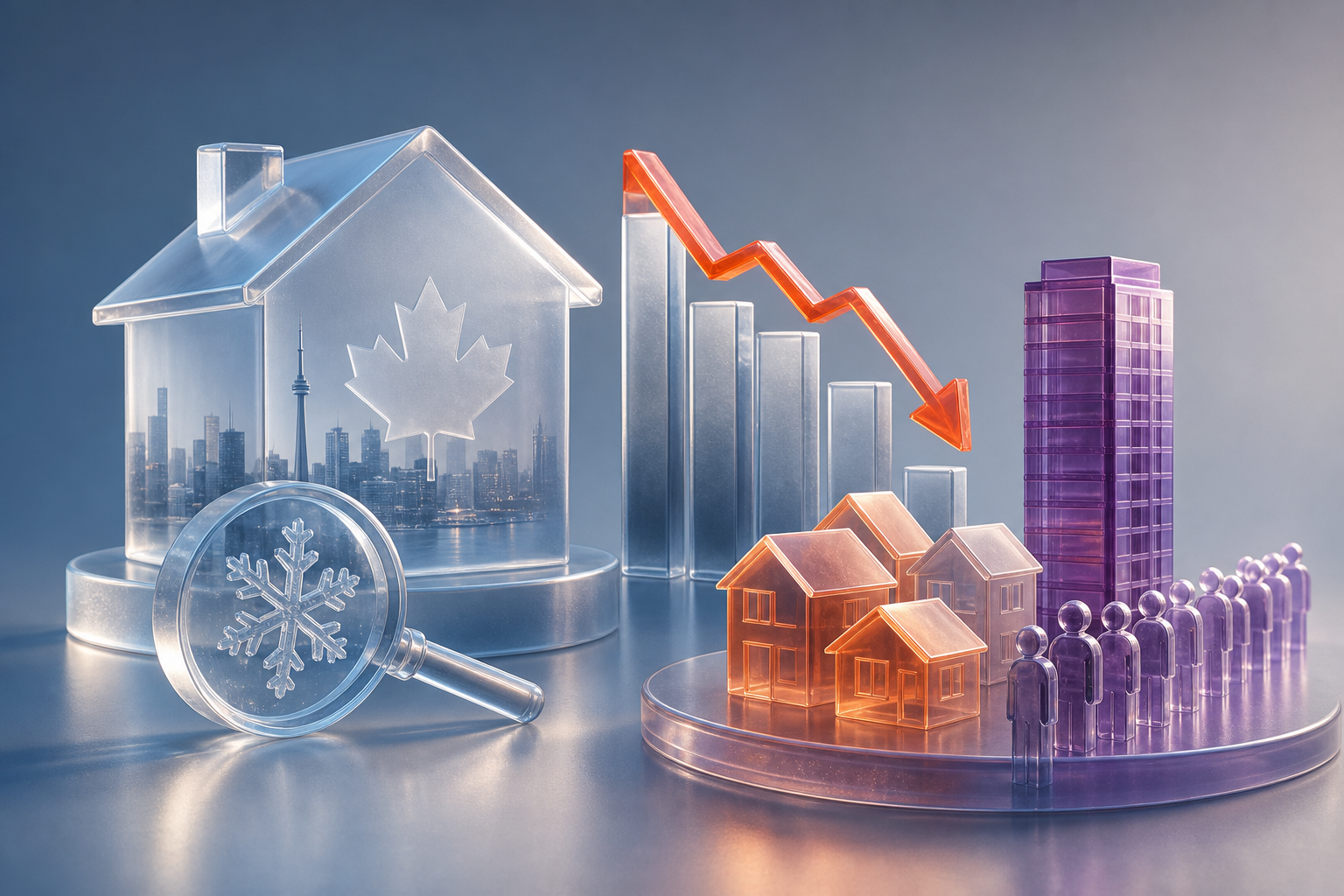
The Canada Mortgage and Housing Corporation's revised 2026 outlook doesn't support that story. The agency is now projecting declines in home sales, prices, and housing starts heading into next year, driven by a combination of elevated borrowing costs, economic uncertainty, and a meaningful slowdown in population growth following federal caps on temporary residents. This isn't a two-quarter wobble. CMHC is describing a structural shift in the conditions that have historically kept the market hot.
Why the logic broke
The "housing always recovers" belief comes from pattern recognition, not economic law. Between 1995 and 2020, Canadian home prices experienced brief corrections but never sustained multi-year declines at the national level. Buyers learned that waiting meant missing out. Sellers learned that inventory shortages would rescue valuations. The pattern held long enough to feel permanent.
But the pattern was built on cheap credit and accelerating population growth. Both inputs have reversed. The Bank of Canada's policy rate, even after several cuts in 2025, remains structurally higher than the pre-pandemic decade. Mortgage stress tests now eliminate a large share of first-time buyers who would have qualified in 2019. And population growth, while still positive, has slowed sharply due to caps on study permits and work visas implemented in late 2024 and 2025. The demand pipeline that kept the market tight is no longer filling at the same rate.
Housing starts are projected to drop below 200,000 units annualized in certain quarters of 2026, according to CMHC. Developers are pulling back, not because demand has disappeared, but because the cost of capital makes new projects unviable at current price points. That creates a second-order problem: the supply lag being created now will likely trigger another price spike in 2028 or 2029, once rates stabilize and demand returns. The market isn't healing. It's cycling between undersupply and unaffordability.
The wait-and-see trap
Buyers aren't just priced out, they're psychologically sidelined. Inventory is rising in the Greater Toronto Area and Greater Vancouver Area as listings sit longer, but transaction volume is falling because buyers are waiting for a definitive bottom that may never be obvious in real time. The "scarcity panic" that defined 2021 and 2022 has flipped into "wait-and-see paralysis." Neither state produces a functional market.
The counterargument is that this is a correction, not a collapse. Most Canadian homeowners hold significant equity. Forced sales remain rare. The rental market is still tight, with national vacancy rates near 1.5% in major hubs. The fundamentals haven't failed, they've just stopped supporting the appreciation rate everyone came to expect.
Fair enough. But a correction following a 50% price run-up over three years still means a generation of recent buyers is underwater on a nominal basis, and a cohort of would-be buyers has been pushed out of the market entirely. The "no crash" framing is accurate and also irrelevant to the household that refinanced in 2021 at 1.79% and is now renewing at 5.2%.
The housing market isn't crashing. It's stalling. And a stall, in a country that has treated housing as the primary wealth-building asset for two decades, is its own kind of crisis.



A 47-year-old homeowner in Etobicoke who bought in 2021 has spent the last four years hearing that any price softness would be brief. Housing always bounces back. It's Canada. We have scarcity. Immigration. Geography. The argument isn't even really an argument anymore, it's an assumption baked into household balance sheets and retirement planning across the country.
The Canada Mortgage and Housing Corporation's revised 2026 outlook doesn't support that story. The agency is now projecting declines in home sales, prices, and housing starts heading into next year, driven by a combination of elevated borrowing costs, economic uncertainty, and a meaningful slowdown in population growth following federal caps on temporary residents. This isn't a two-quarter wobble. CMHC is describing a structural shift in the conditions that have historically kept the market hot.
Why the logic broke
The "housing always recovers" belief comes from pattern recognition, not economic law. Between 1995 and 2020, Canadian home prices experienced brief corrections but never sustained multi-year declines at the national level. Buyers learned that waiting meant missing out. Sellers learned that inventory shortages would rescue valuations. The pattern held long enough to feel permanent.
But the pattern was built on cheap credit and accelerating population growth. Both inputs have reversed. The Bank of Canada's policy rate, even after several cuts in 2025, remains structurally higher than the pre-pandemic decade. Mortgage stress tests now eliminate a large share of first-time buyers who would have qualified in 2019. And population growth, while still positive, has slowed sharply due to caps on study permits and work visas implemented in late 2024 and 2025. The demand pipeline that kept the market tight is no longer filling at the same rate.
Housing starts are projected to drop below 200,000 units annualized in certain quarters of 2026, according to CMHC. Developers are pulling back, not because demand has disappeared, but because the cost of capital makes new projects unviable at current price points. That creates a second-order problem: the supply lag being created now will likely trigger another price spike in 2028 or 2029, once rates stabilize and demand returns. The market isn't healing. It's cycling between undersupply and unaffordability.
The wait-and-see trap
Buyers aren't just priced out, they're psychologically sidelined. Inventory is rising in the Greater Toronto Area and Greater Vancouver Area as listings sit longer, but transaction volume is falling because buyers are waiting for a definitive bottom that may never be obvious in real time. The "scarcity panic" that defined 2021 and 2022 has flipped into "wait-and-see paralysis." Neither state produces a functional market.
The counterargument is that this is a correction, not a collapse. Most Canadian homeowners hold significant equity. Forced sales remain rare. The rental market is still tight, with national vacancy rates near 1.5% in major hubs. The fundamentals haven't failed, they've just stopped supporting the appreciation rate everyone came to expect.
Fair enough. But a correction following a 50% price run-up over three years still means a generation of recent buyers is underwater on a nominal basis, and a cohort of would-be buyers has been pushed out of the market entirely. The "no crash" framing is accurate and also irrelevant to the household that refinanced in 2021 at 1.79% and is now renewing at 5.2%.
The housing market isn't crashing. It's stalling. And a stall, in a country that has treated housing as the primary wealth-building asset for two decades, is its own kind of crisis.
Read Next
GIC rates stall as bonds retreat: why deposit accounts still lag
Why Your Employer's Life Insurance Probably Covers Less Than You Think
August Sales Fell 6.9%: What CREA's Numbers Actually Reveal About Buyer Hesitation
Canada's Resource Advantage: What Global Investors Are Betting On in 2026