Canada's Oil Surge Isn't Economic Recovery, It's Proof We Never Diversified
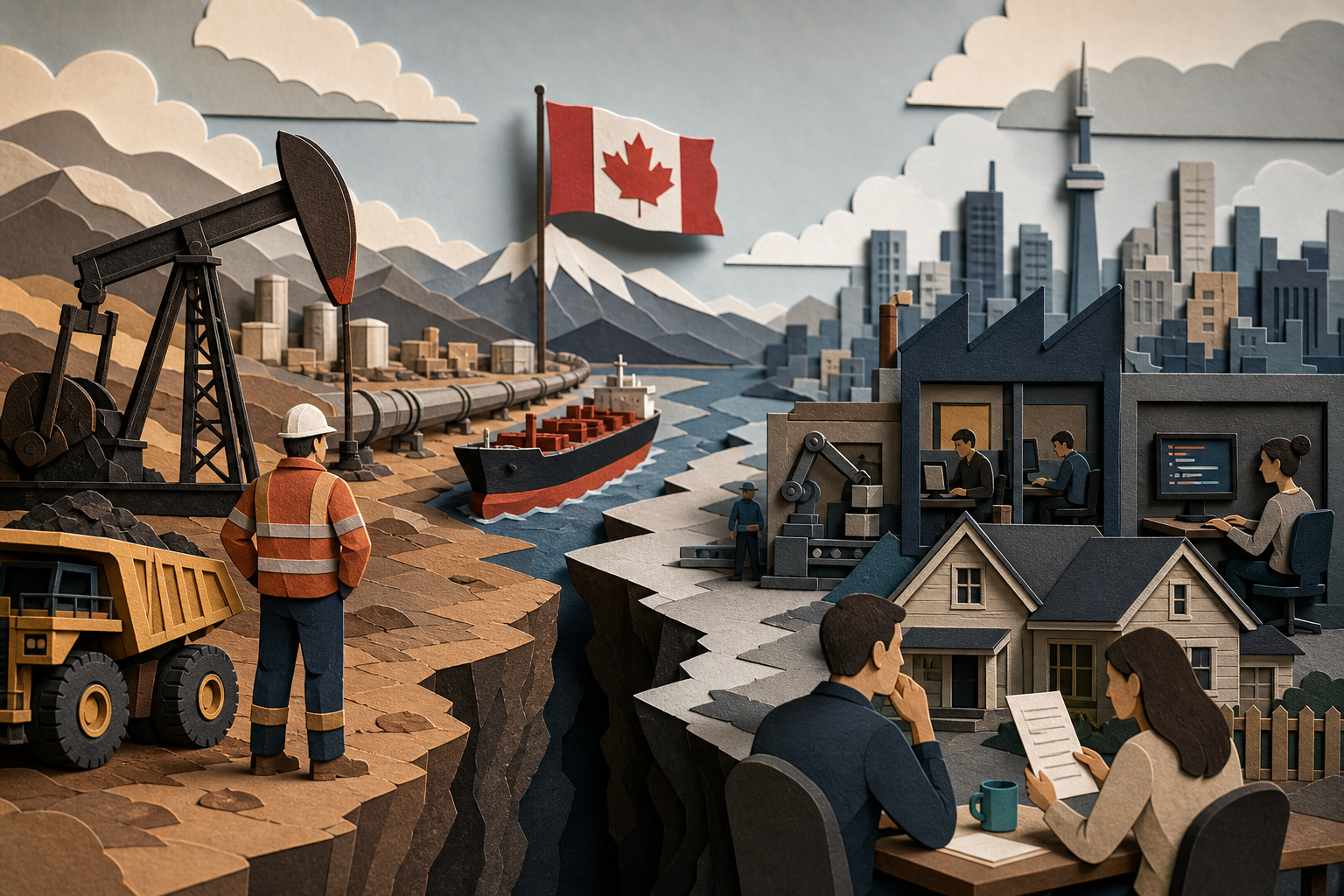
Alberta's oilpatch is running flat-out again, and everyone from Bay Street to the Bank of Canada is calling it a recovery. The Trans Mountain Pipeline is moving 890,000 barrels a day, the WCS-WTI differential has tightened to $13, and after six months of GDP going nowhere, Q2 2026 finally showed positive momentum. Fine. Call it growth if you want. But calling it recovery ignores what the numbers actually prove: we never built anything else that could have done this.
The Rebound Story Hides the Real Dependency
The Q2 spike came almost entirely from increased energy exports to the U.S. and Asian markets. Manufacturing stayed sluggish. Tech hiring didn't materialize. Domestic consumer spending crept up cautiously, constrained by debt servicing on mortgages renewed at rates three times what they were in 2021. The thing that broke the stagnation was the same thing that broke it in 2010, in 2000, in 1985. We drilled more and shipped it faster.
That's not diversification. That's the opposite. An economy with real structural breadth doesn't rebound through a single commodity getting hot. It rebounds through multiple sectors picking up simultaneously, through productivity gains across industries, through innovation producing exportable IP. Canada's Q2 wasn't that. It was Alberta and Saskatchewan doing what they've always done, at higher volumes, while the rest of the country limped along.
The political framing around this matters. When energy drives a rebound, federal and provincial governments treat it like vindication rather than diagnosis. The rhetoric becomes "Canadian energy is back," not "we still haven't solved the underlying problem." Policy conversations shift back to pipeline capacity and regulatory streamlining, which are legitimate short-term revenue levers but do nothing to address what happens the next time oil prices crater or global demand shifts structurally away from hydrocarbons.
The Per Capita Problem Doesn't Go Away
Here's the piece most coverage skips: total GDP can grow while individual Canadians get poorer. The late-2025 period wasn't just slow growth. It was a per-capita recession, where population growth from immigration outpaced economic output. A Q2 rebound driven by energy exports doesn't fix that unless the gains flow through into wage growth, which in a capital-intensive sector like oil production, they mostly don't.
The unemployment rate sits around 6.3%. That's stable, not recovering. The rebound is coming from productivity and exports, not from businesses hiring aggressively. A 28-year-old software developer in Toronto or a 35-year-old manufacturing technician in Oshawa isn't seeing the Q2 growth show up in their bank account. The spreadsheet at Statistics Canada looks better. Their life doesn't.
This creates a political risk that gets underestimated. If the "recovery" narrative takes hold but individual financial stress stays high, you get a disconnect where official numbers say things are improving and voters feel like they're being gaslit. The mortgage renewal wall continues through 2027. Credit card debt is sitting at record levels. A GDP spike driven by energy doesn't service those debts or lower grocery bills.
What Diversification Would Actually Look Like
A diversified recovery would show up differently in the data. You'd see concurrent rebounds in tech exports, advanced manufacturing output, and non-resource services. You'd see venture funding recover alongside oil production. You'd see Ontario and Quebec contributing as much to the rebound as the Prairies.
None of that happened in Q2. The differential in regional economic performance actually widened. The story here isn't that Canada recovered. It's that Canada has one reliable engine, and when that engine turns on, the national numbers improve while the structural vulnerability stays exactly where it was.
The Bank of Canada now faces a more complicated rate environment. Stronger GDP makes further cuts harder to justify if inflation stays sticky, but holding rates higher punishes the sectors and households that didn't benefit from the oil surge. That's the problem with commodity-driven growth. It creates policy paralysis because the gains are unevenly distributed and the risks of overheating are real but localized.
We're not in a recovery. We're in the same place we've been for thirty years, just with the oil tap turned back on.



Alberta's oilpatch is running flat-out again, and everyone from Bay Street to the Bank of Canada is calling it a recovery. The Trans Mountain Pipeline is moving 890,000 barrels a day, the WCS-WTI differential has tightened to $13, and after six months of GDP going nowhere, Q2 2026 finally showed positive momentum. Fine. Call it growth if you want. But calling it recovery ignores what the numbers actually prove: we never built anything else that could have done this.
The Rebound Story Hides the Real Dependency
The Q2 spike came almost entirely from increased energy exports to the U.S. and Asian markets. Manufacturing stayed sluggish. Tech hiring didn't materialize. Domestic consumer spending crept up cautiously, constrained by debt servicing on mortgages renewed at rates three times what they were in 2021. The thing that broke the stagnation was the same thing that broke it in 2010, in 2000, in 1985. We drilled more and shipped it faster.
That's not diversification. That's the opposite. An economy with real structural breadth doesn't rebound through a single commodity getting hot. It rebounds through multiple sectors picking up simultaneously, through productivity gains across industries, through innovation producing exportable IP. Canada's Q2 wasn't that. It was Alberta and Saskatchewan doing what they've always done, at higher volumes, while the rest of the country limped along.
The political framing around this matters. When energy drives a rebound, federal and provincial governments treat it like vindication rather than diagnosis. The rhetoric becomes "Canadian energy is back," not "we still haven't solved the underlying problem." Policy conversations shift back to pipeline capacity and regulatory streamlining, which are legitimate short-term revenue levers but do nothing to address what happens the next time oil prices crater or global demand shifts structurally away from hydrocarbons.
The Per Capita Problem Doesn't Go Away
Here's the piece most coverage skips: total GDP can grow while individual Canadians get poorer. The late-2025 period wasn't just slow growth. It was a per-capita recession, where population growth from immigration outpaced economic output. A Q2 rebound driven by energy exports doesn't fix that unless the gains flow through into wage growth, which in a capital-intensive sector like oil production, they mostly don't.
The unemployment rate sits around 6.3%. That's stable, not recovering. The rebound is coming from productivity and exports, not from businesses hiring aggressively. A 28-year-old software developer in Toronto or a 35-year-old manufacturing technician in Oshawa isn't seeing the Q2 growth show up in their bank account. The spreadsheet at Statistics Canada looks better. Their life doesn't.
This creates a political risk that gets underestimated. If the "recovery" narrative takes hold but individual financial stress stays high, you get a disconnect where official numbers say things are improving and voters feel like they're being gaslit. The mortgage renewal wall continues through 2027. Credit card debt is sitting at record levels. A GDP spike driven by energy doesn't service those debts or lower grocery bills.
What Diversification Would Actually Look Like
A diversified recovery would show up differently in the data. You'd see concurrent rebounds in tech exports, advanced manufacturing output, and non-resource services. You'd see venture funding recover alongside oil production. You'd see Ontario and Quebec contributing as much to the rebound as the Prairies.
None of that happened in Q2. The differential in regional economic performance actually widened. The story here isn't that Canada recovered. It's that Canada has one reliable engine, and when that engine turns on, the national numbers improve while the structural vulnerability stays exactly where it was.
The Bank of Canada now faces a more complicated rate environment. Stronger GDP makes further cuts harder to justify if inflation stays sticky, but holding rates higher punishes the sectors and households that didn't benefit from the oil surge. That's the problem with commodity-driven growth. It creates policy paralysis because the gains are unevenly distributed and the risks of overheating are real but localized.
We're not in a recovery. We're in the same place we've been for thirty years, just with the oil tap turned back on.
Read Next
GIC rates stall as bonds retreat: why deposit accounts still lag
Why Your Employer's Life Insurance Probably Covers Less Than You Think
August Sales Fell 6.9%: What CREA's Numbers Actually Reveal About Buyer Hesitation
Canada's Resource Advantage: What Global Investors Are Betting On in 2026