Canada faces 50% U.S. tariffs as Carney promises counter-measures: what comes next for cross-border trade
The midnight deadline came and went. By 12:01 a.m., negotiators on both sides of the border had packed their briefcases, and a 50% ad valorem tax was live on a range of Canadian exports. What collapsed was not just another round of talks, it was the working assumption that cross-border trade between the two countries operates under a framework of predictable rules.
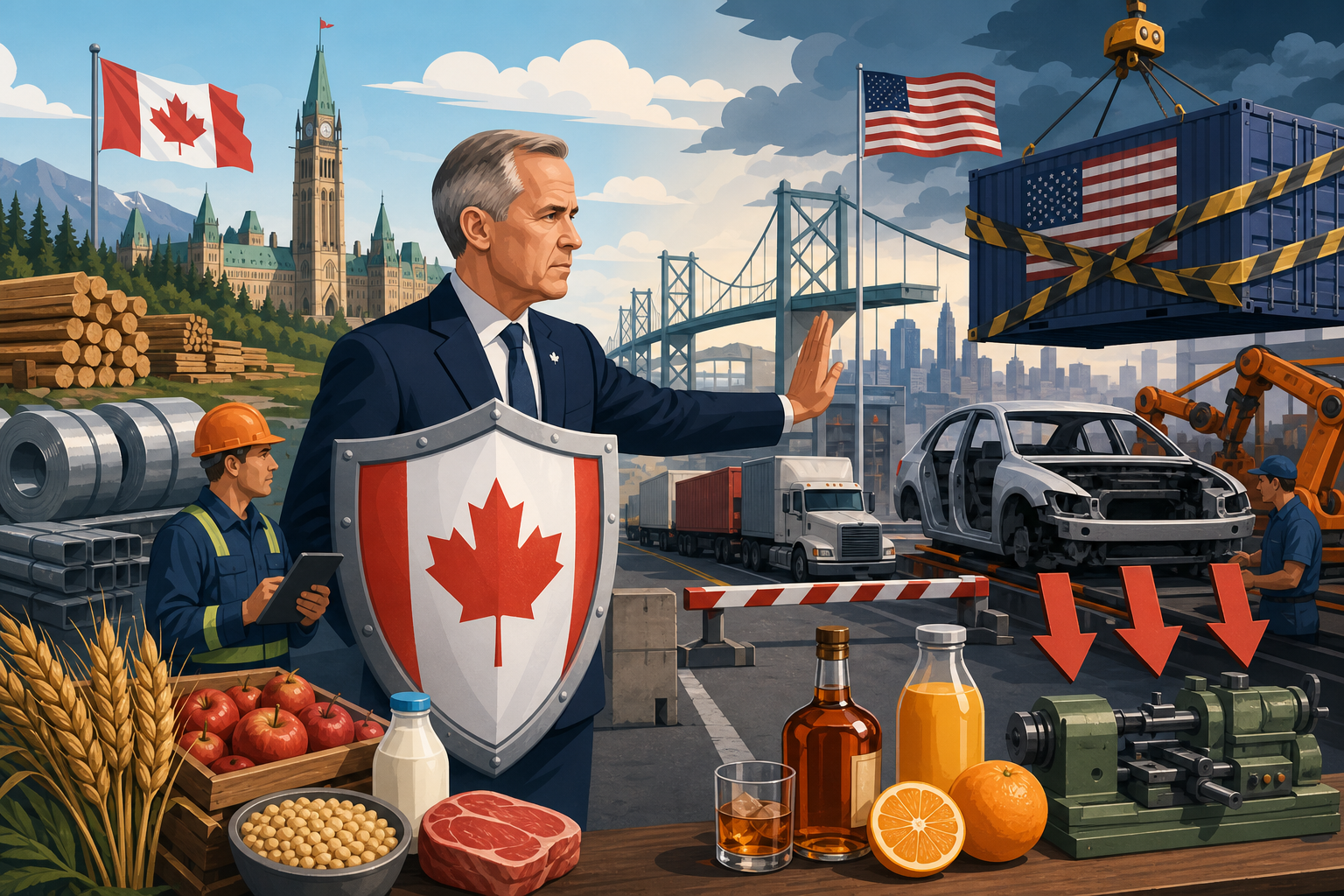
The tariff applies broadly. Steel, aluminum, softwood lumber, and agricultural products are all caught in the net, along with automotive parts that cross the border multiple times during assembly. The Congressional Research Service pegged Canada's retaliatory package in March 2026 at C$15.6 billion, targeting U.S. exports where the political pain would register fastest: bourbon, orange juice, machinery from swing states. Prime Minister Mark Carney's government has signaled it will escalate further, matching the U.S. action dollar for dollar.
What a 50% tariff actually does to supply chains
The automotive sector illustrates the damage. A single vehicle assembled in Ontario might contain components that originated in Michigan, were shipped to Windsor for sub-assembly, returned to Detroit for integration, and crossed back into Canada for final assembly before heading to a dealership in Calgary. Under the tariff regime now in place, each border crossing triggers the levy. The tariff hits both sides equally because the supply chain was designed on the premise that the border was functionally transparent for manufacturing.
Energy flows the same way. Canada supplies the United States with more crude oil, natural gas, and electricity than any other foreign country. A tariff on energy exports raises costs for U.S. refineries and utilities, which will pass those costs to consumers. The C$3.6 billion in goods that moves between the two countries every day, tracked by Wiley Law's analysis as of August 2026, was built on the assumption that shipping could happen without a tariff at each crossing.
The Carney calculation
Mark Carney spent years as Governor of the Bank of Canada and later the Bank of England, where the operating style was technocratic precision and measured responses. The Prime Minister's Office is a different environment. The decision to promise dollar-for-dollar retaliation is a signal that this government will not absorb the hit quietly in hopes of salvaging goodwill.
The counter-tariffs already in place since March targeted industries with outsize political influence in the U.S. Adding to that list means finding exports that hurt specific congressional districts without wrecking Canadian industries that depend on those same imports. The range is narrower than it looks. Canada exports more to the U.S. than it imports, but many of those exports are energy and commodities that Canada cannot easily withhold without self-inflicted damage, so the retaliation has to be surgical.
What happens in the mortgage market and at the grocery store
Trade wars feed into inflation through two channels. The first is direct: tariffs raise the landed cost of imported goods, and retailers pass that through. The second is indirect: bond markets react to economic uncertainty by repricing risk, which moves yields, which in turn shifts the five-year fixed mortgage rates that most Canadian borrowers lock in. In August 2026, that volatility is already showing up in rate sheets.
The grocery aisle will feel it too. Canada imports produce from the U.S. during the winter months when domestic supply disappears. A tariff on those shipments raises prices at checkout, and the hit lands hardest on households that spend the largest share of income on food.
The CUSMA joint review, scheduled for July 1, 2026 according to Global Affairs Canada, was supposed to be a routine confirmation that the trade agreement still worked for all three parties. Instead, the U.S. has effectively sidelined the dispute resolution process the agreement was built to provide, opting for unilateral tariffs and forcing Canada to respond in kind. The two countries are now escalating outside any framework at all.



The midnight deadline came and went. By 12:01 a.m., negotiators on both sides of the border had packed their briefcases, and a 50% ad valorem tax was live on a range of Canadian exports. What collapsed was not just another round of talks, it was the working assumption that cross-border trade between the two countries operates under a framework of predictable rules.
The tariff applies broadly. Steel, aluminum, softwood lumber, and agricultural products are all caught in the net, along with automotive parts that cross the border multiple times during assembly. The Congressional Research Service pegged Canada's retaliatory package in March 2026 at C$15.6 billion, targeting U.S. exports where the political pain would register fastest: bourbon, orange juice, machinery from swing states. Prime Minister Mark Carney's government has signaled it will escalate further, matching the U.S. action dollar for dollar.
What a 50% tariff actually does to supply chains
The automotive sector illustrates the damage. A single vehicle assembled in Ontario might contain components that originated in Michigan, were shipped to Windsor for sub-assembly, returned to Detroit for integration, and crossed back into Canada for final assembly before heading to a dealership in Calgary. Under the tariff regime now in place, each border crossing triggers the levy. The tariff hits both sides equally because the supply chain was designed on the premise that the border was functionally transparent for manufacturing.
Energy flows the same way. Canada supplies the United States with more crude oil, natural gas, and electricity than any other foreign country. A tariff on energy exports raises costs for U.S. refineries and utilities, which will pass those costs to consumers. The C$3.6 billion in goods that moves between the two countries every day, tracked by Wiley Law's analysis as of August 2026, was built on the assumption that shipping could happen without a tariff at each crossing.
The Carney calculation
Mark Carney spent years as Governor of the Bank of Canada and later the Bank of England, where the operating style was technocratic precision and measured responses. The Prime Minister's Office is a different environment. The decision to promise dollar-for-dollar retaliation is a signal that this government will not absorb the hit quietly in hopes of salvaging goodwill.
The counter-tariffs already in place since March targeted industries with outsize political influence in the U.S. Adding to that list means finding exports that hurt specific congressional districts without wrecking Canadian industries that depend on those same imports. The range is narrower than it looks. Canada exports more to the U.S. than it imports, but many of those exports are energy and commodities that Canada cannot easily withhold without self-inflicted damage, so the retaliation has to be surgical.
What happens in the mortgage market and at the grocery store
Trade wars feed into inflation through two channels. The first is direct: tariffs raise the landed cost of imported goods, and retailers pass that through. The second is indirect: bond markets react to economic uncertainty by repricing risk, which moves yields, which in turn shifts the five-year fixed mortgage rates that most Canadian borrowers lock in. In August 2026, that volatility is already showing up in rate sheets.
The grocery aisle will feel it too. Canada imports produce from the U.S. during the winter months when domestic supply disappears. A tariff on those shipments raises prices at checkout, and the hit lands hardest on households that spend the largest share of income on food.
The CUSMA joint review, scheduled for July 1, 2026 according to Global Affairs Canada, was supposed to be a routine confirmation that the trade agreement still worked for all three parties. Instead, the U.S. has effectively sidelined the dispute resolution process the agreement was built to provide, opting for unilateral tariffs and forcing Canada to respond in kind. The two countries are now escalating outside any framework at all.
Sources
Read Next
GIC rates stall as bonds retreat: why deposit accounts still lag
Why Your Employer's Life Insurance Probably Covers Less Than You Think
August Sales Fell 6.9%: What CREA's Numbers Actually Reveal About Buyer Hesitation
Canada's Resource Advantage: What Global Investors Are Betting On in 2026