BMO Says Bank of Canada Rate Cuts Are Off the Table, Unless Trump Follows Through
The Bank of Canada's overnight rate has been parked in restrictive territory for months now, but that stance assumes a world where cross-border trade flows remain roughly predictable. If Donald Trump's administration follows through on the 10 to 20 percent blanket tariffs it's been floating since late 2025, that assumption breaks.
BMO Capital Markets released a note in July arguing that the BoC's "higher-for-longer" position is conditional. The base case, no cuts in 2026, holds only if trade policy stays within historical norms. But Trump's track record suggests historical norms are not the operating framework. The USMCA's mandatory 2026 review is already being used as leverage, and the threat alone has been enough to freeze capital expenditure decisions across Central Canada's manufacturing belt.
Why tariffs change the math
Tariffs are usually thought of as inflationary. They raise the cost of imported goods, which shows up in CPI, which theoretically keeps the BoC's hands tied. That logic works in a closed system. It breaks when you account for what tariffs do to aggregate demand.
Canada sends over 75 percent of its merchandise exports to the United States. A broad tariff regime effectively taxes one-third of Canadian GDP. The initial price spike from costlier imports gets swamped by the demand collapse that follows when exporters lose access to their primary market. Business investment stalls. Hiring freezes. Consumer confidence craters. The BoC suddenly faces a deflationary slump dressed up in short-term inflationary clothing.
The central bank's legal mandate is price stability, which in practice means keeping CPI around 2 percent. But if tariffs trigger a recession, the inflation component becomes a second-order problem. The first-order problem is preventing a full-blown contraction. That's when cuts come back into play.
The mortgage market's perverse incentive
Canadian homeowners have been waiting for rate relief since mid-2024. Mortgage holders who locked in at 1.79 percent in 2021 and are now facing renewal at 5.5 percent have been counting on a return to lower borrowing costs. Under the original BoC trajectory, that relief was not coming in 2026. The bank was prioritizing inflation control over housing affordability.
Tariffs flip the script. The economic shock that makes life harder for exporters and manufacturers is the same shock that forces the BoC to ease. Mortgage relief, in this scenario, arrives not because the economy is healthy but because it's wounded. The people who benefit from rate cuts are the same people whose jobs are at risk from the trade war that triggered them.
The currency trap nobody mentions
A falling Canadian dollar usually helps exporters by making their goods cheaper in foreign markets. That's the textbook offset. But if the U.S. market is functionally closed by tariffs, the weak loonie just makes imports more expensive without providing the export boost. You get the inflation without the growth. Stagflation risk, in other words, which leaves the BoC with no good moves.
BMO's framing is careful. They're not predicting cuts. They're saying cuts become the least-bad option if Trump acts. The distinction matters because it shifts the debate from "when will rates fall" to "what breaks first." The answer to that second question depends entirely on whether the Trump administration treats tariff threats as negotiating posture or actual policy.
The 2026 USMCA review deadline is in four months. If it passes without major disruption, the BoC stays put and homeowners keep waiting. If it doesn't, the rate cuts arrive alongside a recession neither side wanted but both helped create.


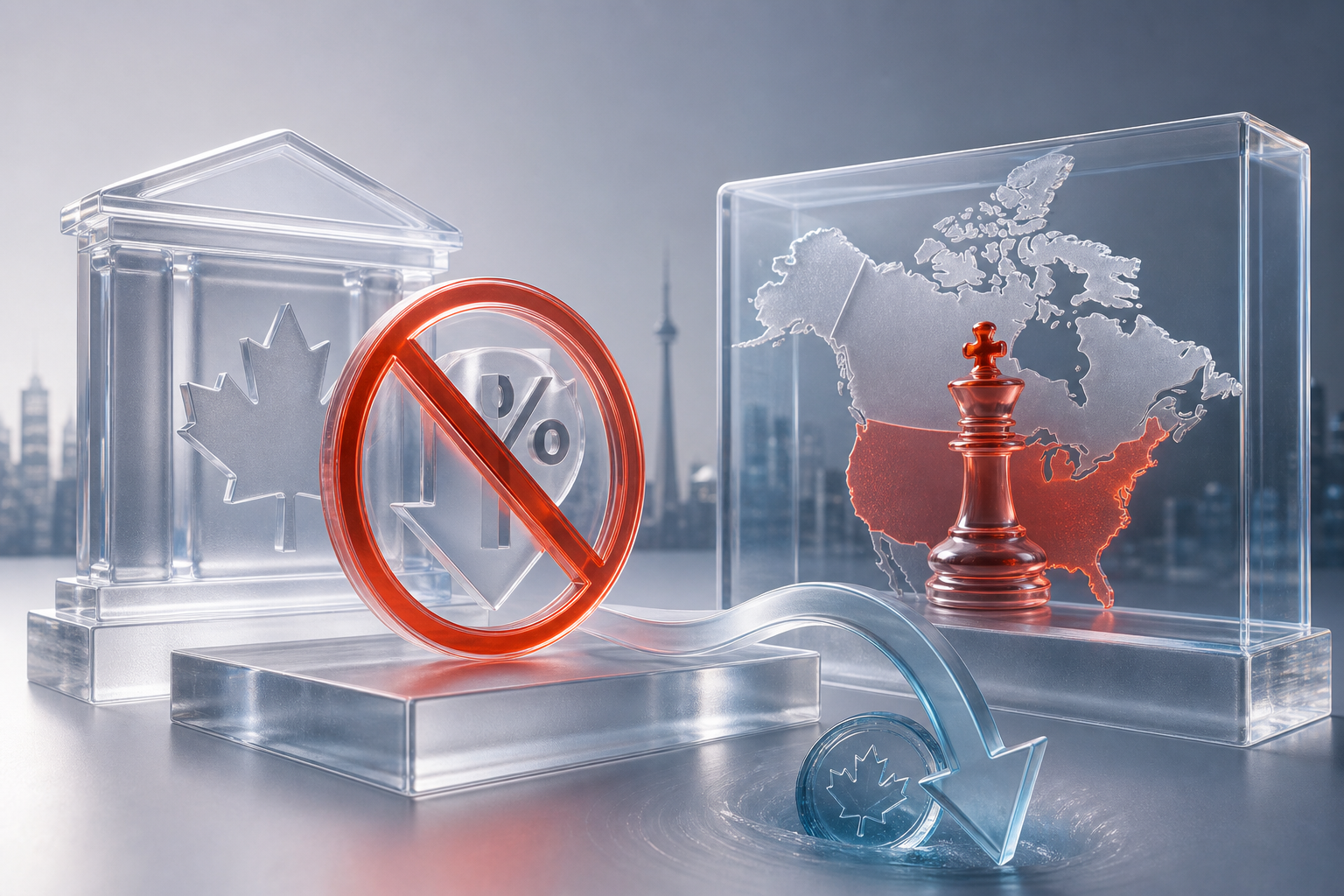

The Bank of Canada's overnight rate has been parked in restrictive territory for months now, but that stance assumes a world where cross-border trade flows remain roughly predictable. If Donald Trump's administration follows through on the 10 to 20 percent blanket tariffs it's been floating since late 2025, that assumption breaks.
BMO Capital Markets released a note in July arguing that the BoC's "higher-for-longer" position is conditional. The base case, no cuts in 2026, holds only if trade policy stays within historical norms. But Trump's track record suggests historical norms are not the operating framework. The USMCA's mandatory 2026 review is already being used as leverage, and the threat alone has been enough to freeze capital expenditure decisions across Central Canada's manufacturing belt.
Why tariffs change the math
Tariffs are usually thought of as inflationary. They raise the cost of imported goods, which shows up in CPI, which theoretically keeps the BoC's hands tied. That logic works in a closed system. It breaks when you account for what tariffs do to aggregate demand.
Canada sends over 75 percent of its merchandise exports to the United States. A broad tariff regime effectively taxes one-third of Canadian GDP. The initial price spike from costlier imports gets swamped by the demand collapse that follows when exporters lose access to their primary market. Business investment stalls. Hiring freezes. Consumer confidence craters. The BoC suddenly faces a deflationary slump dressed up in short-term inflationary clothing.
The central bank's legal mandate is price stability, which in practice means keeping CPI around 2 percent. But if tariffs trigger a recession, the inflation component becomes a second-order problem. The first-order problem is preventing a full-blown contraction. That's when cuts come back into play.
The mortgage market's perverse incentive
Canadian homeowners have been waiting for rate relief since mid-2024. Mortgage holders who locked in at 1.79 percent in 2021 and are now facing renewal at 5.5 percent have been counting on a return to lower borrowing costs. Under the original BoC trajectory, that relief was not coming in 2026. The bank was prioritizing inflation control over housing affordability.
Tariffs flip the script. The economic shock that makes life harder for exporters and manufacturers is the same shock that forces the BoC to ease. Mortgage relief, in this scenario, arrives not because the economy is healthy but because it's wounded. The people who benefit from rate cuts are the same people whose jobs are at risk from the trade war that triggered them.
The currency trap nobody mentions
A falling Canadian dollar usually helps exporters by making their goods cheaper in foreign markets. That's the textbook offset. But if the U.S. market is functionally closed by tariffs, the weak loonie just makes imports more expensive without providing the export boost. You get the inflation without the growth. Stagflation risk, in other words, which leaves the BoC with no good moves.
BMO's framing is careful. They're not predicting cuts. They're saying cuts become the least-bad option if Trump acts. The distinction matters because it shifts the debate from "when will rates fall" to "what breaks first." The answer to that second question depends entirely on whether the Trump administration treats tariff threats as negotiating posture or actual policy.
The 2026 USMCA review deadline is in four months. If it passes without major disruption, the BoC stays put and homeowners keep waiting. If it doesn't, the rate cuts arrive alongside a recession neither side wanted but both helped create.
Read Next
GIC rates stall as bonds retreat: why deposit accounts still lag
Why Your Employer's Life Insurance Probably Covers Less Than You Think
August Sales Fell 6.9%: What CREA's Numbers Actually Reveal About Buyer Hesitation
Canada's Resource Advantage: What Global Investors Are Betting On in 2026