Bicycle Insurance in Canada: 6 Ways to Protect Your Bike Without Buying a Separate Policy
A $4,500 e-bike stolen from outside a Toronto coffee shop. A road bike lifted from a Vancouver apartment parkade. Across Canadian cities, bicycle theft is common enough that many owners assume insurance is either too expensive or requires a standalone policy. Neither is true. Your existing home or tenant insurance already covers bicycles, both at home and away from the premises. The trick is making sure it actually pays out when you need it.
Check your policy's sub-limit, not your total contents coverage
Most homeowners' and tenant policies list bicycles under "personal property," but they cap claims at a per-item sub-limit. The standard range in 2026 is $500 to $2,000, depending on the insurer. If your bike cost $3,800, you're covered for $1,500 at most under a typical policy. Call your insurer and ask for the exact sub-limit on bicycles. The number is in your policy wording, usually buried in a "Special Limits" section. If the limit is lower than your bike's value, the next step is scheduling it.
Schedule high-value bikes as named items
Scheduling means adding your bike as a separate line item on the policy with its own coverage limit. You'll need the original receipt or a professional appraisal. The cost runs roughly 1-2% of the bike's value annually. A $5,000 bike adds about $50-$100 to your yearly premium. The payoff: full replacement cost coverage with no sub-limit, and in many cases, a lower or waived deductible on that specific item. Scheduled items are also covered for damage, not just theft. If you crash your carbon frame, some policies will pay for repairs.
Understand what your deductible actually costs you
Standard tenant and homeowner deductibles sit between $500 and $1,000. For a bike worth $700, a claim nets you $200 after the deductible. The larger cost is often the premium increase. Filing a claim typically removes your claims-free discount, which can raise premiums by 10-15% over the next three years. A $1,500 bike claim might cost you $600 in higher premiums plus $500 out of pocket upfront. Do the math before you file. For bikes under $1,200, you may be better off eating the loss and keeping your discount intact.
Keep the serial number and a dated photo
Insurers require proof of ownership. The serial number, usually stamped on the underside of the bottom bracket, is the single most important piece of evidence. Photograph it. Also photograph the bike itself with something date-stamped in the frame, a newspaper, a receipt, your phone's metadata. Store these in cloud storage, not just on your phone. When a bike is stolen, the first question the insurer asks is "Can you prove you owned this bike and what it was worth?" A photo with serial number visible answers both.
File a police report within 24 hours
Most insurers require a police report to process a theft claim, but many cyclists skip this step because they assume nothing will come of it. File anyway. Urban police forces in Vancouver, Toronto, and Montreal all accept online reports for stolen bikes. The report number is mandatory for your claim. In some cities, you can also register your bike's serial number with Project 529, a national recovery database. Registration is free and increases the odds of recovery if the bike turns up at a pawn shop or online marketplace.
Add your bike to your policy before you buy it, not after it's stolen
Insurance follows the asset. If you buy a $6,000 e-bike and don't notify your insurer within 30 days, many policies default to the standard sub-limit, not the bike's actual value. Call your broker the same week you buy. Scheduling takes less than 10 minutes and requires only the receipt. Waiting until after a theft to "add" the bike retroactively does not work. The coverage has to exist before the loss.
For bikes under $2,000, your existing policy likely covers you as-is. Above that, scheduling is cheap and eliminates the risk of a partial payout. The real cost isn't the premium, it's realizing your $7,000 bike was only insured for $1,500 after someone cuts the lock.


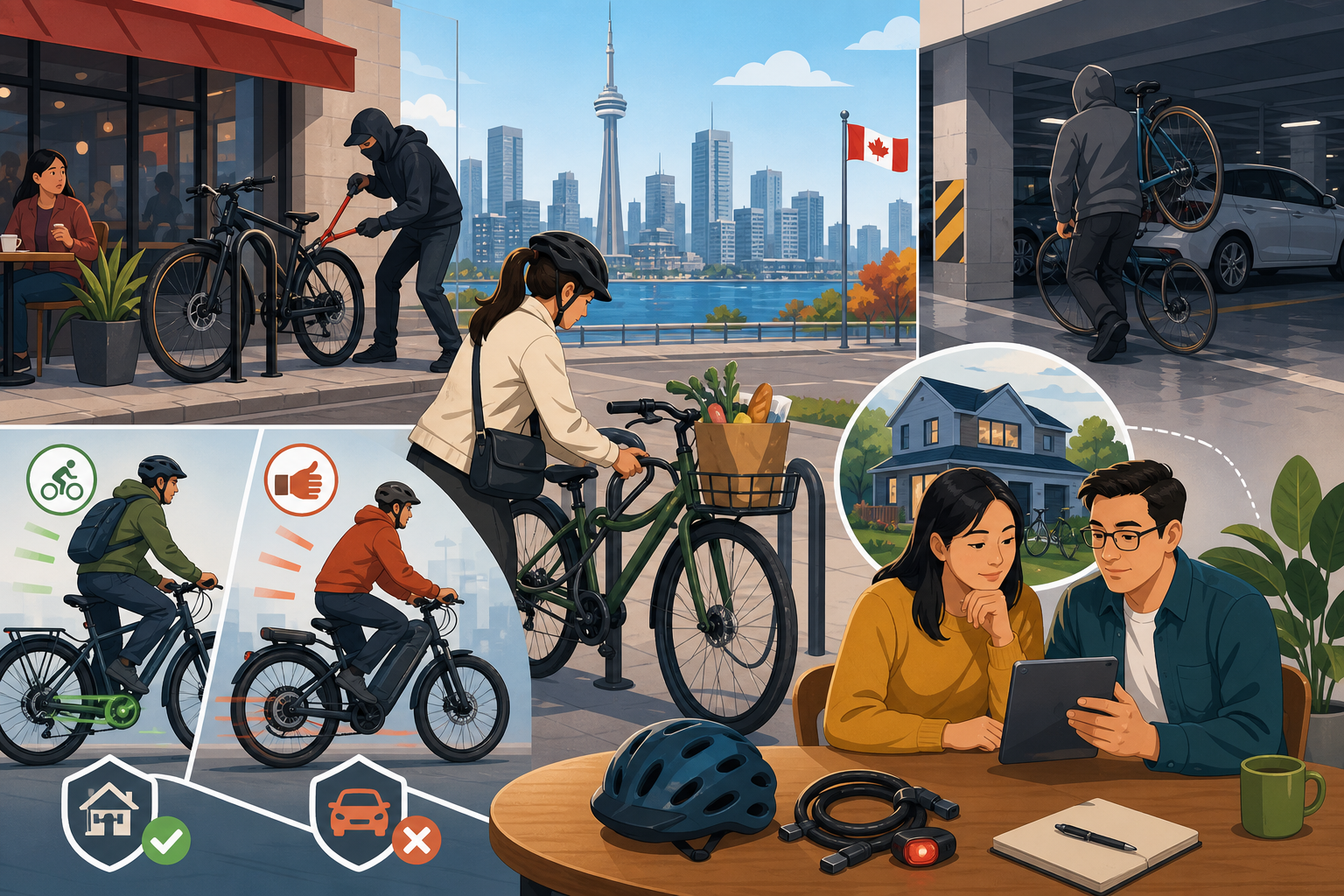

A $4,500 e-bike stolen from outside a Toronto coffee shop. A road bike lifted from a Vancouver apartment parkade. Across Canadian cities, bicycle theft is common enough that many owners assume insurance is either too expensive or requires a standalone policy. Neither is true. Your existing home or tenant insurance already covers bicycles, both at home and away from the premises. The trick is making sure it actually pays out when you need it.
Check your policy's sub-limit, not your total contents coverage
Most homeowners' and tenant policies list bicycles under "personal property," but they cap claims at a per-item sub-limit. The standard range in 2026 is $500 to $2,000, depending on the insurer. If your bike cost $3,800, you're covered for $1,500 at most under a typical policy. Call your insurer and ask for the exact sub-limit on bicycles. The number is in your policy wording, usually buried in a "Special Limits" section. If the limit is lower than your bike's value, the next step is scheduling it.
Schedule high-value bikes as named items
Scheduling means adding your bike as a separate line item on the policy with its own coverage limit. You'll need the original receipt or a professional appraisal. The cost runs roughly 1-2% of the bike's value annually. A $5,000 bike adds about $50-$100 to your yearly premium. The payoff: full replacement cost coverage with no sub-limit, and in many cases, a lower or waived deductible on that specific item. Scheduled items are also covered for damage, not just theft. If you crash your carbon frame, some policies will pay for repairs.
Understand what your deductible actually costs you
Standard tenant and homeowner deductibles sit between $500 and $1,000. For a bike worth $700, a claim nets you $200 after the deductible. The larger cost is often the premium increase. Filing a claim typically removes your claims-free discount, which can raise premiums by 10-15% over the next three years. A $1,500 bike claim might cost you $600 in higher premiums plus $500 out of pocket upfront. Do the math before you file. For bikes under $1,200, you may be better off eating the loss and keeping your discount intact.
Keep the serial number and a dated photo
Insurers require proof of ownership. The serial number, usually stamped on the underside of the bottom bracket, is the single most important piece of evidence. Photograph it. Also photograph the bike itself with something date-stamped in the frame, a newspaper, a receipt, your phone's metadata. Store these in cloud storage, not just on your phone. When a bike is stolen, the first question the insurer asks is "Can you prove you owned this bike and what it was worth?" A photo with serial number visible answers both.
File a police report within 24 hours
Most insurers require a police report to process a theft claim, but many cyclists skip this step because they assume nothing will come of it. File anyway. Urban police forces in Vancouver, Toronto, and Montreal all accept online reports for stolen bikes. The report number is mandatory for your claim. In some cities, you can also register your bike's serial number with Project 529, a national recovery database. Registration is free and increases the odds of recovery if the bike turns up at a pawn shop or online marketplace.
Add your bike to your policy before you buy it, not after it's stolen
Insurance follows the asset. If you buy a $6,000 e-bike and don't notify your insurer within 30 days, many policies default to the standard sub-limit, not the bike's actual value. Call your broker the same week you buy. Scheduling takes less than 10 minutes and requires only the receipt. Waiting until after a theft to "add" the bike retroactively does not work. The coverage has to exist before the loss.
For bikes under $2,000, your existing policy likely covers you as-is. Above that, scheduling is cheap and eliminates the risk of a partial payout. The real cost isn't the premium, it's realizing your $7,000 bike was only insured for $1,500 after someone cuts the lock.
Read Next
GIC rates stall as bonds retreat: why deposit accounts still lag
Why Your Employer's Life Insurance Probably Covers Less Than You Think
August Sales Fell 6.9%: What CREA's Numbers Actually Reveal About Buyer Hesitation
Canada's Resource Advantage: What Global Investors Are Betting On in 2026