Bank of Canada Holds Rates as GDP Rebounds to 2.5%, But Unemployment Tells a Different Story
The second-quarter GDP estimate landed at 2.5%, a figure that would normally signal the kind of broad recovery central bankers hope for after a prolonged tightening cycle. But when Governor Tiff Macklem held the overnight rate at 2.25% on July 15, he pointed to something less straightforward than a clean rebound: unemployment has been stuck at 6.5% since late 2024, and nobody's quite sure when it will budge.
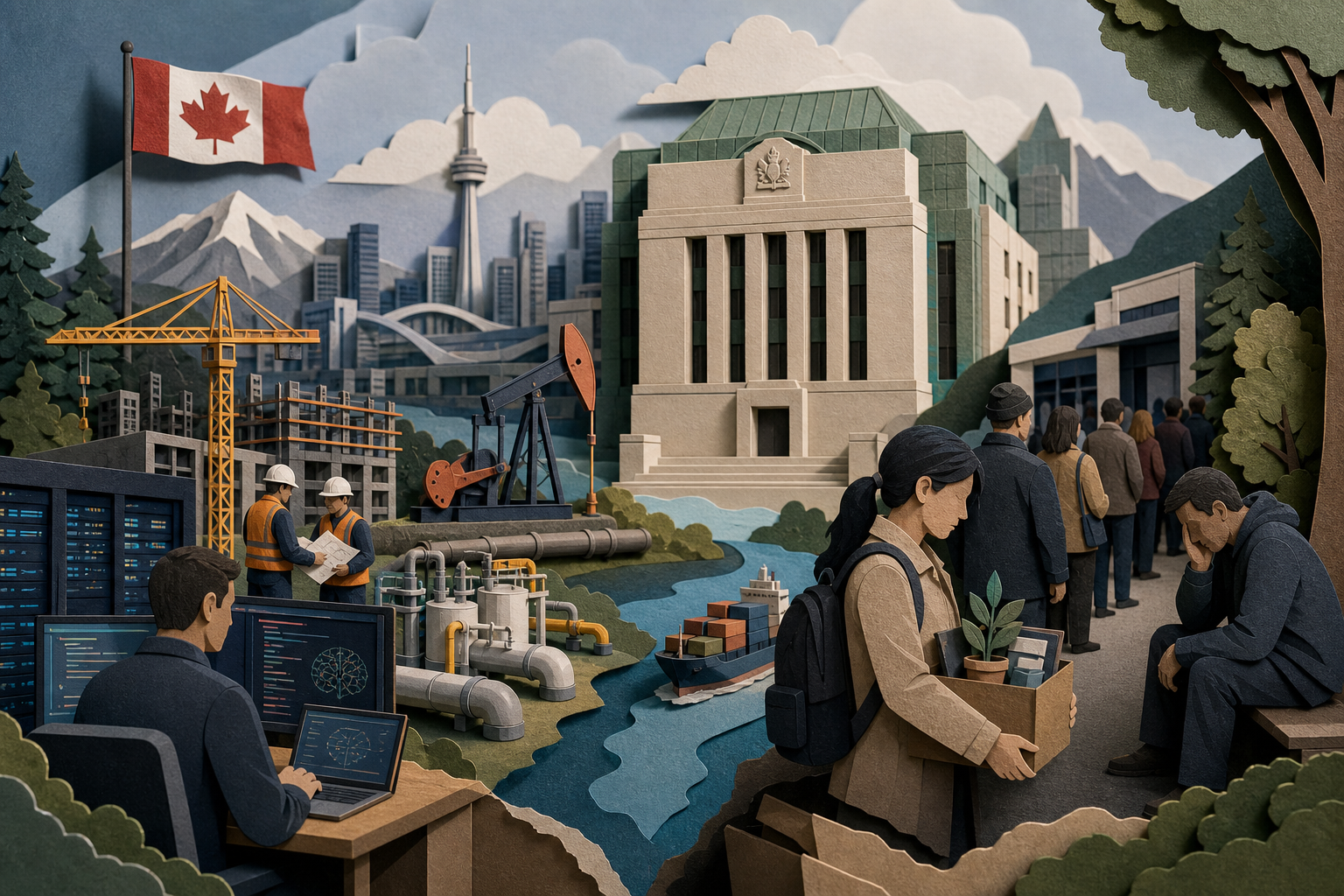
That disconnect matters. GDP can grow without creating jobs if the expansion is concentrated in capital-intensive sectors, energy projects that employ dozens rather than thousands, tech firms that scale through software rather than headcount, or productivity gains that let businesses produce more with the same workforce. The math works. The labor market doesn't feel it.
Why the unemployment floor persists
The 6.5% unemployment rate has become a stubborn baseline over the past 18 months. Part of this reflects deliberate policy: federal caps on temporary residents and tighter international student visa rules have slowed the population surge that defined 2023 and early 2024. Fewer new entrants means less immediate pressure on housing and services, but it also means fewer hands available for roles that were already hard to fill, healthcare aides, construction trades, food service.
At the same time, businesses that survived the uncertainty of the tariff era did so by staying lean. Firms that cut staff during downturns rarely rehire at the same pace when conditions improve. They test whether the remaining team can handle increased output. Often, they can. That caution shows up in the GDP-to-employment gap: output climbs while job openings stay flat.
What 2.25% actually signals
Holding rates at 2.25% after months of speculation about further cuts is a hedge. The Bank is betting that growth has momentum but not enough to justify easing further, and that inflation remains within the 1, 3% target band without requiring renewed tightening. It's the policy equivalent of waiting to see whether the soft labor market is a lagging indicator that will correct itself or a structural problem that requires a different response.
The risk is timing. Monetary policy operates on a 12- to 18-month lag, meaning today's hold reflects judgments about conditions that will materialize in mid-2027. If the unemployment rate is still above 6% a year from now, the current stance will look too restrictive in hindsight. If inflation creeps back above target, it will look too loose. The Bank is threading a gap between two failure modes, and the labor data is the variable that could tip the balance.
What this means for households
For Canadians carrying variable-rate debt or considering a home purchase, the hold offers clarity but not relief. A 2.25% overnight rate translates to prime rates near 4.5%, which is livable but far from the sub-2% environment that defined the pandemic years. Buyers who've been waiting for a signal that rates have bottomed may interpret July's decision as that signal, potentially unlocking late-summer activity in housing markets that have been range-bound for months.
But the employment picture complicates that calculus. A household that finances a purchase based on dual incomes faces more risk when one partner's job security is uncertain. The 6.5% unemployment rate is a national average that obscures regional disparities, Alberta and Saskatchewan may be near full employment in energy-dependent towns, while Ontario's tech sector and British Columbia's services economy face higher jobless rates in urban centers.
The broadening recovery Macklem described is real in aggregate. Whether it broadens enough to pull the unemployment rate down is the question that will determine whether 2.25% holds through the fall or becomes the floor for a new easing cycle. Right now, GDP says yes. The labor market isn't convinced.



The second-quarter GDP estimate landed at 2.5%, a figure that would normally signal the kind of broad recovery central bankers hope for after a prolonged tightening cycle. But when Governor Tiff Macklem held the overnight rate at 2.25% on July 15, he pointed to something less straightforward than a clean rebound: unemployment has been stuck at 6.5% since late 2024, and nobody's quite sure when it will budge.
That disconnect matters. GDP can grow without creating jobs if the expansion is concentrated in capital-intensive sectors, energy projects that employ dozens rather than thousands, tech firms that scale through software rather than headcount, or productivity gains that let businesses produce more with the same workforce. The math works. The labor market doesn't feel it.
Why the unemployment floor persists
The 6.5% unemployment rate has become a stubborn baseline over the past 18 months. Part of this reflects deliberate policy: federal caps on temporary residents and tighter international student visa rules have slowed the population surge that defined 2023 and early 2024. Fewer new entrants means less immediate pressure on housing and services, but it also means fewer hands available for roles that were already hard to fill, healthcare aides, construction trades, food service.
At the same time, businesses that survived the uncertainty of the tariff era did so by staying lean. Firms that cut staff during downturns rarely rehire at the same pace when conditions improve. They test whether the remaining team can handle increased output. Often, they can. That caution shows up in the GDP-to-employment gap: output climbs while job openings stay flat.
What 2.25% actually signals
Holding rates at 2.25% after months of speculation about further cuts is a hedge. The Bank is betting that growth has momentum but not enough to justify easing further, and that inflation remains within the 1, 3% target band without requiring renewed tightening. It's the policy equivalent of waiting to see whether the soft labor market is a lagging indicator that will correct itself or a structural problem that requires a different response.
The risk is timing. Monetary policy operates on a 12- to 18-month lag, meaning today's hold reflects judgments about conditions that will materialize in mid-2027. If the unemployment rate is still above 6% a year from now, the current stance will look too restrictive in hindsight. If inflation creeps back above target, it will look too loose. The Bank is threading a gap between two failure modes, and the labor data is the variable that could tip the balance.
What this means for households
For Canadians carrying variable-rate debt or considering a home purchase, the hold offers clarity but not relief. A 2.25% overnight rate translates to prime rates near 4.5%, which is livable but far from the sub-2% environment that defined the pandemic years. Buyers who've been waiting for a signal that rates have bottomed may interpret July's decision as that signal, potentially unlocking late-summer activity in housing markets that have been range-bound for months.
But the employment picture complicates that calculus. A household that finances a purchase based on dual incomes faces more risk when one partner's job security is uncertain. The 6.5% unemployment rate is a national average that obscures regional disparities, Alberta and Saskatchewan may be near full employment in energy-dependent towns, while Ontario's tech sector and British Columbia's services economy face higher jobless rates in urban centers.
The broadening recovery Macklem described is real in aggregate. Whether it broadens enough to pull the unemployment rate down is the question that will determine whether 2.25% holds through the fall or becomes the floor for a new easing cycle. Right now, GDP says yes. The labor market isn't convinced.
Read Next
GIC rates stall as bonds retreat: why deposit accounts still lag
Why Your Employer's Life Insurance Probably Covers Less Than You Think
August Sales Fell 6.9%: What CREA's Numbers Actually Reveal About Buyer Hesitation
Canada's Resource Advantage: What Global Investors Are Betting On in 2026