Asking Rents Are Down 8% and Canadians Still Can't Afford Housing
A landlord in Etobicoke listed a one-bedroom at $2,100 last month, down from $2,280 a year earlier. The tenant who moved in still spends 42% of her pre-tax income on rent.
That's the gap nobody's talking about when headlines announce rental price corrections. Asking rents have fallen roughly 8% nationally since their 2024 peak, the largest sustained drop in over a decade. Yet a new survey of Canadian renters shows affordability remains the dominant concern by a wide margin, outranking scarcity, quality, and displacement combined. The obvious question: if prices are falling, why isn't the pain?
The baseline was unsustainable
The 8% decline is real. It's also falling from an all-time high. Average asking rents crossed $2,150 nationally in early 2024, nearly 40% higher than 2019 levels. An 8% correction brings the number to roughly $1,980, still 28% above where it sat five years ago. Median wages over the same period rose about 14%. The math didn't get better. It got slightly less catastrophic.
The problem compounds when you look at what "asking rent" actually measures. Platforms like Rentals.ca track newly listed units, not the rents paid by the majority of Canadians already in tenancies. A household that locked in a controlled rent in 2021 at $1,600 sees listings for comparable units at $1,980 and understands they cannot move without absorbing a 24% increase. The reported decline reflects new supply entering the market, often at the luxury end. It does not reflect the experience of renters trapped in aging stock because the gap to current market rates is prohibitive.
This creates the "lock-in effect" now visible across Toronto and Vancouver. Long-term tenants stay in units they've outgrown, couples in bachelor apartments, families in one-bedrooms, because moving up means moving into a rent bracket that consumes 50% or more of household income. The vacancy rate sits at 1.8% in Metro Vancouver, below the 3% threshold economists consider balanced. When vacancies are that low, landlords don't need to negotiate. The posted price is the price.
New supply isn't solving for the middle
Federal elimination of GST on new purpose-built rental construction has boosted the supply pipeline. CMHC reports record rental starts in several provinces. But the bulk of new inventory is positioned as high-end product, buildings with concierge service, rooftop terraces, in-suite laundry, renting at a 20% premium to older stock. Developers underwrite projects at today's construction and financing costs, which forces them upmarket. The missing piece is the unglamorous three-bedroom walkup priced for a household earning $70,000.
The "supply will fix this" argument isn't wrong. It's just operating on a longer horizon than household budgets can wait out. A family spending 48% of gross income on rent today does not benefit from units breaking ground in 2026 that won't lease until 2029.
What renters are actually optimizing for
The survey data shows a shift. Renters aren't prioritizing space or neighborhood as much as they're prioritizing cost certainty. All-inclusive leases, covering utilities, parking, internet, are increasingly preferred even when the headline rent is higher, because they eliminate the risk of variable costs spiking mid-lease. Proximity to transit is now a top-three factor, not for convenience but because car ownership has become unaffordable for households already stretched on shelter.
That's the tell. When renters start making decisions to minimize financial exposure rather than maximize quality of life, affordability isn't one concern among many. It's the concern that shapes every other trade-off. Prices are down 8%. The rent-to-income ratio is still at a record high. Those two facts coexist because the starting point was so far outside historical norms that a correction this size barely registers in household cash flow.
The headline says progress. The budget says otherwise.


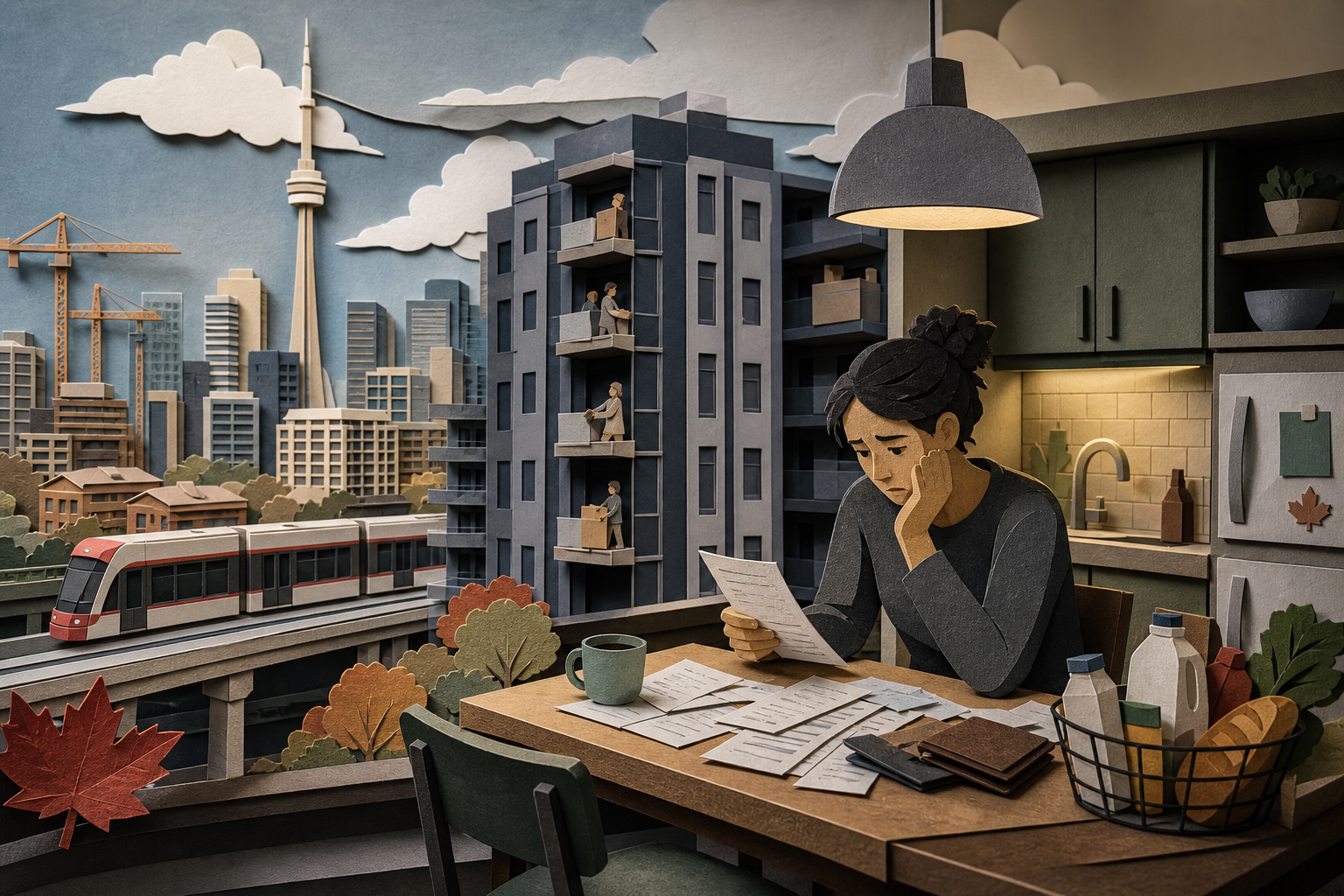

A landlord in Etobicoke listed a one-bedroom at $2,100 last month, down from $2,280 a year earlier. The tenant who moved in still spends 42% of her pre-tax income on rent.
That's the gap nobody's talking about when headlines announce rental price corrections. Asking rents have fallen roughly 8% nationally since their 2024 peak, the largest sustained drop in over a decade. Yet a new survey of Canadian renters shows affordability remains the dominant concern by a wide margin, outranking scarcity, quality, and displacement combined. The obvious question: if prices are falling, why isn't the pain?
The baseline was unsustainable
The 8% decline is real. It's also falling from an all-time high. Average asking rents crossed $2,150 nationally in early 2024, nearly 40% higher than 2019 levels. An 8% correction brings the number to roughly $1,980, still 28% above where it sat five years ago. Median wages over the same period rose about 14%. The math didn't get better. It got slightly less catastrophic.
The problem compounds when you look at what "asking rent" actually measures. Platforms like Rentals.ca track newly listed units, not the rents paid by the majority of Canadians already in tenancies. A household that locked in a controlled rent in 2021 at $1,600 sees listings for comparable units at $1,980 and understands they cannot move without absorbing a 24% increase. The reported decline reflects new supply entering the market, often at the luxury end. It does not reflect the experience of renters trapped in aging stock because the gap to current market rates is prohibitive.
This creates the "lock-in effect" now visible across Toronto and Vancouver. Long-term tenants stay in units they've outgrown, couples in bachelor apartments, families in one-bedrooms, because moving up means moving into a rent bracket that consumes 50% or more of household income. The vacancy rate sits at 1.8% in Metro Vancouver, below the 3% threshold economists consider balanced. When vacancies are that low, landlords don't need to negotiate. The posted price is the price.
New supply isn't solving for the middle
Federal elimination of GST on new purpose-built rental construction has boosted the supply pipeline. CMHC reports record rental starts in several provinces. But the bulk of new inventory is positioned as high-end product, buildings with concierge service, rooftop terraces, in-suite laundry, renting at a 20% premium to older stock. Developers underwrite projects at today's construction and financing costs, which forces them upmarket. The missing piece is the unglamorous three-bedroom walkup priced for a household earning $70,000.
The "supply will fix this" argument isn't wrong. It's just operating on a longer horizon than household budgets can wait out. A family spending 48% of gross income on rent today does not benefit from units breaking ground in 2026 that won't lease until 2029.
What renters are actually optimizing for
The survey data shows a shift. Renters aren't prioritizing space or neighborhood as much as they're prioritizing cost certainty. All-inclusive leases, covering utilities, parking, internet, are increasingly preferred even when the headline rent is higher, because they eliminate the risk of variable costs spiking mid-lease. Proximity to transit is now a top-three factor, not for convenience but because car ownership has become unaffordable for households already stretched on shelter.
That's the tell. When renters start making decisions to minimize financial exposure rather than maximize quality of life, affordability isn't one concern among many. It's the concern that shapes every other trade-off. Prices are down 8%. The rent-to-income ratio is still at a record high. Those two facts coexist because the starting point was so far outside historical norms that a correction this size barely registers in household cash flow.
The headline says progress. The budget says otherwise.
Read Next
GIC rates stall as bonds retreat: why deposit accounts still lag
Why Your Employer's Life Insurance Probably Covers Less Than You Think
August Sales Fell 6.9%: What CREA's Numbers Actually Reveal About Buyer Hesitation
Canada's Resource Advantage: What Global Investors Are Betting On in 2026