Apple Stock Trades Like a Bank, Not a Tech Company
Warren Buffett sold half his Apple position in Q2 2024, the largest single-stock reduction Berkshire Hathaway had made in a decade. The move confused analysts who had watched Buffett call Apple "the best business I know" two years earlier. But Buffett wasn't abandoning Apple because the business had weakened. He was recognizing that the premium Wall Street was paying for it no longer matched what the company actually does.
Apple trades at 28x to 32x earnings in September 2026, roughly double the 15x multiple it carried in 2016. Over the same period, the company's revenue growth rate fell from mid-teens to mid-single digits. The margin expansion came from Services, App Store fees, iCloud storage, Apple Music subscriptions, which now represent 25% to 28% of total revenue and carry gross margins around 72%, versus 35% to 37% on hardware.
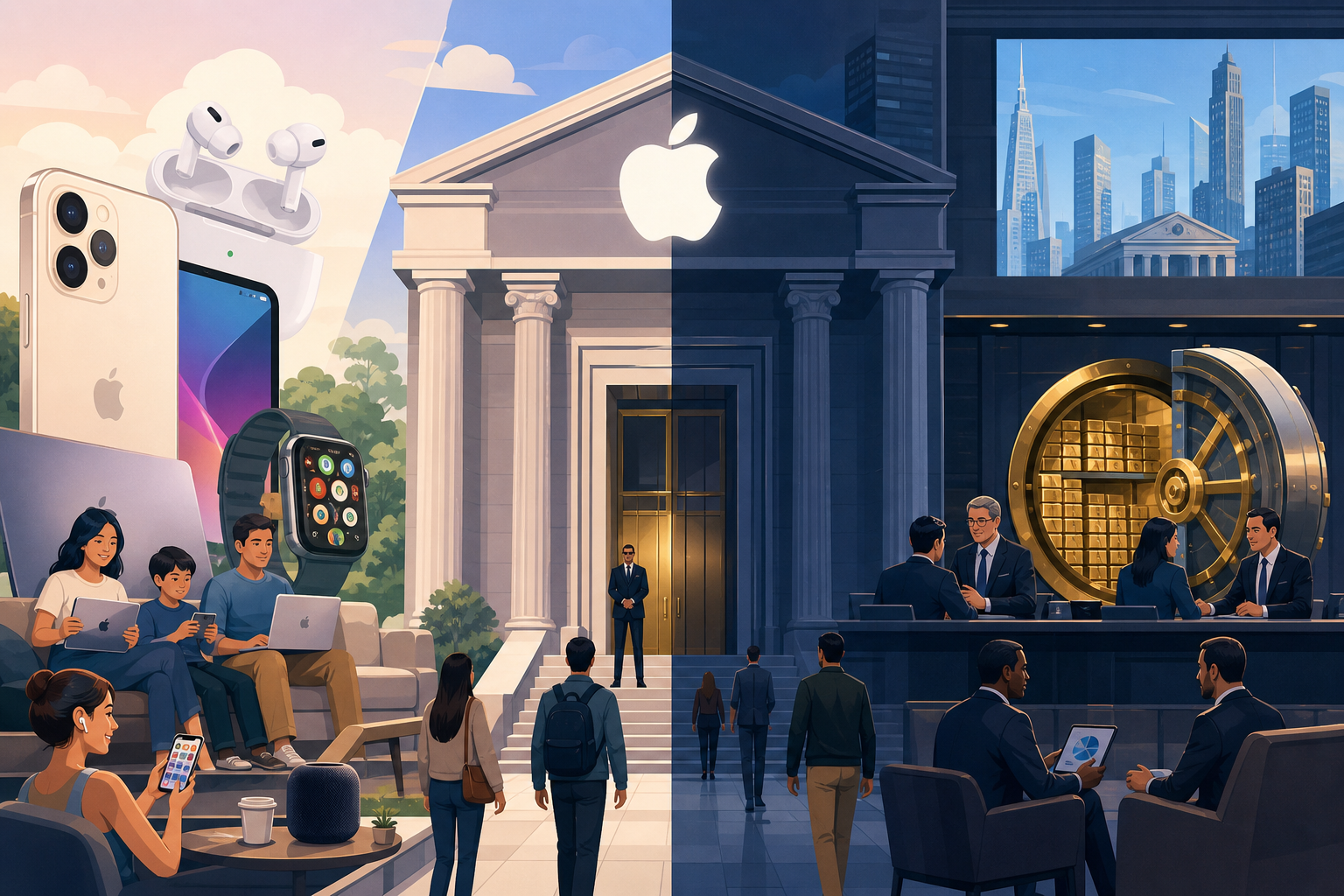
That shift is why the stock behaves more like JPMorgan than Meta. Apple isn't priced for disruption. It's priced for recurring cash flow from a captive base. The installed base of active Apple devices hit a record high in 2026, and each device is a locked gateway to a subscription bundle the user will pay for years. The iPhone is customer acquisition. Services is the actual product.
The Valuation Lives in the Moat
The premium Apple commands reflects investor confidence that switching costs will hold. iMessage lock-in is real. So is iCloud photo storage, which quietly grows until the free 5GB runs out and the $0.99 monthly fee feels cheaper than the effort of migration. Apple Watch only works with iPhone. AirPods pair better with iPhone. iMessage, iCloud, Apple Watch, and AirPods lock users into the Apple product line by design. This interconnection is the entire strategy.
Banks trade at valuation multiples tied to the durability of their deposit base and the likelihood customers stay. Apple's 2-billion-device installed base functions the same way. The recurring revenue model looks less like software-as-a-service and more like net interest margin on sticky deposits. Investors pay a premium because churn is structurally low and lifetime value per user is predictable.
The company has reinforced this by spending tens of billions annually on share buybacks, one of the largest repurchase programs in history. Buybacks lift earnings per share mechanically, which supports the multiple even when underlying growth slows. That's bank behavior, return capital when growth opportunities thin, keep the dividend flowing, maintain the valuation through financial engineering rather than product launches.
Where the Model Cracks
Regulatory pressure is the counterargument. The European Union's Digital Markets Act forces Apple to allow third-party app stores and alternative payment systems, which directly attacks the Services margin. If a developer can bypass the App Store's 30% take, the high-margin revenue stream that justifies the valuation gets thinner. The U.S. Department of Justice lawsuit filed in early 2024 makes similar claims. If courts force interoperability, the walled garden becomes a picket fence.
There's also the hardware dependency problem. You cannot sell Services without selling devices first. A major supply chain disruption, geopolitical conflict involving Taiwan, where most advanced chips are made, would crater iPhone shipments and cut off the pipeline that feeds the Services base. The premium valuation assumes stable hardware distribution. That assumption held through COVID-19 lockdowns, but the risks are larger now than they were in 2020.
Apple has convinced Wall Street to value it as a subscription business while still generating the top-line scale of a hardware giant. That's the arbitrage. The company avoids the commodity trap that crushed Dell and HP by making Apple devices a status symbol and positioning the iPhone ecosystem as a privacy-centric refuge competitors cannot match. It works until courts or competitors break the lock, or until manufacturing concentration becomes a single point of failure. At 30x earnings, the stock price says neither will happen. Buffett's sale says he's less sure.



Warren Buffett sold half his Apple position in Q2 2024, the largest single-stock reduction Berkshire Hathaway had made in a decade. The move confused analysts who had watched Buffett call Apple "the best business I know" two years earlier. But Buffett wasn't abandoning Apple because the business had weakened. He was recognizing that the premium Wall Street was paying for it no longer matched what the company actually does.
Apple trades at 28x to 32x earnings in September 2026, roughly double the 15x multiple it carried in 2016. Over the same period, the company's revenue growth rate fell from mid-teens to mid-single digits. The margin expansion came from Services, App Store fees, iCloud storage, Apple Music subscriptions, which now represent 25% to 28% of total revenue and carry gross margins around 72%, versus 35% to 37% on hardware.
That shift is why the stock behaves more like JPMorgan than Meta. Apple isn't priced for disruption. It's priced for recurring cash flow from a captive base. The installed base of active Apple devices hit a record high in 2026, and each device is a locked gateway to a subscription bundle the user will pay for years. The iPhone is customer acquisition. Services is the actual product.
The Valuation Lives in the Moat
The premium Apple commands reflects investor confidence that switching costs will hold. iMessage lock-in is real. So is iCloud photo storage, which quietly grows until the free 5GB runs out and the $0.99 monthly fee feels cheaper than the effort of migration. Apple Watch only works with iPhone. AirPods pair better with iPhone. iMessage, iCloud, Apple Watch, and AirPods lock users into the Apple product line by design. This interconnection is the entire strategy.
Banks trade at valuation multiples tied to the durability of their deposit base and the likelihood customers stay. Apple's 2-billion-device installed base functions the same way. The recurring revenue model looks less like software-as-a-service and more like net interest margin on sticky deposits. Investors pay a premium because churn is structurally low and lifetime value per user is predictable.
The company has reinforced this by spending tens of billions annually on share buybacks, one of the largest repurchase programs in history. Buybacks lift earnings per share mechanically, which supports the multiple even when underlying growth slows. That's bank behavior, return capital when growth opportunities thin, keep the dividend flowing, maintain the valuation through financial engineering rather than product launches.
Where the Model Cracks
Regulatory pressure is the counterargument. The European Union's Digital Markets Act forces Apple to allow third-party app stores and alternative payment systems, which directly attacks the Services margin. If a developer can bypass the App Store's 30% take, the high-margin revenue stream that justifies the valuation gets thinner. The U.S. Department of Justice lawsuit filed in early 2024 makes similar claims. If courts force interoperability, the walled garden becomes a picket fence.
There's also the hardware dependency problem. You cannot sell Services without selling devices first. A major supply chain disruption, geopolitical conflict involving Taiwan, where most advanced chips are made, would crater iPhone shipments and cut off the pipeline that feeds the Services base. The premium valuation assumes stable hardware distribution. That assumption held through COVID-19 lockdowns, but the risks are larger now than they were in 2020.
Apple has convinced Wall Street to value it as a subscription business while still generating the top-line scale of a hardware giant. That's the arbitrage. The company avoids the commodity trap that crushed Dell and HP by making Apple devices a status symbol and positioning the iPhone ecosystem as a privacy-centric refuge competitors cannot match. It works until courts or competitors break the lock, or until manufacturing concentration becomes a single point of failure. At 30x earnings, the stock price says neither will happen. Buffett's sale says he's less sure.
Read Next
Birch Hill builds a regional aviation network in British Columbia through Harbour Air's Pacific Coastal acquisition
South Korea's Stock Market Has Become a National Liability
Tech CEOs Walk the Investor Tightrope: Signal AI Risk Without Cutting Off Billions in Funding
Canada Child Benefit Payments Arrive Early This September, Here's What Changed in July