7 types of student financial aid in Canada, and which to apply for first
In 2024, the average undergraduate in Canada will graduate with roughly $28,000 in student debt, but only if they apply for the right aid in the right order. Most students apply for loans first because loans are visible and easy to understand. That's backwards. Here's the actual priority sequence, written for students entering their first or second year.
Apply through your province's student aid portal, Ontario Student Assistance Program (OSAP) if you're in Ontario, StudentAid BC if you're in BC, and so on. The application automatically assesses you for both federal grants and provincial grants. The Canada Student Grant for Full-Time Students pays up to $3,000 per year (2026 figures) based on family income. Students with permanent disabilities can access up to $4,000 annually. These grants do not require repayment, ever. You cannot access them without filling out the loan application first, which confuses people, but submitting the loan application does not obligate you to accept the loan. Accept the grant, decline the loan if you don't need it.
2. Scholarships and bursaries from your school
Most universities and colleges have internal awards tied to grades, financial need, or specific programs. These are separate from government aid. Check your school's financial aid office website and apply directly. Deadlines vary wildly, some close in February for September entry, others stay open into the fall term. A $2,000 entrance scholarship is $2,000 you don't borrow. Non-obvious detail: many schools have "automatic consideration" scholarships that require no separate application if your admission average is above a threshold, but you still need to accept the award formally or it expires.
3. Registered Education Savings Plans (RESPs)
If your parents or grandparents opened an RESP for you, the Educational Assistance Payments (the government grant portion and investment growth) come out tax-free to you as the student. Withdraw these funds in your first or second year when your taxable income is lowest to avoid a tax hit later. The contributions (the money your family put in) can be withdrawn anytime tax-free. Co-ordinate with whoever holds the account.
Then borrow, in this order
4. Federal and provincial student loans (integrated)
These are issued through the same application as the grants. As of 2023, the federal portion is permanently interest-free. The provincial portion may still carry interest depending on where you live, Ontario's portion charges interest, for example. You don't make payments while you're in school, and you get a six-month grace period after graduation before principal payments begin. Maximum borrowing capacity is roughly $210 per week of study for most undergrads, which works out to around $60,000 over four years, though high-cost programs (medicine, dentistry) have higher limits.
5. Lines of credit from family (informal loans)
If a parent or relative offers to lend you money, treat it seriously. Write down the terms: amount, interest rate (even if it's 0%), repayment start date. A $10,000 loan from a parent at 0% saves you roughly $600 in interest per year compared to a private line of credit at 6%. Informal doesn't mean unstructured.
6. Private student lines of credit
Banks offer student lines of credit up to $80,000, $350,000 depending on your program, but they require a co-signer (usually a parent) who is 100% liable if you default. Interest starts accruing immediately, even while you're in school, though some lenders allow you to defer payments on the principal. Rates in 2025 sit around prime + 1% to prime + 2%, which translates to 6%, 7%. Use this only if government loans don't cover your costs, and understand your co-signer's retirement savings are on the line.
7. Credit cards and personal loans
Last resort. Credit card rates run 19%, 29%, and personal loans for students without income or credit history are rare and expensive. If you're considering this, you've either missed earlier aid deadlines or you're attending a program whose cost wildly exceeds reasonable borrowing capacity. Reassess the program choice first.
The one thing students miss most often: they assume "financial aid" means loans, so they never apply, leaving thousands in grants unclaimed. Apply for the aid package. Then decide what to accept.


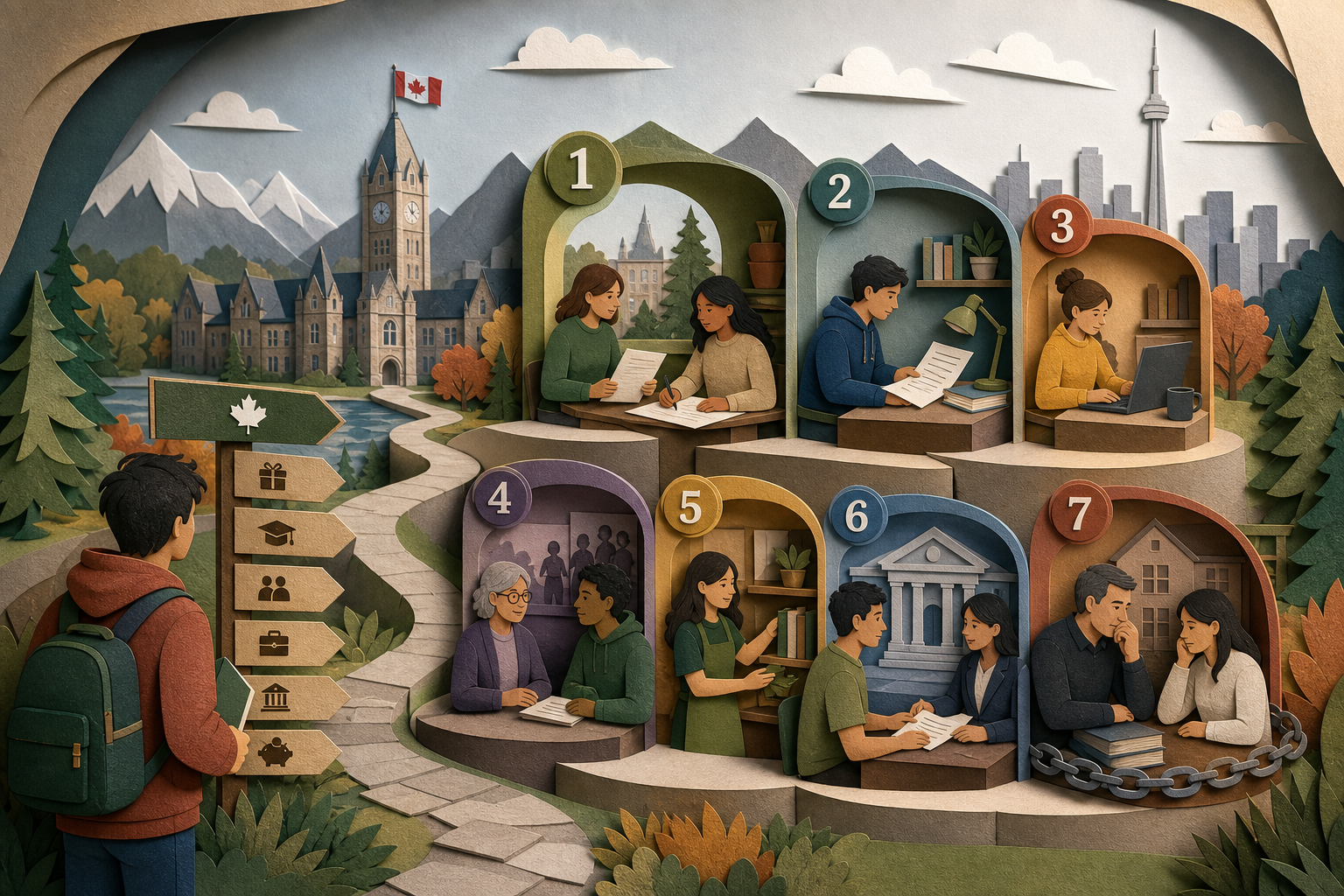

In 2024, the average undergraduate in Canada will graduate with roughly $28,000 in student debt, but only if they apply for the right aid in the right order. Most students apply for loans first because loans are visible and easy to understand. That's backwards. Here's the actual priority sequence, written for students entering their first or second year.
Start with the money you never have to repay
1. Canada Student Grants (and provincial equivalents)
Apply through your province's student aid portal, Ontario Student Assistance Program (OSAP) if you're in Ontario, StudentAid BC if you're in BC, and so on. The application automatically assesses you for both federal grants and provincial grants. The Canada Student Grant for Full-Time Students pays up to $3,000 per year (2026 figures) based on family income. Students with permanent disabilities can access up to $4,000 annually. These grants do not require repayment, ever. You cannot access them without filling out the loan application first, which confuses people, but submitting the loan application does not obligate you to accept the loan. Accept the grant, decline the loan if you don't need it.
2. Scholarships and bursaries from your school
Most universities and colleges have internal awards tied to grades, financial need, or specific programs. These are separate from government aid. Check your school's financial aid office website and apply directly. Deadlines vary wildly, some close in February for September entry, others stay open into the fall term. A $2,000 entrance scholarship is $2,000 you don't borrow. Non-obvious detail: many schools have "automatic consideration" scholarships that require no separate application if your admission average is above a threshold, but you still need to accept the award formally or it expires.
3. Registered Education Savings Plans (RESPs)
If your parents or grandparents opened an RESP for you, the Educational Assistance Payments (the government grant portion and investment growth) come out tax-free to you as the student. Withdraw these funds in your first or second year when your taxable income is lowest to avoid a tax hit later. The contributions (the money your family put in) can be withdrawn anytime tax-free. Co-ordinate with whoever holds the account.
Then borrow, in this order
4. Federal and provincial student loans (integrated)
These are issued through the same application as the grants. As of 2023, the federal portion is permanently interest-free. The provincial portion may still carry interest depending on where you live, Ontario's portion charges interest, for example. You don't make payments while you're in school, and you get a six-month grace period after graduation before principal payments begin. Maximum borrowing capacity is roughly $210 per week of study for most undergrads, which works out to around $60,000 over four years, though high-cost programs (medicine, dentistry) have higher limits.
5. Lines of credit from family (informal loans)
If a parent or relative offers to lend you money, treat it seriously. Write down the terms: amount, interest rate (even if it's 0%), repayment start date. A $10,000 loan from a parent at 0% saves you roughly $600 in interest per year compared to a private line of credit at 6%. Informal doesn't mean unstructured.
6. Private student lines of credit
Banks offer student lines of credit up to $80,000, $350,000 depending on your program, but they require a co-signer (usually a parent) who is 100% liable if you default. Interest starts accruing immediately, even while you're in school, though some lenders allow you to defer payments on the principal. Rates in 2025 sit around prime + 1% to prime + 2%, which translates to 6%, 7%. Use this only if government loans don't cover your costs, and understand your co-signer's retirement savings are on the line.
7. Credit cards and personal loans
Last resort. Credit card rates run 19%, 29%, and personal loans for students without income or credit history are rare and expensive. If you're considering this, you've either missed earlier aid deadlines or you're attending a program whose cost wildly exceeds reasonable borrowing capacity. Reassess the program choice first.
The one thing students miss most often: they assume "financial aid" means loans, so they never apply, leaving thousands in grants unclaimed. Apply for the aid package. Then decide what to accept.
Read Next
GIC rates stall as bonds retreat: why deposit accounts still lag
Why Your Employer's Life Insurance Probably Covers Less Than You Think
August Sales Fell 6.9%: What CREA's Numbers Actually Reveal About Buyer Hesitation
Canada's Resource Advantage: What Global Investors Are Betting On in 2026