25 States Sue Trump Over Tariffs, Testing the Outer Limits of Presidential Trade Power
California spent $83 billion on infrastructure in 2025. Under the new tariff regime, the state comptroller estimates that same spending would cost $91 billion, an eight-billion-dollar federal tax on concrete, steel, rebar, and electrical components that shows up nowhere in the state budget but comes out of the same voter-approved bond measures. Twenty-four other states are making versions of this calculation, and they have decided the math is unconstitutional.
The multi-state lawsuit, filed in August 2026, does not argue that tariffs are bad policy. It argues that the President lacks the authority to impose them without Congressional approval, and that the statutes he is relying on, Section 232 of the Trade Expansion Act of 1962 and Section 301 of the Trade Act of 1974, were never intended to delegate taxing power on this scale. The complaint frames tariffs not as trade negotiations but as what they technically are: taxes on imports, paid by domestic businesses and passed to consumers. Article I, Section 8 of the Constitution assigns that power to Congress. The question is whether Congress can give it away.
The National Security Loophole Has No Boundary
Section 232 allows the President to restrict imports that threaten national security. In 1962, that meant steel for tanks. The Trump administration has stretched the definition to include aluminum for beverage cans, lumber for housing, semiconductors for consumer electronics, and rare earths for wind turbines. The legal test is whether the President's determination of a security threat is "reasonable," and courts have historically been reluctant to second-guess it. But reasonableness has limits, and the states argue we have now passed them.
The tariffs being challenged range from 10% to 25% on goods from Canada, Mexico, and China, including materials that have no domestic substitute at any price. A manufacturer in Illinois that imports a specific grade of capacitor from Shenzhen cannot simply buy American. The component does not exist in American production. The administration's answer has been that companies should have diversified their supply chains earlier, but supply chains are not rewired in six months, and the tariffs carry no statutory exclusion process for cases of genuine necessity.
What the States Are Actually Protecting
The lawsuit is a federalism argument wrapped in an economic one. It claims the executive branch is effectively levying a nationwide consumption tax, raising an estimated $320 billion annually if fully implemented, without a vote from the people's representatives. The political texture matters. These are Democratic attorneys general suing a Republican president using "states' rights" framing, the same argument conservatives have deployed for decades to block federal environmental rules and healthcare mandates. The reversal is deliberate.
Each plaintiff state has attached an economic impact study. New York's retail sector estimates a $4.1 billion annual increase in cost of goods sold. Michigan's auto suppliers project a 7% margin compression, enough to push marginal plants into closure. California is citing the $8 billion infrastructure figure, but the larger claim is about compounding effects, higher costs reduce consumer spending, which slows economic growth, which lowers state tax receipts, which forces cuts to services voters approved. The tariffs do not just tax imports. They tax the fiscal capacity of state governments.
Courts do not like to referee trade policy. The President's authority in foreign affairs is broad, and judicial deference is the norm. But deference assumes the President is operating within delegated boundaries. The states are arguing that a statute allowing tariffs for "national security" is not a blank check to reshape the entire economy. Whether five justices agree will determine if Congress still controls the power to tax, or if it permanently signed that authority over in 1962.


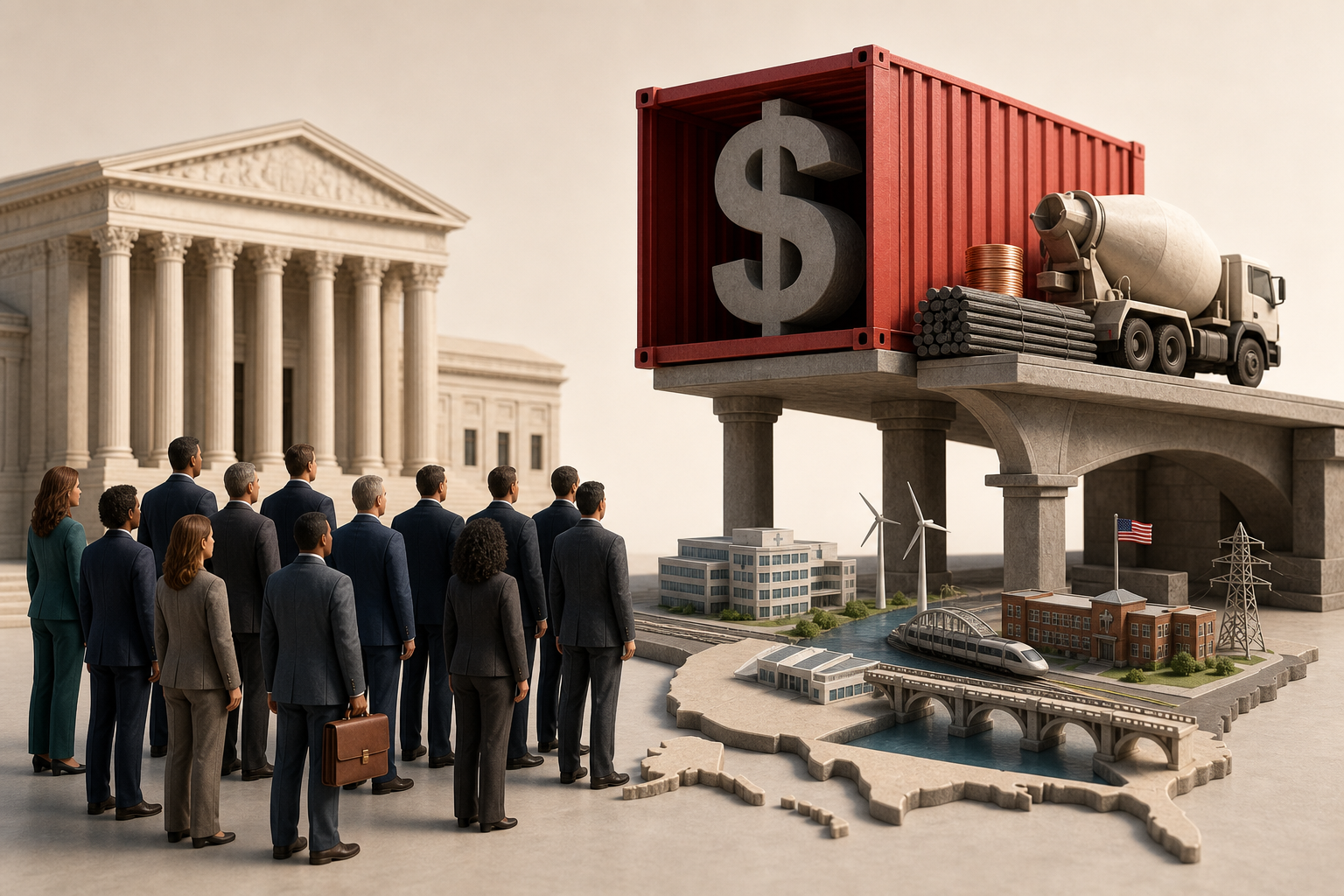

California spent $83 billion on infrastructure in 2025. Under the new tariff regime, the state comptroller estimates that same spending would cost $91 billion, an eight-billion-dollar federal tax on concrete, steel, rebar, and electrical components that shows up nowhere in the state budget but comes out of the same voter-approved bond measures. Twenty-four other states are making versions of this calculation, and they have decided the math is unconstitutional.
The multi-state lawsuit, filed in August 2026, does not argue that tariffs are bad policy. It argues that the President lacks the authority to impose them without Congressional approval, and that the statutes he is relying on, Section 232 of the Trade Expansion Act of 1962 and Section 301 of the Trade Act of 1974, were never intended to delegate taxing power on this scale. The complaint frames tariffs not as trade negotiations but as what they technically are: taxes on imports, paid by domestic businesses and passed to consumers. Article I, Section 8 of the Constitution assigns that power to Congress. The question is whether Congress can give it away.
The National Security Loophole Has No Boundary
Section 232 allows the President to restrict imports that threaten national security. In 1962, that meant steel for tanks. The Trump administration has stretched the definition to include aluminum for beverage cans, lumber for housing, semiconductors for consumer electronics, and rare earths for wind turbines. The legal test is whether the President's determination of a security threat is "reasonable," and courts have historically been reluctant to second-guess it. But reasonableness has limits, and the states argue we have now passed them.
The tariffs being challenged range from 10% to 25% on goods from Canada, Mexico, and China, including materials that have no domestic substitute at any price. A manufacturer in Illinois that imports a specific grade of capacitor from Shenzhen cannot simply buy American. The component does not exist in American production. The administration's answer has been that companies should have diversified their supply chains earlier, but supply chains are not rewired in six months, and the tariffs carry no statutory exclusion process for cases of genuine necessity.
What the States Are Actually Protecting
The lawsuit is a federalism argument wrapped in an economic one. It claims the executive branch is effectively levying a nationwide consumption tax, raising an estimated $320 billion annually if fully implemented, without a vote from the people's representatives. The political texture matters. These are Democratic attorneys general suing a Republican president using "states' rights" framing, the same argument conservatives have deployed for decades to block federal environmental rules and healthcare mandates. The reversal is deliberate.
Each plaintiff state has attached an economic impact study. New York's retail sector estimates a $4.1 billion annual increase in cost of goods sold. Michigan's auto suppliers project a 7% margin compression, enough to push marginal plants into closure. California is citing the $8 billion infrastructure figure, but the larger claim is about compounding effects, higher costs reduce consumer spending, which slows economic growth, which lowers state tax receipts, which forces cuts to services voters approved. The tariffs do not just tax imports. They tax the fiscal capacity of state governments.
Courts do not like to referee trade policy. The President's authority in foreign affairs is broad, and judicial deference is the norm. But deference assumes the President is operating within delegated boundaries. The states are arguing that a statute allowing tariffs for "national security" is not a blank check to reshape the entire economy. Whether five justices agree will determine if Congress still controls the power to tax, or if it permanently signed that authority over in 1962.
Read Next
GIC rates stall as bonds retreat: why deposit accounts still lag
Why Your Employer's Life Insurance Probably Covers Less Than You Think
August Sales Fell 6.9%: What CREA's Numbers Actually Reveal About Buyer Hesitation
Canada's Resource Advantage: What Global Investors Are Betting On in 2026