Why Canadian Homeowners Can't Walk Away From an Underwater Mortgage the Way Americans Did in 2008
A 47-year-old software engineer in Calgary who put 15% down on a $680,000 home in 2022 watched the property's value drop to $590,000 by early 2025. He still owes $612,000. Walking away from that $22,000 shortfall sounds rational until you learn that in Canada, the shortfall follows him. The bank can garnish his wages, freeze his accounts, and pursue his car. The debt doesn't vanish with the keys.
Most Canadians assume mortgage law works like it does in the United States, where "jingle mail" became shorthand for homeowners mailing their keys to the lender and walking away from underwater properties. That worked in states with non-recourse mortgages, where the lender's only remedy is the property itself. In Canada, nearly every mortgage is a recourse loan. The lender can pursue the borrower's other assets when the foreclosure sale doesn't cover the balance.
The Two Provinces Where the Rule Breaks
Alberta and Saskatchewan are the exceptions, but the exception is narrower than it appears. Non-recourse protections in those provinces apply only to conventional mortgages, loans with at least 20% down. If the mortgage is insured through CMHC, Sagen, or Canada Guaranty, it becomes recourse nationwide. The insurer pays out the lender, then pursues the borrower for the deficiency. A first-time buyer in Edmonton who put down 10% has no more protection than someone in Toronto.
Even in Alberta, where non-recourse law is clearest, lenders have adapted. Many now include contractual clauses that restore recourse even on conventional loans. The borrower signs away the statutory protection without realizing it, buried in a 40-page agreement they never read.
What Actually Happens When You Stop Paying
In Ontario, the standard process is Power of Sale, not foreclosure. The lender sells the property, often quickly and below market value, because its goal is recovering the debt, not maximizing the sale price. The borrower has no control over the listing, the marketing, or the timing. When the sale closes at $540,000 on a $612,000 balance, the lender obtains a deficiency judgment for the $72,000 gap plus legal fees.
That judgment doesn't expire. It can be enforced for up to 20 years in most provinces. The lender can garnish up to 50% of take-home pay in some jurisdictions. Bank accounts can be frozen. The borrower's credit report carries the default for six to seven years, making it nearly impossible to rent a decent apartment, finance a car, or get approved for a credit card.
The borrower can file for bankruptcy or a consumer proposal to discharge the deficiency debt, but those remedies are far more punishing than simply "walking away." Bankruptcy stays on a credit report for six years after discharge in most provinces, nine in some. A consumer proposal requires repaying a negotiated portion of the debt over up to five years. Either route destroys the borrower's financial standing for the better part of a decade.
Why Lenders Prefer Workouts
Lenders do not want to own houses. Foreclosure and Power of Sale are expensive, slow, and risky in a declining market. Most banks will offer payment deferrals, extended amortization, or interest-only periods before seizing a property. The stress test implemented by OSFI in 2016, which requires borrowers to qualify at rates 2% above their contract rate, was designed specifically to prevent the kind of mass defaults that make "walking away" seem attractive.
The deeper structural difference is this: in the United States, housing debt is tied to the asset. In Canada, it is tied to the person. That distinction reshapes every calculation a homeowner makes when the value drops below the loan. The property can lose value. The borrower cannot lose the debt.


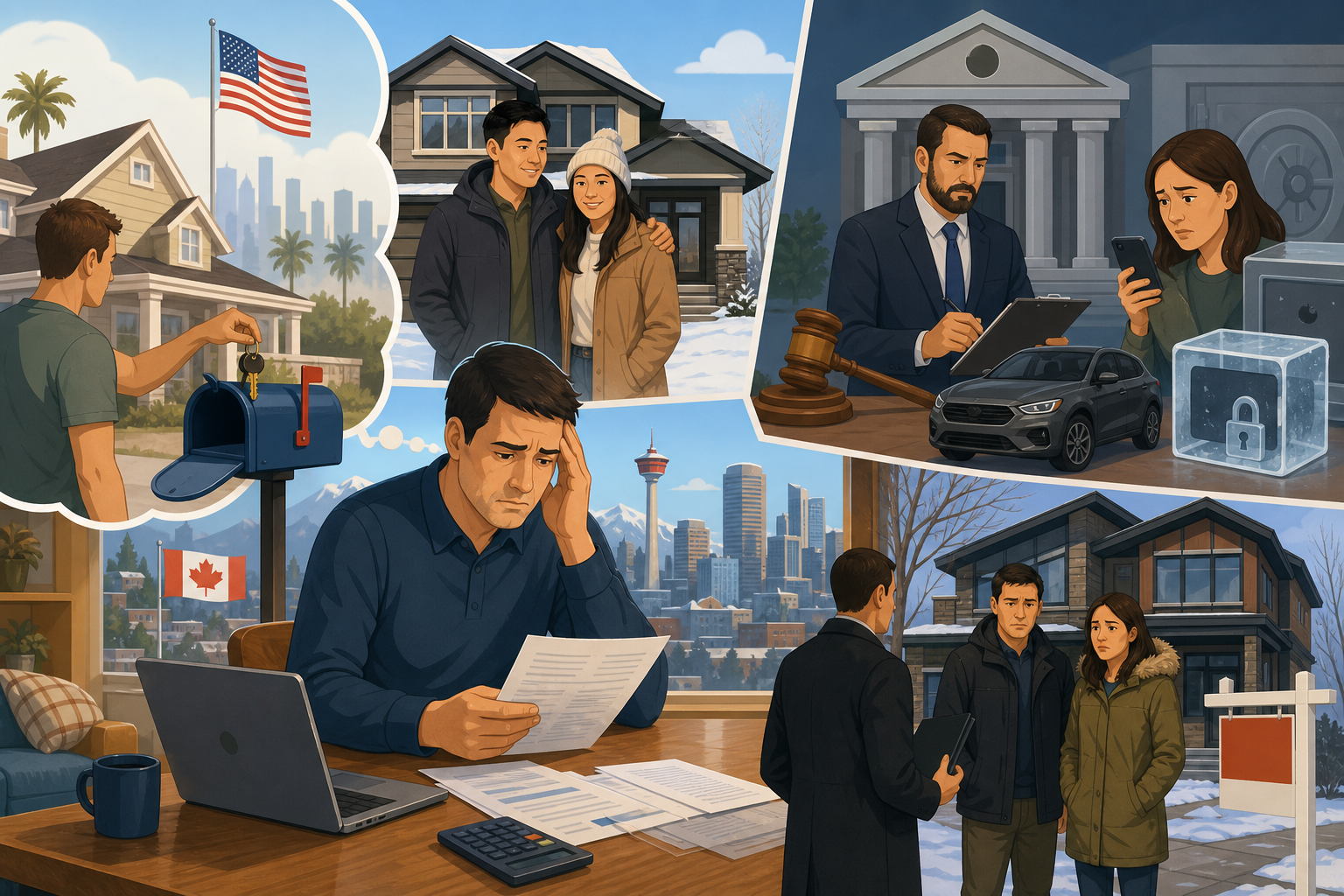

A 47-year-old software engineer in Calgary who put 15% down on a $680,000 home in 2022 watched the property's value drop to $590,000 by early 2025. He still owes $612,000. Walking away from that $22,000 shortfall sounds rational until you learn that in Canada, the shortfall follows him. The bank can garnish his wages, freeze his accounts, and pursue his car. The debt doesn't vanish with the keys.
Most Canadians assume mortgage law works like it does in the United States, where "jingle mail" became shorthand for homeowners mailing their keys to the lender and walking away from underwater properties. That worked in states with non-recourse mortgages, where the lender's only remedy is the property itself. In Canada, nearly every mortgage is a recourse loan. The lender can pursue the borrower's other assets when the foreclosure sale doesn't cover the balance.
The Two Provinces Where the Rule Breaks
Alberta and Saskatchewan are the exceptions, but the exception is narrower than it appears. Non-recourse protections in those provinces apply only to conventional mortgages, loans with at least 20% down. If the mortgage is insured through CMHC, Sagen, or Canada Guaranty, it becomes recourse nationwide. The insurer pays out the lender, then pursues the borrower for the deficiency. A first-time buyer in Edmonton who put down 10% has no more protection than someone in Toronto.
Even in Alberta, where non-recourse law is clearest, lenders have adapted. Many now include contractual clauses that restore recourse even on conventional loans. The borrower signs away the statutory protection without realizing it, buried in a 40-page agreement they never read.
What Actually Happens When You Stop Paying
In Ontario, the standard process is Power of Sale, not foreclosure. The lender sells the property, often quickly and below market value, because its goal is recovering the debt, not maximizing the sale price. The borrower has no control over the listing, the marketing, or the timing. When the sale closes at $540,000 on a $612,000 balance, the lender obtains a deficiency judgment for the $72,000 gap plus legal fees.
That judgment doesn't expire. It can be enforced for up to 20 years in most provinces. The lender can garnish up to 50% of take-home pay in some jurisdictions. Bank accounts can be frozen. The borrower's credit report carries the default for six to seven years, making it nearly impossible to rent a decent apartment, finance a car, or get approved for a credit card.
The borrower can file for bankruptcy or a consumer proposal to discharge the deficiency debt, but those remedies are far more punishing than simply "walking away." Bankruptcy stays on a credit report for six years after discharge in most provinces, nine in some. A consumer proposal requires repaying a negotiated portion of the debt over up to five years. Either route destroys the borrower's financial standing for the better part of a decade.
Why Lenders Prefer Workouts
Lenders do not want to own houses. Foreclosure and Power of Sale are expensive, slow, and risky in a declining market. Most banks will offer payment deferrals, extended amortization, or interest-only periods before seizing a property. The stress test implemented by OSFI in 2016, which requires borrowers to qualify at rates 2% above their contract rate, was designed specifically to prevent the kind of mass defaults that make "walking away" seem attractive.
The deeper structural difference is this: in the United States, housing debt is tied to the asset. In Canada, it is tied to the person. That distinction reshapes every calculation a homeowner makes when the value drops below the loan. The property can lose value. The borrower cannot lose the debt.
Read Next
A Tesla and SpaceX Merger Solves Musk's Problems and Hands Shareholders His Risks
Prem Watsa's IDBI Bet Tests What Foreign Capital Can Do in Indian Banking
Credit Markets Are Quietly Pricing an AI Borrowing Risk Tech Stocks Ignore
When Insiders Lose Faith in Housing: 7 Assumptions Every Buyer Should Stress-Test