Smith and Carney Say Canada Is Ready for Another Oilsands Boom. Is It?
The expanded Trans Mountain pipeline starts at a terminal just east of Edmonton and can now carry about 890,000 barrels of oil a day to the B.C. coast. That is roughly three times what the line moved before the expansion came fully online in 2024. Premier Danielle Smith and Prime Minister Mark Carney now point to a second route, a proposed West Coast Pipeline, as the next step. Both say the province will handle the growth better than it handled the last two booms.
That claim is worth testing piece by piece, because each piece reaches Edmonton households and investors in a different way.
What "ready" is supposed to mean
Alberta's past booms followed a familiar order. Oil prices rose, companies hired, and people arrived faster than the province could build homes, schools and roads. During the mid-2000s run, Fort McMurray and the Edmonton region both felt the strain, and the bust that followed left the provincial budget exposed.
The government's answer this time has two parts. The first is saving more of the windfall. Alberta put about $2 billion from its 2023-24 surplus into the Heritage Savings Trust Fund, which pushed the fund past $22 billion (2024 figures). The second is building services before the population arrives. Both ideas are sound, and both can be measured, which matters more than the slogan.
The pipeline is still a proposal
The West Coast Pipeline does not exist yet. Any new line to the coast has to go through years of federal environmental review. It will also face likely court challenges from environmental groups or Indigenous communities along the route. Federal rules, including the Clean Electricity Regulations and the proposed emissions cap on oil and gas, remain a running dispute between Alberta and the federal government over how fast the oilsands can expand.
The prize is real. For decades, most Alberta oil went to the United States at a discount, known as the Western Canadian Select differential, because there was nowhere else to send it. Coastal capacity lets producers sell into Asian markets and narrow that gap. Trans Mountain already proved the mechanism works. A second line would extend it, but only after the approvals clear, and nobody can promise a date.
What reaches Edmonton first
Edmonton sits closer to this story than the map suggests. Extraction happens in the north, but the city is where much of the fabrication, logistics, staging and head-office work gets done. When oilsands spending rises, Edmonton hiring follows, and housing demand follows the hiring.
There are early signals in the national numbers. Statistics Canada reported real GDP grew 3.3% annualized in the second quarter of 2026, and spending on engineering structures, the category that includes pipelines and plants, rose 2.3% (August 28, 2026 release). Neither figure is an Alberta boom on its own. Both show construction money moving.
For a first-time buyer, the practical question is timing. A boom that lifts incomes also lifts competition for entry-level homes in neighbourhoods close to industrial employers in the east and northeast parts of the region. For an investor, steady energy employment can support rental demand, though it does not set a floor under prices.
Where readiness runs out
Two limits sit outside Alberta's control. Global oil prices are the first. A recession abroad or a faster shift to electric vehicles would cut investment no matter how many schools were built in advance. The second is closer to home but just as stubborn: Alberta still struggles to find enough skilled tradespeople to build the projects being promised, including the housing a larger workforce would need.
Savings help after a bust. They do little during one.
Looked at this way, "ready" describes the parts of a boom a province can control: how much of the surplus it saves, and whether new subdivisions get schools before families move in. The size and timing of the boom itself still depend on approvals from the federal government, crews Alberta has not yet trained, and an oil price set far from Edmonton.


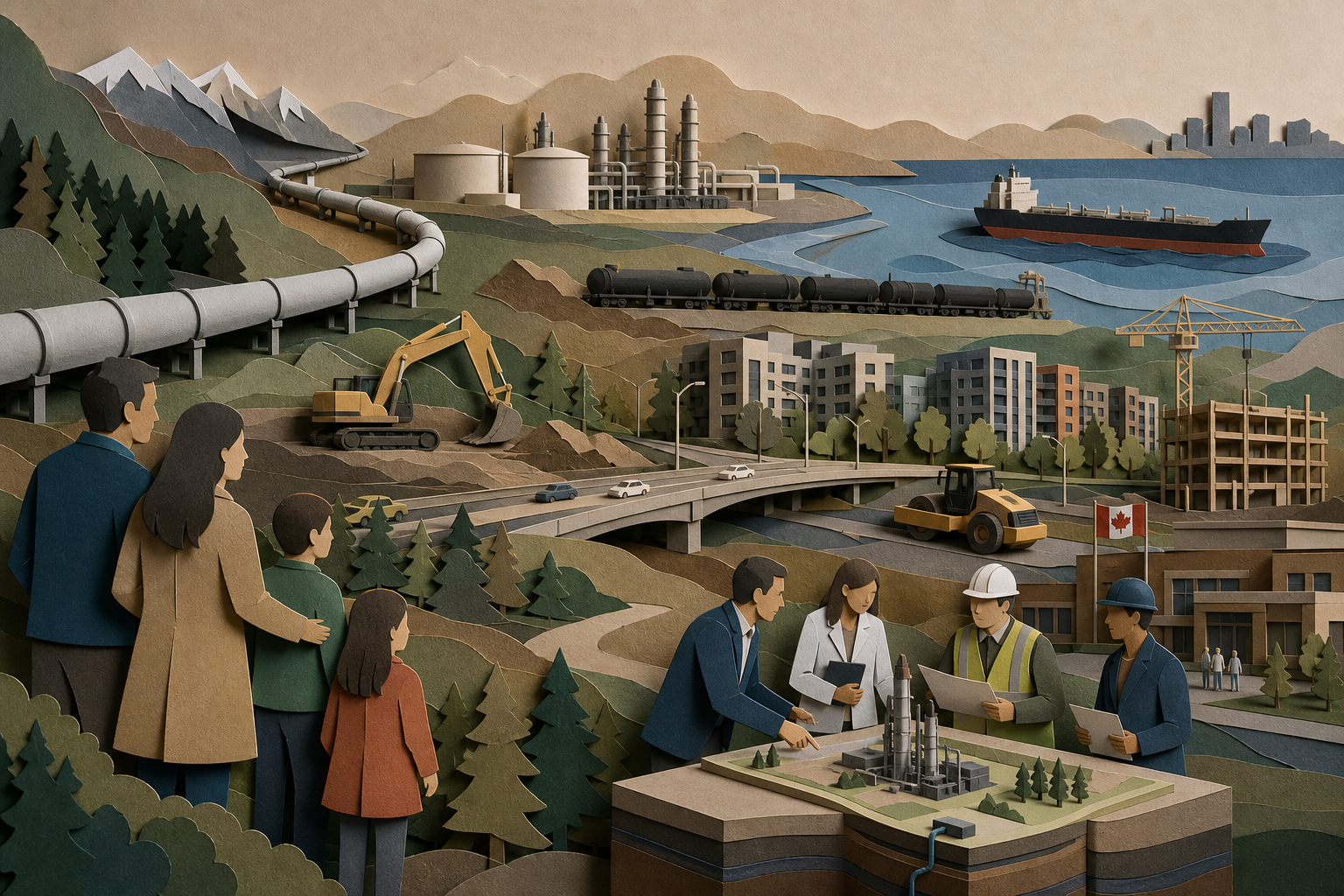

The expanded Trans Mountain pipeline starts at a terminal just east of Edmonton and can now carry about 890,000 barrels of oil a day to the B.C. coast. That is roughly three times what the line moved before the expansion came fully online in 2024. Premier Danielle Smith and Prime Minister Mark Carney now point to a second route, a proposed West Coast Pipeline, as the next step. Both say the province will handle the growth better than it handled the last two booms.
That claim is worth testing piece by piece, because each piece reaches Edmonton households and investors in a different way.
What "ready" is supposed to mean
Alberta's past booms followed a familiar order. Oil prices rose, companies hired, and people arrived faster than the province could build homes, schools and roads. During the mid-2000s run, Fort McMurray and the Edmonton region both felt the strain, and the bust that followed left the provincial budget exposed.
The government's answer this time has two parts. The first is saving more of the windfall. Alberta put about $2 billion from its 2023-24 surplus into the Heritage Savings Trust Fund, which pushed the fund past $22 billion (2024 figures). The second is building services before the population arrives. Both ideas are sound, and both can be measured, which matters more than the slogan.
The pipeline is still a proposal
The West Coast Pipeline does not exist yet. Any new line to the coast has to go through years of federal environmental review. It will also face likely court challenges from environmental groups or Indigenous communities along the route. Federal rules, including the Clean Electricity Regulations and the proposed emissions cap on oil and gas, remain a running dispute between Alberta and the federal government over how fast the oilsands can expand.
The prize is real. For decades, most Alberta oil went to the United States at a discount, known as the Western Canadian Select differential, because there was nowhere else to send it. Coastal capacity lets producers sell into Asian markets and narrow that gap. Trans Mountain already proved the mechanism works. A second line would extend it, but only after the approvals clear, and nobody can promise a date.
What reaches Edmonton first
Edmonton sits closer to this story than the map suggests. Extraction happens in the north, but the city is where much of the fabrication, logistics, staging and head-office work gets done. When oilsands spending rises, Edmonton hiring follows, and housing demand follows the hiring.
There are early signals in the national numbers. Statistics Canada reported real GDP grew 3.3% annualized in the second quarter of 2026, and spending on engineering structures, the category that includes pipelines and plants, rose 2.3% (August 28, 2026 release). Neither figure is an Alberta boom on its own. Both show construction money moving.
For a first-time buyer, the practical question is timing. A boom that lifts incomes also lifts competition for entry-level homes in neighbourhoods close to industrial employers in the east and northeast parts of the region. For an investor, steady energy employment can support rental demand, though it does not set a floor under prices.
Where readiness runs out
Two limits sit outside Alberta's control. Global oil prices are the first. A recession abroad or a faster shift to electric vehicles would cut investment no matter how many schools were built in advance. The second is closer to home but just as stubborn: Alberta still struggles to find enough skilled tradespeople to build the projects being promised, including the housing a larger workforce would need.
Savings help after a bust. They do little during one.
Looked at this way, "ready" describes the parts of a boom a province can control: how much of the surplus it saves, and whether new subdivisions get schools before families move in. The size and timing of the boom itself still depend on approvals from the federal government, crews Alberta has not yet trained, and an oil price set far from Edmonton.
Sources
Read Next
Canada's Productivity Problem Starts in a Tax Code Nobody Can Read
Cancel or Keep the Card? Closing It Can Spike Your Credit Utilization
The Easiest Tax Return in Canada Could Cost Low-Income Filers the Most
India's Biggest Banking Deal Had No Major Investment Bank Behind It