McDonald's Lost 30% Because Value Promises Couldn't Overcome Price Inflation
A Big Mac combo in major Canadian cities has climbed into double figures. That's the point where McDonald's crossed a line. The company went from being the "cheap meal" option to customers wondering if they were really paying this much to eat in a car. The stock dropped 30% from its peak.
The stock dropped 30% from its peak because the company spent three years raising prices to cover input costs and then watched its core customers, households earning under $45,000, stop showing up. Not reduce their visits. Stop. The first quarterly sales decline in 13 quarters arrived in late 2024, and the market finally acknowledged what franchisees in Alberta had been seeing for months: you can't be the value leader when your drive-thru costs more than meal prep at Safeway.
The Value Gap Became Real
McDonald's built nearly six decades of market position on being the cheapest option that didn't require cooking. When a single combo approaches $20 Canadian, that position evaporates. A family of four spending $60 at a drive-thru starts comparing that experience to Boston Pizza, where the food quality is demonstrably higher and you get a table.
McDonald's raised prices past the point where the brand promise held. Prices have risen substantially since 2019 across most Canadian locations, but wages for the customer base McDonald's historically served, retail workers, tradespeople on lunch breaks, single parents grabbing dinner, did not rise at the same pace. Groceries did. Rent did. The result is that fast food moved from necessity spending to discretionary, and discretionary means skippable.
Franchisees don't set prices to punish customers. They set them because Alberta's minimum wage, commercial insurance, beef costs, and electricity all climbed faster than the general inflation rate. A franchisee running three locations in Edmonton faces a genuine math problem: raise prices or operate at a loss. Corporate McDonald's understands this. What they missed is that the customer has math too, and when the drive-thru bill exceeds the Superstore deli counter, the customer solves for Superstore.
The Stock Told the Truth First
Investors react to revenue trends, and the revenue trend was unambiguous. Same-store sales softened, then declined, and the CFO's explanation on the earnings call, "macro pressures," "consumer headwinds", translated cleanly to "we priced ourselves out." The 30% drawdown wasn't panic. It was the market repricing McDonald's from a recession-proof consumer staple to a discretionary restaurant chain competing for the same dollar as Chipotle.
The tell was geographic. U.S. locations saw the same pattern, but Canada's food-away-from-home inflation ran hotter. Statistics Canada reported the "food purchased from restaurants" category rose 3.6% year-over-year in 2024, outpacing headline CPI at multiple intervals. That's the environment where a $5 value meal, McDonald's Canada's attempt to reclaim affordability, reads as damage control, not strategy.
What Comes Next
McDonald's introduced app-based pricing and digital kiosks to create a two-tier system: savvy customers who hunt deals pay one price, walk-ins pay sticker. That works until the walk-in customer feels exploited and stops walking in. The risk isn't the technology. The risk is bifurcating your pricing so aggressively that half your customers conclude they're subsidizing the other half.
The company remains profitable. The franchisees will survive. But the 30% stock decline is a signal that even the most durable brands lose pricing power when they ask their lowest-income customers to treat fast food as a luxury. McDonald's spent decades training the market to expect cheap, fast, reliable. They cannot unilaterally redefine "cheap" to mean $18 and expect the market to follow. When drive-thru prices climbed well into double figures, the customers looking for value went to the grocery store instead.


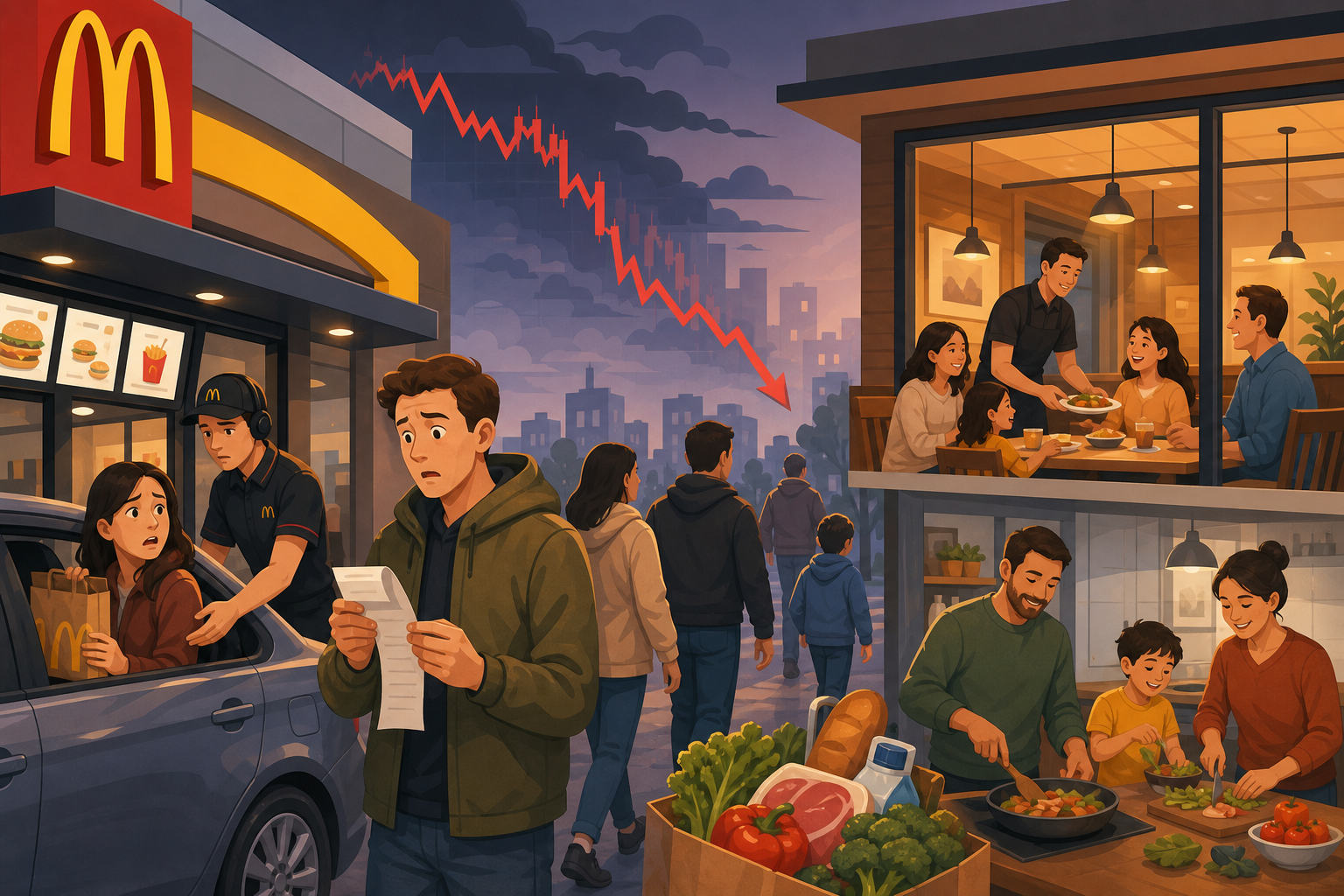

A Big Mac combo in major Canadian cities has climbed into double figures. That's the point where McDonald's crossed a line. The company went from being the "cheap meal" option to customers wondering if they were really paying this much to eat in a car. The stock dropped 30% from its peak.
The stock dropped 30% from its peak because the company spent three years raising prices to cover input costs and then watched its core customers, households earning under $45,000, stop showing up. Not reduce their visits. Stop. The first quarterly sales decline in 13 quarters arrived in late 2024, and the market finally acknowledged what franchisees in Alberta had been seeing for months: you can't be the value leader when your drive-thru costs more than meal prep at Safeway.
The Value Gap Became Real
McDonald's built nearly six decades of market position on being the cheapest option that didn't require cooking. When a single combo approaches $20 Canadian, that position evaporates. A family of four spending $60 at a drive-thru starts comparing that experience to Boston Pizza, where the food quality is demonstrably higher and you get a table.
McDonald's raised prices past the point where the brand promise held. Prices have risen substantially since 2019 across most Canadian locations, but wages for the customer base McDonald's historically served, retail workers, tradespeople on lunch breaks, single parents grabbing dinner, did not rise at the same pace. Groceries did. Rent did. The result is that fast food moved from necessity spending to discretionary, and discretionary means skippable.
Franchisees don't set prices to punish customers. They set them because Alberta's minimum wage, commercial insurance, beef costs, and electricity all climbed faster than the general inflation rate. A franchisee running three locations in Edmonton faces a genuine math problem: raise prices or operate at a loss. Corporate McDonald's understands this. What they missed is that the customer has math too, and when the drive-thru bill exceeds the Superstore deli counter, the customer solves for Superstore.
The Stock Told the Truth First
Investors react to revenue trends, and the revenue trend was unambiguous. Same-store sales softened, then declined, and the CFO's explanation on the earnings call, "macro pressures," "consumer headwinds", translated cleanly to "we priced ourselves out." The 30% drawdown wasn't panic. It was the market repricing McDonald's from a recession-proof consumer staple to a discretionary restaurant chain competing for the same dollar as Chipotle.
The tell was geographic. U.S. locations saw the same pattern, but Canada's food-away-from-home inflation ran hotter. Statistics Canada reported the "food purchased from restaurants" category rose 3.6% year-over-year in 2024, outpacing headline CPI at multiple intervals. That's the environment where a $5 value meal, McDonald's Canada's attempt to reclaim affordability, reads as damage control, not strategy.
What Comes Next
McDonald's introduced app-based pricing and digital kiosks to create a two-tier system: savvy customers who hunt deals pay one price, walk-ins pay sticker. That works until the walk-in customer feels exploited and stops walking in. The risk isn't the technology. The risk is bifurcating your pricing so aggressively that half your customers conclude they're subsidizing the other half.
The company remains profitable. The franchisees will survive. But the 30% stock decline is a signal that even the most durable brands lose pricing power when they ask their lowest-income customers to treat fast food as a luxury. McDonald's spent decades training the market to expect cheap, fast, reliable. They cannot unilaterally redefine "cheap" to mean $18 and expect the market to follow. When drive-thru prices climbed well into double figures, the customers looking for value went to the grocery store instead.
Sources
Read Next
Developer Perks or a Lower Price: Why the Smaller Sticker Usually Wins
Three 2026 Mortgage Hall of Fame Careers Trace How Canadian Lending Changed
Why Commercial Insolvencies Peaked Before Rates Started Falling: A Timing Problem
A Tesla and SpaceX Merger Solves Musk's Problems and Hands Shareholders His Risks